
Commentary
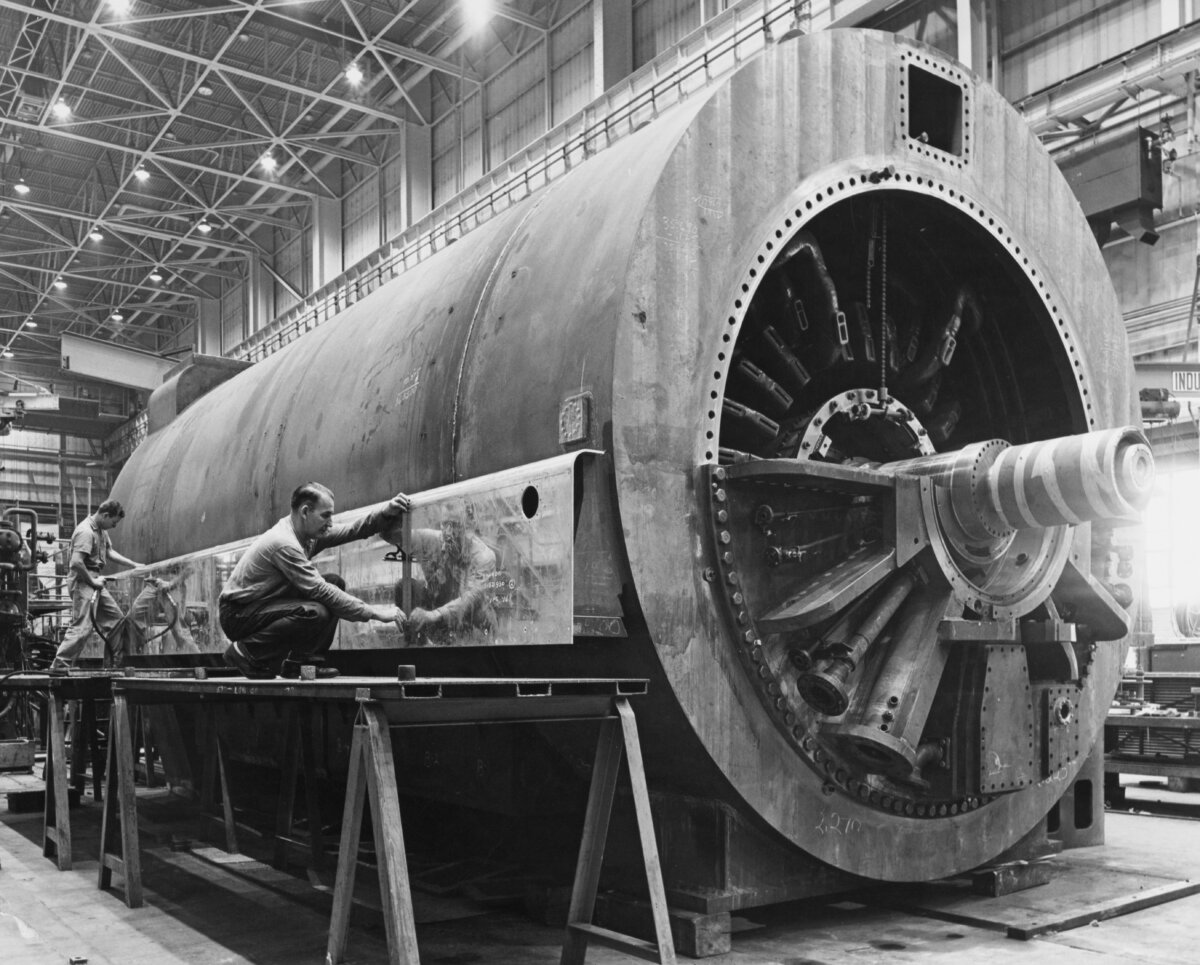
It’s to President Donald Trump’s credit that he sounded the alarm on American economic prospects, particularly as regards manufacturing. It should strike anyone as alarming and strangely unusual that the greatest manufacturing country in the world, dominant in every industry with skills and infrastructure stretching coast to coast, would in the course of 50 years have it all nearly gutted.
To be sure, I have many friends who think this is no big deal. Let others make stuff. We buy it. We get goods, they get paper. It’s all fine. Is it really? It’s not war, and we do adjust. The economy has been financialized, and the United States does excel in services and at least one natural resource (oil). Why do we need also to produce pianos, watches, boats, tools, toys, textiles, apparel, steel, agriculture, home electronics, and chips? Let others do that while we enjoy the fruits.
If we go back 200 years in the writings defending free trade, they nowhere said it would be just great if an entire country were to give up its specialization in every manufacturing process that made it great. It would have been intolerable to any nation in the 18th and 19th centuries to undertake such a policy. And indeed, it did not happen for one technical reason: every trading partner was on the gold standard. Accounts settled. No country faced a permanent and unresolved advantage in the cost basis of wages and materials.
All that changed following World War II and the Nixon economic shock of 1971. The dollar became the world reserve currency, and eventually, its gold backing was entirely removed. As a result, there was a limitless demand for dollars overseas and a huge manufacturing advantage for every country in the world that was not the United States. While the United States gained seeming prestige as a military power, it gradually lost all advantage as a powerhouse that made things.
The problem traces to persistent cost differentials that are shored by the global demand for the dollar, which is a main U.S. export. This is reflected in the trade deficit that has only worsened since the end of the Bretton Woods system. To be clear, the problem is not the trade deficit as such but what it signals as a nation of exporters versus importers. Something dramatic changed. This should be obvious, and it is not unconcerning.
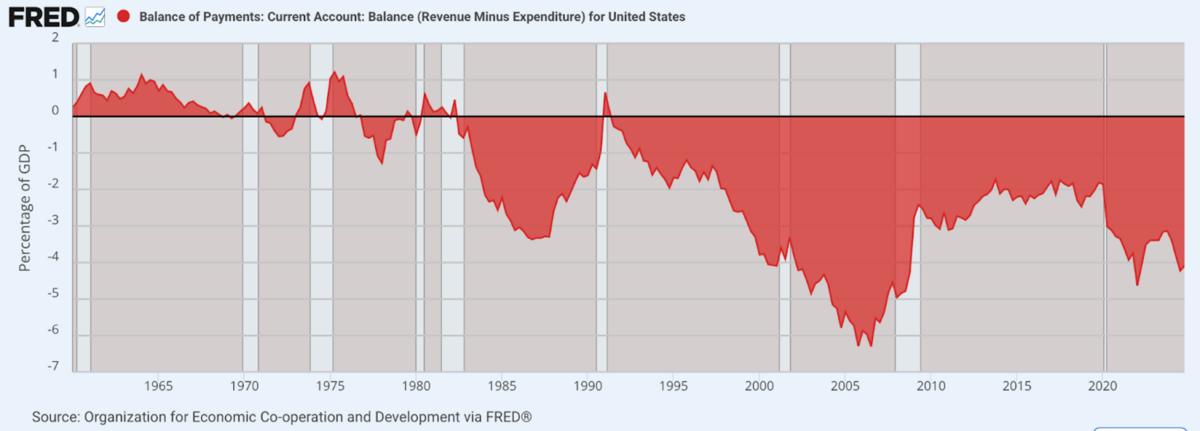
The theory of Trump’s solution of tariffs was to even the playing field. It would charge a tax on imports as a proxy for what was currency settlement in the old days. It was a novel theory, and no one would say with empirical certainty or proof that it would not achieve at least some of the objective. The danger of course is that by turning the United States into an economic fort, it creates a range of industries that are unsustainable without the tariff-created walled garden. That is a genuine danger.
What’s actually surprising, however, is that the tariffs have not shrunk the U.S. trade deficit. Lately and incredibly it has started to worsen even in the presence of higher tariffs than we’ve had in a century.
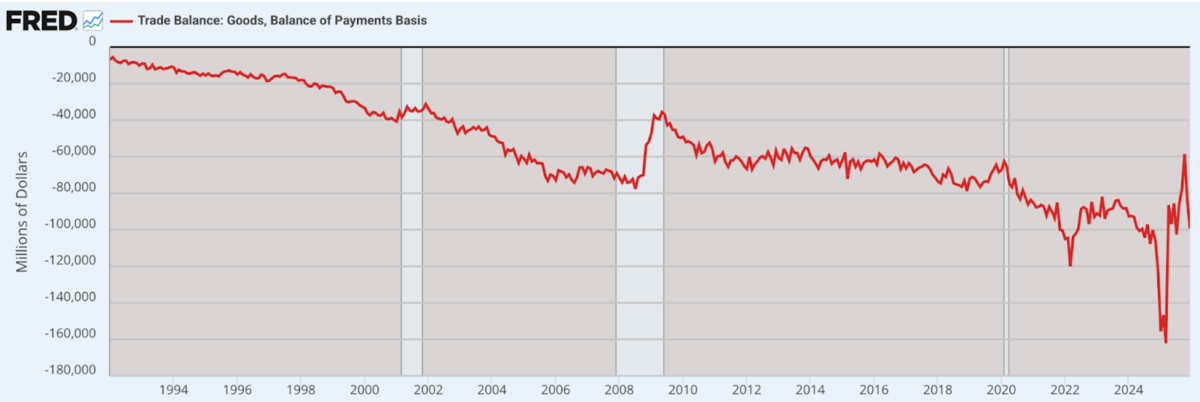
What’s gone wrong? China, Germany, Taiwan, Japan, South Korea, and many other countries have doubled down on their exporting strategy by further subsidizing industry in a way that leaps over the tariff wall, while relying on the United States as the importer of choice. It works because the differential between U.S. business costs, including salaries and wages, and those of the rest of the world is vast. That’s a consequence of U.S. dollar dominance. There seems to be no way to get around it.
In addition, these countries are working on other ways to lower business costs, such as cuts in taxes and regulations, making them more and not less competitive. It’s like a race where the winners keep beating the upstarts with steroids and rocket shoes. It’s becoming ever more clear that no amount of tariffs is going to fix this problem. They only end up raising costs for American importers and U.S. manufacturers and consumers. This is a strategy of taxing one’s own people in order to punish foreigners—which, quite frankly, doesn’t make sense. In any case, it’s not working.
Trump is obviously very wedded to the tariff strategy, and I doubt anything can change that. But there are other ways to fight this war, among them lowering the value of the dollar internationally relative to other countries. That would change the economic calculation dramatically, but it is not easily done. Another path is more direct: put every effort into lowering American business costs, from taxes to regulations. The Trump administration has been fantastic on many environmental regulations, but there remain huge problems in health insurance mandates and high payroll taxes from U.S. laborers. Those all need dramatic reduction to make the United States more competitive, else we’ll never win this.
The United States has undertaken terrible policy mistakes over half a century. The carnage is all around us: burned-out infrastructure in major cities, loss of purpose, wasted human skill, traditions shattered, and communities devastated. American productivity was not entirely vanquished but rather migrated to finance, medical services, and government. Such changes will take a long time to repair, but the problem is not irreversible.
Tariffs are a blunt instrument that have so far not achieved their promise, even in the narrow sense of reducing the trade deficit. Other ideas will prove more fruitful. Hard work to free up the medical insurance market, reduce and eliminate the payroll tax, obliterate bureaucracy, and fire up the engines of American entrepreneurship will prove more sustainable over the long term.
Views expressed in this article are the opinions of the author and do not necessarily reflect the views of The Epoch Times.
 Friends Read Free
Copy
Facebook
Tweet
Friends Read Free
Copy
Facebook
Tweet