
Commentary
A 2025 survey of American adults aged 30 and younger found that 62 percent held a favorable view of socialism.
The same survey found that 34 percent held a favorable view of communism.
It would be a mistake to view these statistics as a reaction to the current administration. Surveys by different organizations conducted over the past five years are in the ballpark with these figures.
Those of us who regard communism as evil are appalled by these numbers. Do these young people know that in the past 100 years communists have killed more than 100 million people?
Are they aware of the broken promises of communism in dictatorships such as Cuba, North Korea, and China?
Do they not realize that under a communist government, unless they were in the inner circle, their lives would be dictated by the state?
Can they even define socialism and communism?
The answer to these questions and others can only be a resounding no. They are either ignorant of these 20th-century monstrosities or they are the victims of propaganda. No properly educated human being would agree to become a slave to the state.
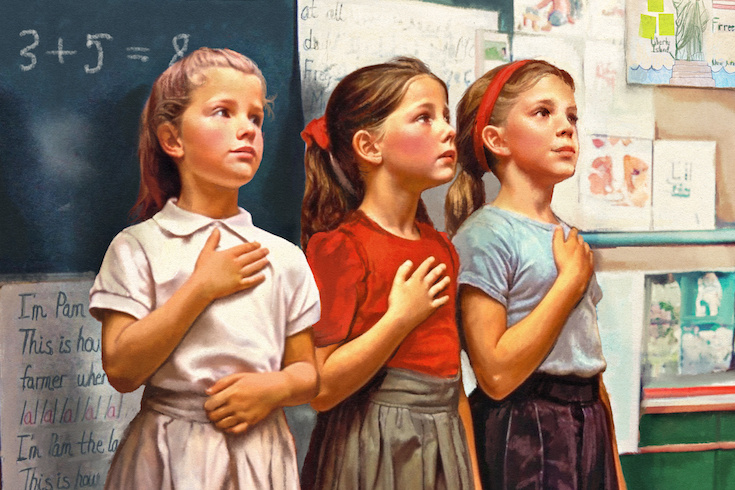
And on May 18, a fifth grade teacher and a Roman Catholic priest showed me a way we can counter this miseducation.
On May 17, Lara Purciel, the teacher who is also a friend, mentioned that she had invited Fr. Tom Shepanzyk to speak to her Padre Pio Academy class about communism. Shepanzyk lived under communism in Poland in his younger years before making his way to the United States. Sensing my interest, Purciel then invited me to come and listen.
For a little more than an hour, Shepanzyk held the attention of that class and the eighth graders who had joined them. He spoke of what his life was like as a devout Catholic youngster in a system that despised and mocked religion. He told his young audience of the hours he’d spent waiting in lines at grocery stores to buy just the staples of life, the propaganda in the schools and on the ubiquitous posters in the streets, the state-controlled television, the fear of being overheard by the wrong people that stymied free speech.
“Everybody lived in fear,” Shepanzyk said. “Everybody was afraid.”
Some of his stories, I’m sure, struck home.
He said that when informed that someday the whole world would be communist, with everything owned by “the people,” he and his classmates would joke, “Will our socks be private?”
He explained that he received an orange only once per year.
“When I came to the United States I ate oranges day and night,” he said.
At one point, Shepanzyk told the students, “The communists always go after the young.” They do so by appealing to their idealism and by misleading them on the realities of a socialist/communist government versus that idealism.
And right here is the lesson I drew from that hour in class. Like those on the left, we need to go after the young. Many of our schools, universities, and cultural influencers are doing just that. They understand, and have understood for decades, that there is a war for the hearts and minds of our young people.
As the old adage goes, we need to fight fire with fire. Through stories in particular, we need to show our young people the evils of Marxism.
The good news is that we have the resources to do so. Search online for “How many victims of communism live in the United States?” and artificial intelligence answers that the numbers are difficult to determine, but are in the millions. That number rises even higher when we consider the children and grandchildren born from these refugees from Marxism.
Just as Shepanzyk did in that classroom, we need these men and women talking to our young people about the abuses and suffering they witnessed, the cruel suppression of dignity and personal ambitions. Those stories can then be stored away as antidotes to counter the poison of communist and socialist propaganda.
Teachers can simply follow Purciel’s example and invite one or more of these witnesses to speak to their classes. Homeschool groups and other youth organizations could do the same. Surely there are enough Eastern Europeans, Vietnamese, Chinese, and other nationals who would be willing to join this fight.
Another tremendous resource is the Victims of Communism Memorial Foundation. Its Witness Project and Voices for Freedom feature interviews with people from around the globe who were imprisoned, tortured, or stripped of their natural rights under communist governments.
Teachers and parents can also introduce the young to books and films decrying totalitarianism and collectivism. Older teens might watch “Mr. Jones,” the sickening film about the Holodomor—which means “death by hunger”—through which the Soviet Union starved millions of Ukrainians.
The R-rated film “The Lives of Others” gives us the underbelly of the East German police state and its monitoring of private conversations. Books such as Lois Lowry’s anti-collectivist novel “The Giver,” George Orwell’s classics “Animal Farm” and “1984,” and James Clavell’s largely forgotten but important “The Children’s Story” can help provide protection against far-left toxicants.
Our young people need to know before they go off to college or the workplace that communism kills the soul and oftentimes the body, that it doesn’t deliver on its promises, and that under a communist government there are no unalienable rights, no life, liberty, or the pursuit of happiness.
And it’s up to us to teach them these things.
Views expressed in this article are the opinions of the author and do not necessarily reflect the views of The Epoch Times.
 Friends Read Free
Copy
Facebook
Tweet
Friends Read Free
Copy
Facebook
Tweet