
Commentary
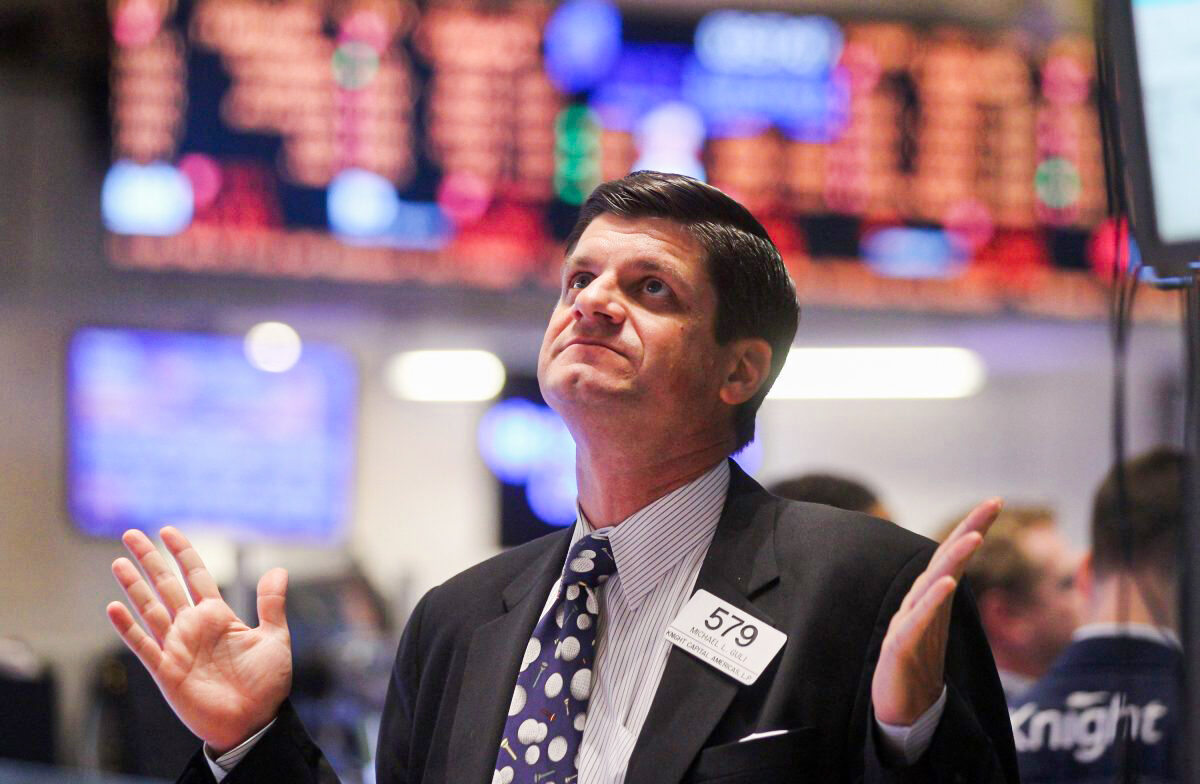
Politicians of the world are nonchalant toward astronomical debt levels in every developed nation. They should pay closer attention to what bond markets are saying. Traders can see the forecasts for spending, growth, debt, and inflation. The numbers no longer make sense. The result is rising yields all up and down the curve, moving in a way that central banks can no longer control.
It was Bill Clinton who first observed how bond markets are a beast that no one can control. His adviser James Carville summed it up: “I used to think that if there was reincarnation, I wanted to come back as the president or the pope or as a .400 baseball hitter. But now I want to come back as the bond market. You can intimidate everybody.”
It’s funny but carries truth. How does this work? There are a number of moving parts here. Let’s attempt to map them out without recourse to obscurantist jargon.
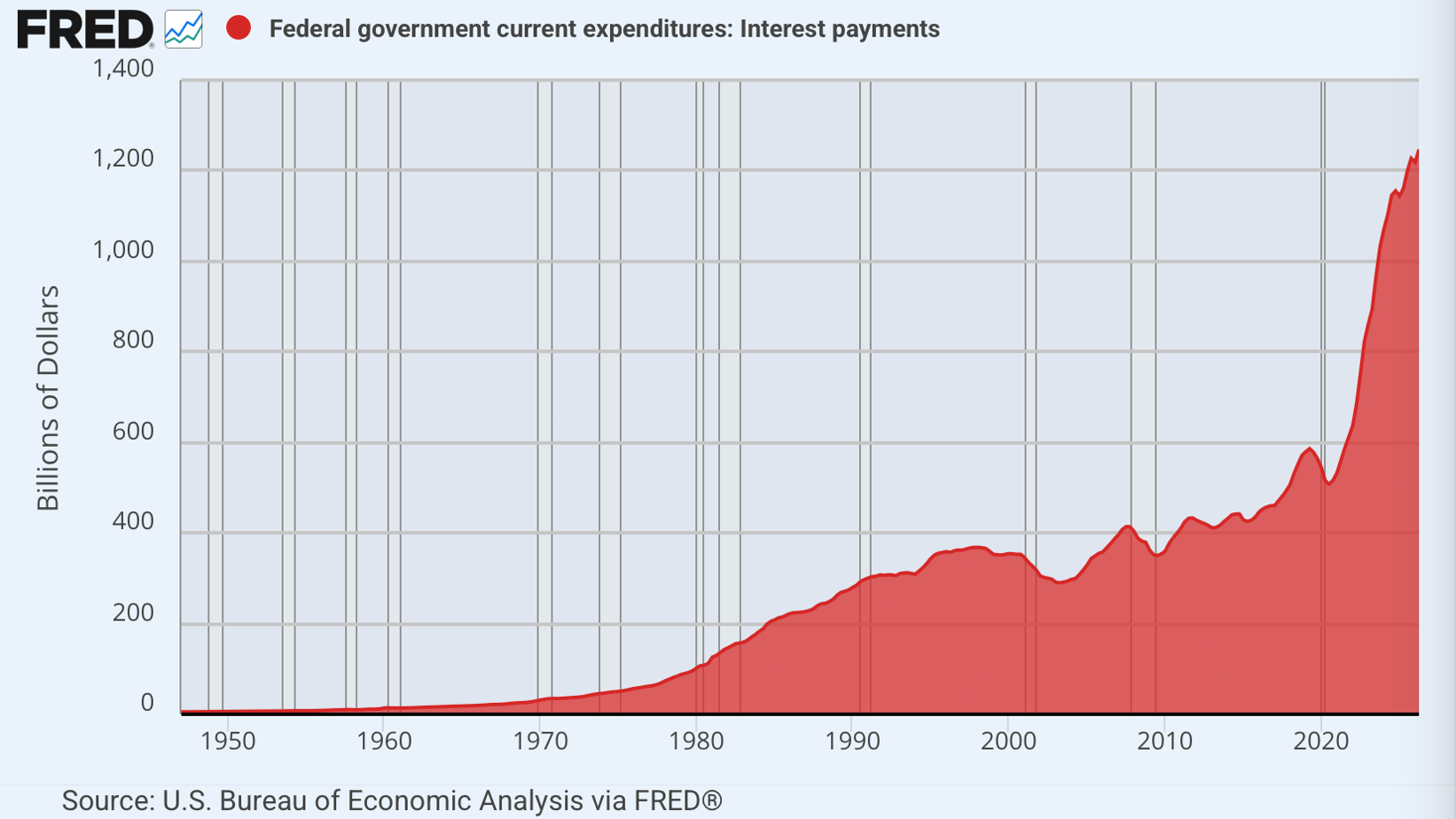
Let us begin with the most disastrous trend of all, from my point of view, namely the percentage of the U.S. budget that goes to servicing debt rather than servicing people. The numbers are off the charts.
This was not a problem in the 1950s through the 1960s. The end of the gold standard unleashed the money printers, and expenditures for debt service started to rise, reaching a few hundred billion dollars by the early 1990s. The problem then flattened and even declined in the late 1990s and early 2000s thanks to budget surpluses and lower rates.
Then came zero interest rates, creating an illusory boon. Spend and borrow without consequence, they said. Then came 2020. After the COVID-19 spending blowout, inflation, and rising rates, the line turned sharply steeper: Interest outlays roughly doubled in a few years, crossing $1 trillion in late 2023 and continuing to new highs through 2025 and 2026 as higher rates and larger debt stocks took effect.
The Fed increased rates but adjusted for inflation, and they have still generally remained in the realm of zero, which is hugely distorting normal investment decision-making. It rewards debt over saving, speculation over prudence, and leverage over real investment. This is how capitalism itself gets broken.
Meanwhile, governments are trapped. Higher rates mean high debt service. The dark truth here is that while inflation hurts regular people, it benefits governments that are running huge debts and deficits. The higher the inflation, the less the real burden of debt service becomes. Right now, forecasts suggest that debt service will devour 100 percent of revenue by 2052, but that is under very modest assumptions. Raise the rates, and the problem intensifies.
Let’s say the central bank really, truly, and genuinely wants to stop inflation, as new Fed Chair Kevin Warsh claims. What would that require? At this point, he would have to defer to market forces that are pushing up rates across the yield curve. If we actually stop open-market operations (which allow the Fed to buy new debt from the Treasury), rates would soar.
How much? It’s anyone guess, but since growth is running 2 percent to 3 percent and inflation at about 4 percent, we would need 7 percent overnight yields to put us back in something approaching equilibrium.
That is frankly intolerable. Most pressingly, this would blow the budget entirely and much sooner than 2052. It would result in financial strains unseen in decades. Because of this, all policymakers are feeling themselves being hemmed in.
Inflation, high spending, and subsidized rates: can’t live with them, can’t live without them. That’s where we are.
The truth is that the Fed hasn’t tried very hard to fight inflation because doing so would impose intolerable burdens on the federal budget. Think of what it would be like for you to carry a $50,000 debt on a credit card and see a gradual climb in servicing costs from 15 percent to 20 percent to 25 percent.
At first, the minimum payment is painful but familiar: you cut a few extras, tell yourself you will pay it down when the next raise comes, and the balance still feels like something a household can live with. Then the rate steps up, and the same balance suddenly demands a payment that used to cover rent. You are not buying more; you are just standing still, and a larger slice of every paycheck is already spoken for before groceries or the mortgage.
Your present and future consist of nothing but paying for what you have already consumed. Not a good life.
At 25 percent, the math turns cruel. New charges, even small ones, compound so fast that “getting ahead” becomes a fantasy, and the only choices left are a brutal cut in living standards, a frantic hunt for higher income, or default.
That is the federal budget at 7 percent overnight rates instead of 4 percent: The debt is already there, the rate reset does not wait for Congress to feel ready, and each year, more of the country’s tax revenue is consumed, just keeping the old balance from exploding.
Meanwhile, debt obligations keep growing: Medicare, Medicaid, Social Security, massive military budgets, and countless industries and nonprofits with their hands out. Economic growth is nonnegotiable: the government needs the revenue generation machine. Recessions cause shortfalls, and they don’t want that.
We wonder why our political class seems so blasé about all of this. It’s because they have decided it is not worth worrying about. There is far more to be gained by ignoring the problem rather than dealing with it.
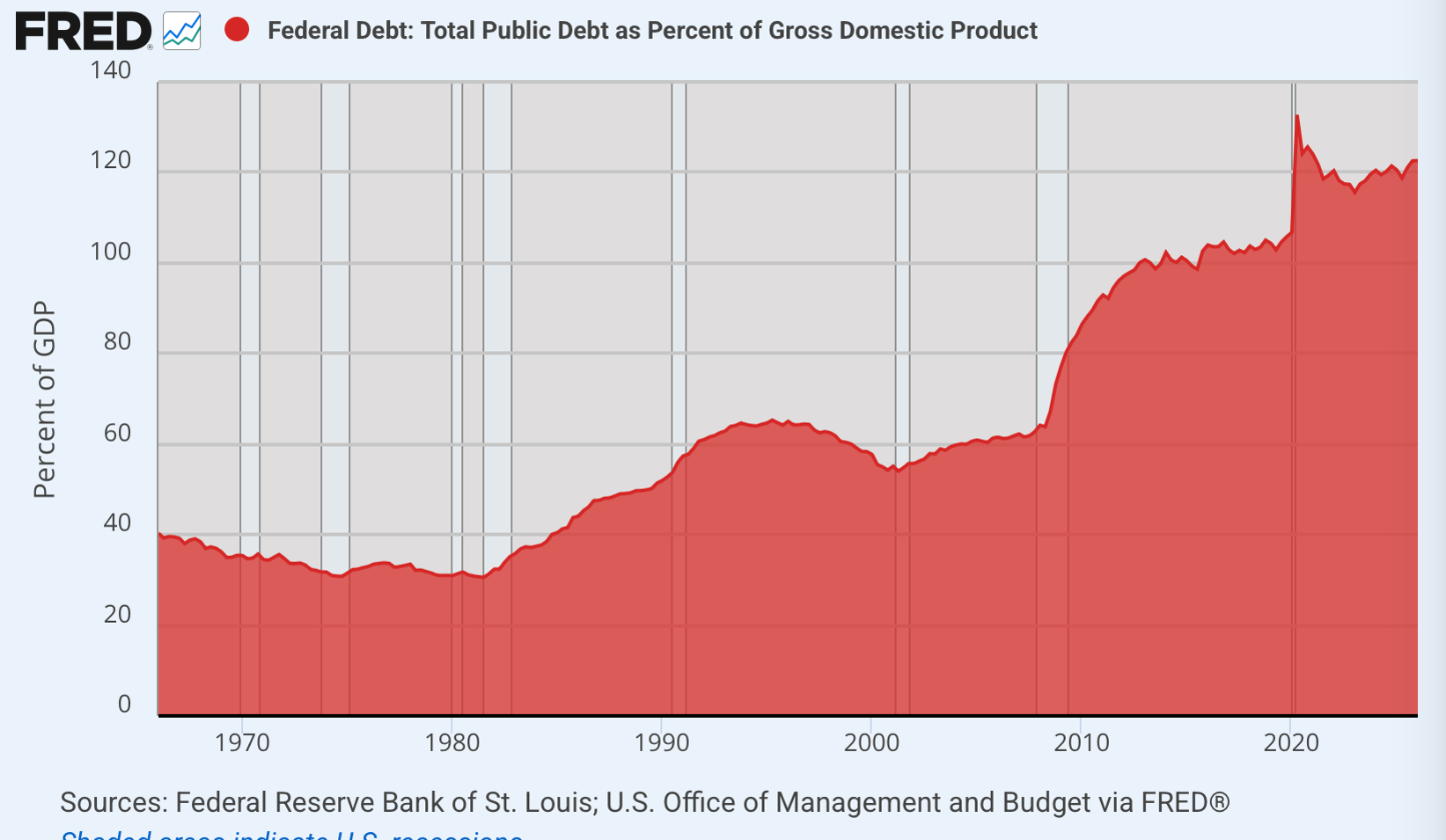
The debt is already running at 120 percent of gross domestic product, and that excludes trillions of dollars in unfunded liabilities.
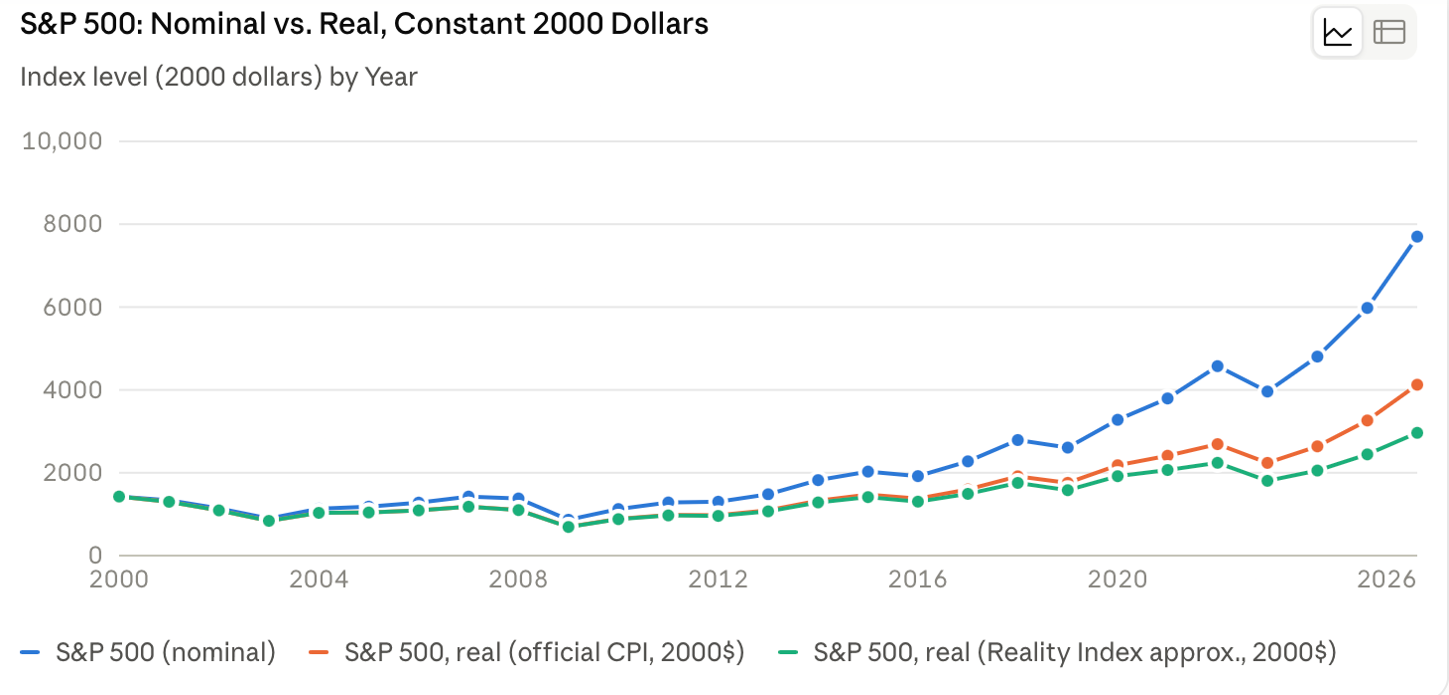
Plus, the stock market has not risen nearly as much as it first appears. Based on the 2000 dollar, by 2026, roughly 46 percent of the nominal S&P index’s face value has been eaten by inflation under the consumer price index deflator, and roughly 62 percent under the Reality Index approximation.
Economics can be a cruel taskmaster. It sets hard limits. It builds impenetrable walls around visions that are otherwise unconstrained. It’s the bookkeeper who lords it over you while saying you cannot do that without dire consequences. There is no power on earth mighty enough to override the laws of economics and accounting. Nuclear weapons pale in comparison to the power of supply and demand.
You know how they say don’t blame the messenger? The bond market is the messenger.
Views expressed in this article are the opinions of the author and do not necessarily reflect the views of The Epoch Times.
 Friends Read Free
Copy
Facebook
Tweet
Friends Read Free
Copy
Facebook
Tweet