
Commentary
Foreign policy doctrines are too often treated as temporary political slogans attached to individual presidencies. History suggests something else entirely. The doctrines that survive are tied to historical American grand strategy rather than to the personality of the president who announced them. Others disappear almost as quickly as they are proclaimed because they lack strategic coherence, fail to identify enduring national interests, or collapse under the pressure of geopolitical reality.
In “The National Security Doctrines of the American Presidency,” I argued that successful doctrines do not emerge randomly. Over time, recurring principles organically developed within American grand strategy: American exceptionalism, manifest destiny and expansion, the empire of liberty and democracy promotion, free trade and market access, unilateralism of mission, internationalism of alliance systems, the American way of war, geopolitical realism, and primacy.
The Carter Doctrine occupies a fascinating place in that history because President Jimmy Carter’s presidency itself was, in broad strategic terms, unsuccessful.
The Iranian hostage crisis humiliated the United States before the world. Soviet expansionism accelerated during the administration. America abandoned key allies and American military power and deterrence were weakened; the administration frequently appeared divided between post-Vietnam restraint, moral aspiration, and the continuing realities of Cold War power politics. Human rights universalism often coexisted uneasily with geopolitical necessity. It was a double-minded struggle in itself.
Yet despite these failures, one part of the Carter Doctrine endured long after Carter left office: the recognition that the Persian Gulf represented an American national interest tied directly to maritime security, commercial access, strategic geography, and freedom of navigation, most of which were grounded in the national security doctrine of our first president, President George Washington.
That principle, which we see today, survived because it reflected realities larger than Carter himself.
In 1979, the Shah of Iran fell from power, and the Islamic Revolution transformed one of Washington’s principal regional allies into a hostile revolutionary regime openly committed to opposing American influence. American diplomats were seized in Tehran while the world watched the paralysis of the American response. Then, in December of that same year, the Soviet Union invaded Afghanistan. To American planners, the possibility of Soviet movement toward the Persian Gulf represented a serious geopolitical danger.
Carter responded in January 1980 with what became known as the Carter Doctrine: “An attempt by any outside force to gain control of the Persian Gulf region will be regarded as an assault on the vital interests of the United States of America.”
Most modern commentary reduces the doctrine to oil.
The doctrine was also part of a much older American strategic tradition connecting maritime access and commercial freedom to national security itself.
The roots of this principle reach back to the earliest years of the republic. Following Washington and President John Adams, the Barbary Wars under President Thomas Jefferson were not simply campaigns against piracy. These conflicts illustrated the American republic’s refusal to accept coercion against its shipping and maritime commerce. Even in its infancy, the United States understood that commercial vulnerability at sea could become strategic vulnerability everywhere else.
By the late 19th century, Alfred Thayer Mahan, America’s chief “navalist,” transformed sea power into one of the defining principles of modern geopolitics through the projection of power. This was about naval reach, strategic choke points, maritime commerce, and commercial access, which became inseparable from the rise and survival of great powers. His influence shaped generations of American planners during the 20th century and now space strategists in the 21st century.
The United States absorbed those lessons fully during World War II and the Cold War.
American grand strategy increasingly revolved around preventing hostile domination over strategically important regions tied to maritime commerce and sea lanes. The Atlantic and Pacific oceans became decisive theaters precisely because industrial civilization depended upon shipping, logistics, naval supremacy, and secure access. During the Cold War, maritime strategy became tied to containment, alliance systems, deterrence, and economic stability.
The Persian Gulf entered that framework for the simplest reason in strategy: geopolitics.
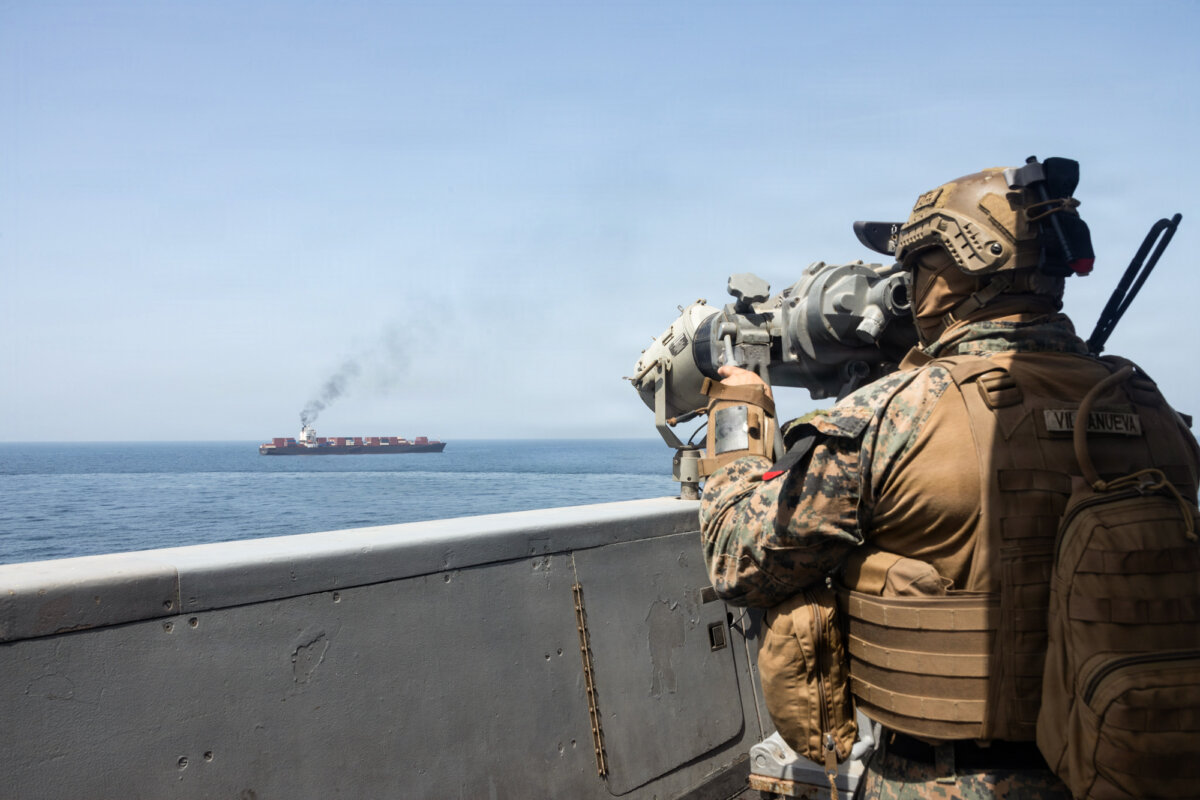
A substantial portion of the world’s energy supply moved through the Strait of Hormuz and still does today. The issue was never merely petroleum in isolation. The larger question was whether a hostile power could dominate one of the principal arteries of the international economic system.
That concern did not disappear with the “end of the Cold War.”
Today, tensions involving Iran, attacks on shipping, instability extending into the Red Sea, and repeated American naval operations protecting maritime traffic all reflect the continuing relevance of the same strategic reality Carter confronted decades ago. Iranian threats against the Strait of Hormuz are not regional annoyances. They threaten one of the world’s most important commercial choke points. Likewise, Houthi terrorist group attacks in the Red Sea demonstrate how vulnerable international shipping remains to disruption by regional actors backed by hostile regimes.
Presidents and their names change, but the map does not.
That reality explains why every administration following Carter effectively accepted the doctrine’s central premise, regardless of party or ideology. President Ronald Reagan strengthened the military infrastructure in the Gulf. President George H.W. Bush defended the Gulf order during the First Gulf War. President Bill Clinton continued (albeit poorly) containment policies against Iraq and Iran.
President George W. Bush expanded American military operations throughout the region after 9/11. President Barack Obama had at least enough sense not to abandon the region, and President Donald Trump’s first administration pursued maritime pressure and deterrence against Iran. President Joe Biden continued naval operations tied directly to shipping security and regional stability. Trump has renewed the doctrine with military force.
Presidents avoided Carter’s name, but they kept his map.
That is critical to understanding the idea of doctrines. A doctrine succeeds when it becomes larger than the administration that created it. It survives in any nation because it aligns with geography, commerce, military necessity, and enduring national interests. Additionally, it survives in the United States by combining democratic values and realist interests. A doctrine fails when it becomes an abstraction detached from power realities or when aspiration replaces strategy. It succeeds if it is organic, not manufactured.
The Carter presidency revealed both dynamics simultaneously.
Large portions of Carter’s broader foreign policy reflected uncertainty about the use of American power during a period when adversaries, especially the Soviet Union, remained deeply committed to geopolitical competition. The administration frequently struggled to reconcile moral language with deterrence, military preparedness, alliance management, and Soviet expansionism. In some respects, the administration appeared to confuse restraint with stability.
But the Persian Gulf component rested on firmer strategic ground because it aligned with enduring American principles already deeply embedded within American grand strategy: primacy, maritime security, freedom of navigation, and resistance to hostile domination over strategically vital regions.
That is why the doctrine outlived Carter himself; the Carter Doctrine eventually ceased to belong to Carter. It became absorbed into the larger continuity of American strategic behavior.
Modern political debate often treats foreign policy crises as isolated events disconnected from historical structure. Yet the United States did not suddenly discover maritime security in 1980, nor did American concern with strategic waterways begin with the Iranian Revolution. The Carter Doctrine represented the continuation of older strategic traditions in the context of late-Cold War conditions.
Today, those same principles extend beyond the Persian Gulf itself. The South China Sea, the Taiwan Strait, the Panama Canal, the Dardanelles and the Strait of Gibraltar, the Red Sea, and other maritime corridors increasingly reflect the same strategic concern that shaped earlier American policy: whether hostile powers can dominate the arteries of global commerce and reshape the balance of power itself.
China and Iran understand this clearly. The United States once understood it instinctively.
Sea power, strategic choke points, and freedom of navigation still matter. Nations that lose secure access to maritime commerce eventually lose far more than commerce itself.
Carter did not successfully redefine American grand strategy. Much of his presidency demonstrated the dangers of strategic incoherence during periods of geopolitical competition.
Presidents come and go. Grand strategy remains.
Views expressed in this article are the opinions of the author and do not necessarily reflect the views of The Epoch Times.
 Friends Read Free
Copy
Facebook
Tweet
Friends Read Free
Copy
Facebook
Tweet