
Commentary
In this 250th year of American independence, as current events seem too often a headlong train of rancor and spite, and as screens large and small fill public areas with trying chatter and poor conduct, the Declaration of Independence itself has a more than historical and political value. The opening paragraphs of that brief document are an everlasting expression of principle and calm in a turbulent moment long ago—and today.
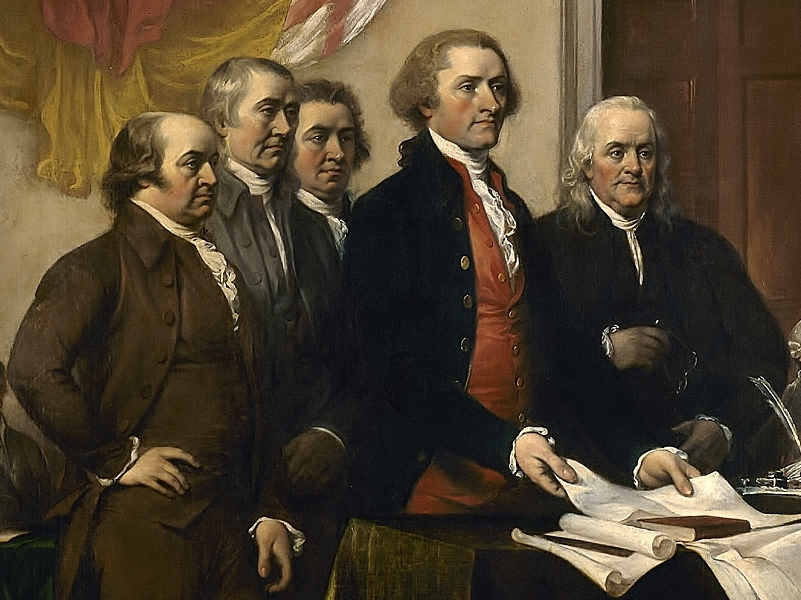
The act alone was rash and irreversible. To declare independence from one of the great powers of the earth, to affirm oneself no longer a subject of the king, to know that an army will come to squash you, to expect many fellow colonists to renounce you and stay loyal to Britain—this was an extreme enterprise. And yet, Thomas Jefferson’s words are rational, judicious, and intelligent; the contrast of mutinous deed and dignified idiom is a lesson in decorum. It tells the readers of it that however much the Declaration opens the way to war, the world in which it will take place is civilized, not savage; intelligent, not crude; moral, not immoral.
Jefferson opens with an assumption that the passage of time is more than a random succession of one day after another. Rather, there is a “course of human events,” a march of time, a momentum in the development of the human story. William Shakespeare’s Macbeth says, “Tomorrow and tomorrow and tomorrow/ Creeps in this petty pace,” the very opposite of Jefferson’s faith in an underlying reason in the affairs of men. And when a disruption occurs in the progress of a society or nation, it properly does so by necessity (“it becomes necessary”), and the ones to prosecute it maintain a “decent respect” for the opinions of others. They are not wild agitators. An enlightened populace rises up only when it has to, when violations have occurred that can no longer be endured (“it is their right, it is their duty, to throw off such Government”). Radical change is never pursued for its own sake.
There is more to say on this, for the things that have been violated are not casual or arbitrary, either. They go beyond “light and transient causes,” for there are “laws of Nature and of Nature’s God” that structure our lives and transcend the vicissitudes of politics and factions, not to mention fashion and money. This is a message young Americans must hear. How comforting is it to realize that existence has an order and a meaning, that the laws of the cosmos work to our benefit, that the realities of life are ultimately good and presided over by a divine and benevolent power? It’s a faith that delivers what used to be called “ontological security” by the existentialists of the postwar period, and what Friedrich Nietzsche called “metaphysical comfort.”
They said so with something of a sneer. By contrast, the Founders affirmed the deity and his creation with a sober piety and personal confidence. They didn’t argue over the nature of things because they didn’t have to. Instead, they appealed to the “self-evident truths” of the second paragraph of the Declaration. The qualifier “self-evident” means that these beliefs need no other evidence, no justification. If we are rational beings, we recognize them instantly. When we hear “all men are created equal,” we assent automatically, because we know that apart from the obvious distinctions of physique, eyesight, beauty, etc., in our hearts we intuit that when it comes to basic humanity, we are all equally human and deserve equal treatment. Society is fair, and it gives everyone a fair chance to pursue his own happiness.
Again, this is a beneficent message for the young. Over the years, I have taught the Declaration in American literature survey courses and noted how smoothly students have taken the air of thoughtful and reasonable assertion in these lines. They are 20 years old, halfway to being on their own, and wondering what the world is going to be as they find a job, a residence, a boyfriend or girlfriend, and new acquaintances. As I’ve written before in these pages, social media, video games, YouTube, instant messaging, and X hand them over the small screen waves of stimulation, much of it vulgar and chaotic. It entertains them, but only in virtual form. To be an actual participant in the spectacles they view is a whole other experience, often a perilous one. Given what they see online, we shouldn’t be perplexed by the desire for “safe spaces.”
There is nothing chaotic or irrational in Jefferson’s introductory words, only the tyranny of the crown, which is cast as a disorder, an intrusion of capricious will into an otherwise orderly universe. The signers of the Declaration are the opposite, men of “prudence” who act out of “right” and “duty,” not greed or rebelliousness.
Again, how comforting it is to see the leaders of such a daring enterprise express their consciousness of the hazards of revolution. Compare their professions of obedience to nature and God with the grand ambitions of other revolutionaries, from Maximilien Robespierre to Vladimir Lenin and beyond. No talk among the Founders of reshaping society or reforming the people. These are men by whom we should feel securely governed, should their venture succeed. Other modern thinkers see the world as unjust (Karl Marx), irrational (Sigmund Freud), ruthlessly competitive (Nietzsche), or empty and cold (Jean-Paul Sartre). The Founders believed in God, and they believed in civic virtue, which would keep ambition and venality in check.
Let us celebrate the Declaration of Independence for its political philosophy and Enlightenment ideals. Let us also hail it for its reasonable tone and civilized manner. The Founders weren’t just brilliant designers of government. They were also models of civility.
Views expressed in this article are the opinions of the author and do not necessarily reflect the views of The Epoch Times.
 Friends Read Free
Copy
Facebook
Tweet
Friends Read Free
Copy
Facebook
Tweet