
Commentary
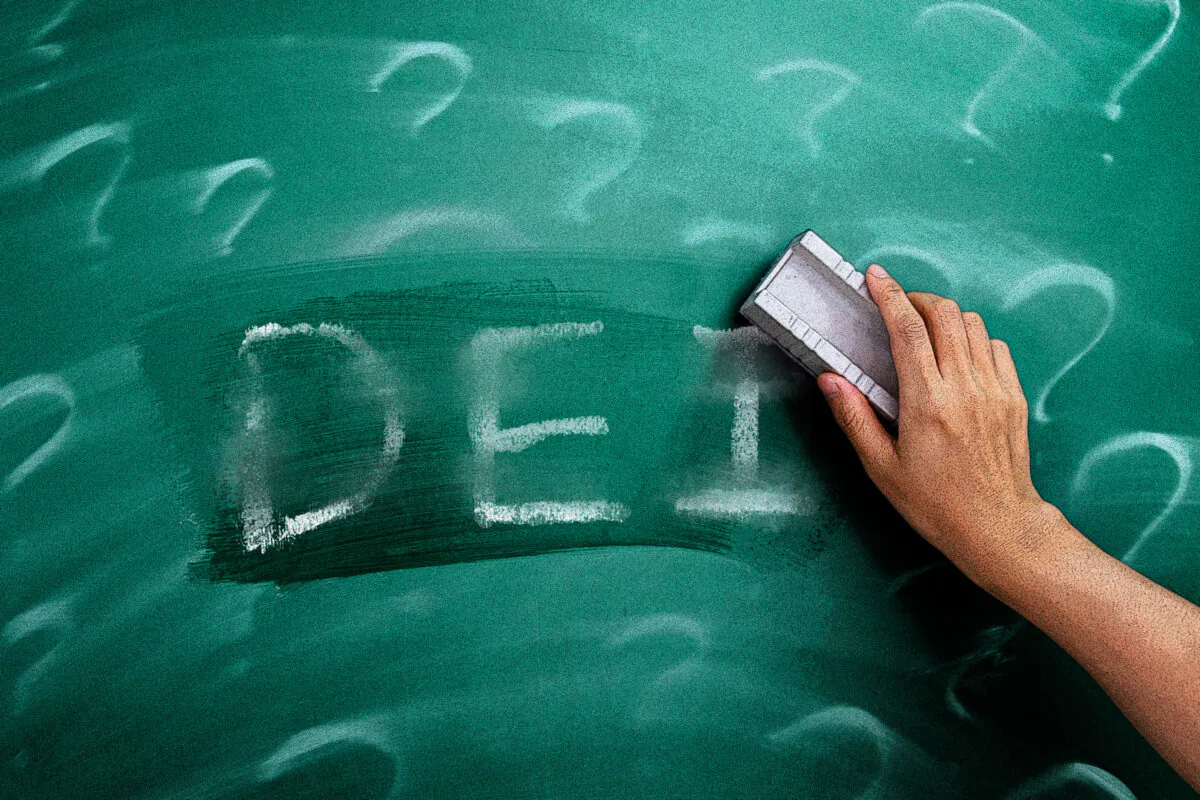
President Trump’s executive order banning DEI practices from colleges and universities is only a step in the termination of this latest form of social engineering on campus. Just because an order is given doesn’t mean that the proscribed actions will end. There are too many layers of decision-making and implementation between the Oval Office in Washington and the college classroom and diversity dean’s office in Boulder, Colorado; Madison, Wisconsin; Berkeley, California; Austin, Texas, and so on, too many steps that the order must traverse, each one an occasion for an official who disagrees to slow or halt progress.
Everyone in the Trump administration must be committed to its success, with no delays or diversions, and everyone in the college administration must comply. It’s impossible for the U.S. president to monitor the course of his commands, and it’s even difficult for the president of a university with 40,000 students to do the same.
DEI (diversity, equity, and inclusion) is a special case, a particularly thorny problem. First of all, it’s not a small operation. We shouldn’t call it a “DEI program”—we should call it the “DEI industrial complex.” The network is huge, with larger campuses boasting DEI staff that number more than 100. In the 2022–23 academic year, for example, the University of Michigan had more than 140 staff members devoted to the agenda. The salaries and benefits paid to those individuals topped $18 million. The vice provost of equity and inclusion alone drew a salary of $380,000, while 17 others earned more than $200,000 in total compensation. The number of people and impressive amounts paid prove just how embedded DEI has been in the ordinary workings of the campus. They demonstrate a commitment that won’t bend easily to an order issued from far away by a person loathed and despised throughout higher education.
A second factor constitutes a different source of resistance, not jobs and money but a psychological element. To judge the DEI complex as a bureaucracy alone is to overlook its most powerful incentive. If you listen to a DEI figure in action speaking her principles, in but a few minutes it becomes clear that she sees it as much more than a job and a paycheck.
Yes, many DEI figures have gone into the field because it has had good growth prospects and nice incomes. But for most, the work they do running diversity workshops, watching over job searches, responding to complaints, and so on matters more than that. It’s a mission. Their individual efforts follow from a worldview, a vision of history, a dedication to their version of progress, a national effort to correct what they see as historic injustice.
If they come across as presumptuous (“I shall uncover the bias of which you are unconscious”), that’s because they have moral fervor. If they classify individuals as members of good groups and bad groups, they feel they have to do so to reverse the old, oppressive classifications. It is true that the positions they occupy attract people with preexisting suspicions and resentments, with perhaps some antisocial elements mixed in, but the social and historical contexts in which DEI has been created and promoted license them to give their psychological traits a moral warrant.
The personal investment has worked for them. DEI leaders have enjoyed power and privilege, not to mention hefty remuneration, for a long time. Their ascent has been remarkable. Thirty years ago, if my department ran a search for a junior professor of Renaissance literature and someone proposed that all applicants add a diversity statement to their curriculum vitae and cover letter, we would have laughed and moved on. By 2020, nobody dared laugh at the requirement, which was now part of every application packet. When in early 2023 we trustees at New College of Florida canceled all DEI actions on campus, the first response was incredulity, followed by indignation. In the votaries’ eyes, we had assailed a core value, an essential goal. We had desecrated the mission.
Now, the attack comes from the White House. Put yourself in the diversity dean’s place. It’s not just her job that is threatened. Her beliefs are, too—her faith, her deepest commitments. She is not going to give them up. I am not even sure that she can be forced to do so and accept another job at the college that asks her to shelve those beliefs as she goes about her new duties. This is going to be a crisis for the schools. What will they do with True Believers in DEI, people who regard anti-DEI persons as vandals and infidels? For much of my academic life, I watched the rest of the campus community defer to them.
This will be not only the end of DEI within academe, but a shake-up of the personnel dynamics, the social hierarchy of the institution. I look forward to it.
Views expressed in this article are the opinions of the author and do not necessarily reflect the views of The Epoch Times.
 Friends Read Free
Copy
Facebook
Tweet
Friends Read Free
Copy
Facebook
Tweet