
Commentary
Tommy Douglas continues to be celebrated as a national hero, referred to in media reports as the “Father of Canadian Medicare” and the “Greatest Canadian.” He has schools named after him, a commemorative stamp, a bronze statue in his hometown of Weyburn, Saskatchewan, the National Film Board’s 1986 film, “Tommy Douglas: Keeper of the Flame,” and his very own cringey, inaccurate CBC drama, “Prairie Giant: The Tommy Douglas Story,” which even former NDP Premier Allan Blakeney slammed as “seriously flawed.”)
The basic myth came from Douglas himself—just as the Winston Churchill myth began with his own historical writings. It begins in 1910 with a young boy almost getting his leg amputated because he was poor. That tale grew in the telling, and for the rest of his life Douglas said everywhere that in the old Canada, if you could not afford to pay, you could have your leg taken off unnecessarily. The rich got better care. Patients who could not pay were denied care. A doctor’s bills could put a family in the poorhouse.
Such powerful socialist tropes thrive on envy, class hatred, and virtue-signalling. In Canada, they remain the justification for a state monopoly that still dominates health care 60 years later. Yet they are a tissue of lies.
Douglas built up his personal legend, which served as a power base for the political left. In a set of interviews for the book “The Making of a Socialist: The Recollections of T.C. Douglas,” he said that as a 6-year-old boy in Scotland in 1910, he took a fall and damaged his knee. The wound got infected, “osteomyelitis set in,” and this required three operations in Scotland “in which the femur was scraped” to remove the infection. After moving to Winnipeg with his family within the year, “the osteomyelitis recurred” and he spent “a long period” in hospital.
“The doctors told my parents that the leg would have to be amputated,” he said. But then, “Dr. R. J. Smith, a very famous orthopaedic surgeon, became interested in my case.” Smith told Douglas’s parents “that he was prepared to take over” the boy’s care and would perform operations for free to save the leg if they allowed medical students to observe. “As a result of several operations, he saved my leg,” Douglas said, as recorded in the book.
“If I hadn’t been so fortunate as to have this doctor offer me his services gratis, I would probably have lost my leg. My parents were having quite a difficult time during the depression, money was very scarce, and they couldn’t possibly have hired a man of Dr. Smith’s standing.” Here’s where the thinly-veiled tendentiousness comes in: “I felt that no boy should have to depend either for his leg or his life upon the ability of his parents to raise enough money to bring a first-class surgeon to his bedside.” And so, “I came to believe that health services ought not to have a price-tag on them, and that people should be able to get whatever health services they required irrespective of their individual capacity to pay.”
As CTV reported, Douglas was motivated by the “suffering he witnessed during the Depression.” That may be, but it is presented as if no one else had such motivations; that no one had alleviated suffering before, such as churches or philanthropic individuals or groups.
It seems like a straightforward retelling of facts. Poor boys could lose “life or limb” if they could not afford to pay, and even if a surgeon helped unpaid, “the loss of his leg was only averted after the doctor asked if he could use the boy as a teaching case.” It’s as though teaching by observation wasn’t the norm, then and now, for example at Harvard Medical School.
Ironically, the myth runs counter to the same story told by Douglas—a story in which a doctor did help the boy with no regard for money. The Douglas family did not need to hire “a man of Dr. Smith’s standing.” In fact, they did not pay and still received first-class treatment.
But the myth is reinforced by the Canadian Medical Association, which says Canada’s medicare was inspired by Douglas’s “lifelong belief that wealth should not determine access to medical care.” Even though wealth did not determine access to medical care, the CMA implies that doctors in the pre-1960s society refused patients who were poor: “If you were sick, you had to make a choice. It cost money to go to the doctor or the hospital. If you couldn’t afford it, you could try to make it on your own. Many people went without care.”
In reality, people who went without care probably chose not to go to the doctor, which is still true today, when nearly 10 percent (three million Canadians) who are sick don’t bother to see a doctor, or have unmet health-care needs.
That didn’t matter. As Saskatchewan’s Co-operative Commonwealth Federation (CCF) premier from 1944 to 1961, Douglas brought in the Saskatchewan Hospital Services Plan in 1947, the “first universal hospital insurance program in North America,” step one. In 1959, he added public funding with the Saskatchewan Medical Care Insurance Act. Predictably, the policy required public service empire-building by an Economic Advisory and Planning Board.
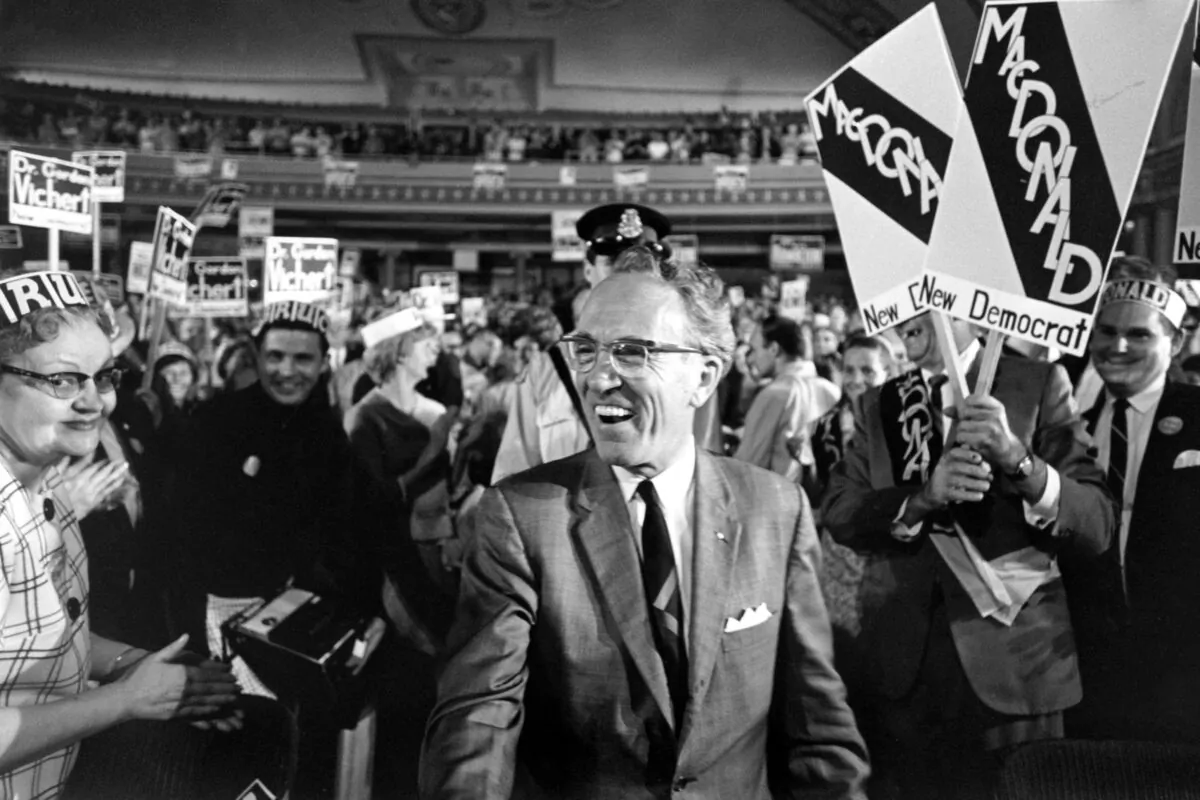
Douglas’s next step was to become the first leader of the federal NDP in 1961. He already knew Ottawa well, having been elected as a federal CCF MP in 1935. It’s sometimes overlooked that he’d been a Baptist minister before, which does not fit the profile of “Greatest Canadian” awarded him in a 2004 CBC contest, despite recent attempts to undermine Douglas’s reputation because he supported eugenics. (He has also been in the news because, as a socialist, the RCMP quite naturally kept a security file on him.)
The feds got in on the act, as Prime Minister Lester Pearson promised that Ottawa would pay half of provincial health costs. The Liberal minority government needed NDP support—and got political cover from a federal Royal Commission (named by the previous Conservative government with Supreme Court Justice Emmett Hall as chairman) whose 1964 report called for “universal health coverage for all Canadians.” Hall was a left-wing pro-labour Catholic lawyer and showed his bias when he said, “The only thing more expensive than good health care is no health care.” (Hall also co-authored a 1968 report that “pushed for sweeping reforms” in Ontario schools, “including the abolition of grades, homework and formal exams.”)
In reality, doctors before the 1960s already treated patients whether or not they could pay. That’s because traditional medical ethics obliges a doctor to save life and limb first. Collecting payment is a secondary matter. Canadian doctors actually gave “great care” to patients who could not pay, as Dr. Shawn Whatley, an author and former president of the Ontario Medical Association, found after surveying doctors who worked in the 1950s–60s, for an essay published in The Dorchester Review. In reality, only 78 percent of doctors’ work in 1929 was paid; and in 1932, almost half of the patients in Canada were non-paying but were still treated. “The only major difference in practice before medicare was the doctors often worked for free,” Whatley wrote.
Power-sharing, vote-getting, and empire-building are the sordid political realities behind Canada’s universal medicare. According to researcher Carolyn Hughes Tuohy, the medicare policies of the 1960s were actually an “elite project” that warped Canada’s self-image into that of a socialist “sharing community.” Over time, it became a truism that state planning can alleviate suffering better than private care. The latter is demonized (though selectively so) as a bogeyman even today.
Views expressed in this article are the opinions of the author and do not necessarily reflect the views of The Epoch Times.
 Friends Read Free
Copy
Facebook
Tweet
Friends Read Free
Copy
Facebook
Tweet