Commentary
Saturday morning, I woke up knowing it was a big day. Health Secretary Robert F. Kennedy Jr. was coming to Sovereignty Ranch. But the morning itself felt familiar in so many ways. My kids needed to be fed. They did not want me to leave the house. Life did not pause just because something important was happening. Still, the excitement was palpable.
This was the first annual American Regeneration Conference at Sovereignty Ranch, a three-day gathering in Bandera, Texas, held in collaboration with Acres U.S.A., one of the country’s longest-standing organic agriculture publications. It came together through months of work, pulling in farmers, innovators, policymakers, and families from across the country. Everyone arrived with the same underlying question: What does the future of agriculture actually look like?
I called my brother, Ryland Engelhart, and thanked him for the work it took to bring this day together. Chairs were being moved. The demo stations were being organized. The radio kept chirping with questions. How should we refer to him? What time is he arriving? What are his meal preferences? The answer came back simple and grounded: two grass-fed beef patties, a steak, two eggs, a side of kimchi, and a side of yogurt.
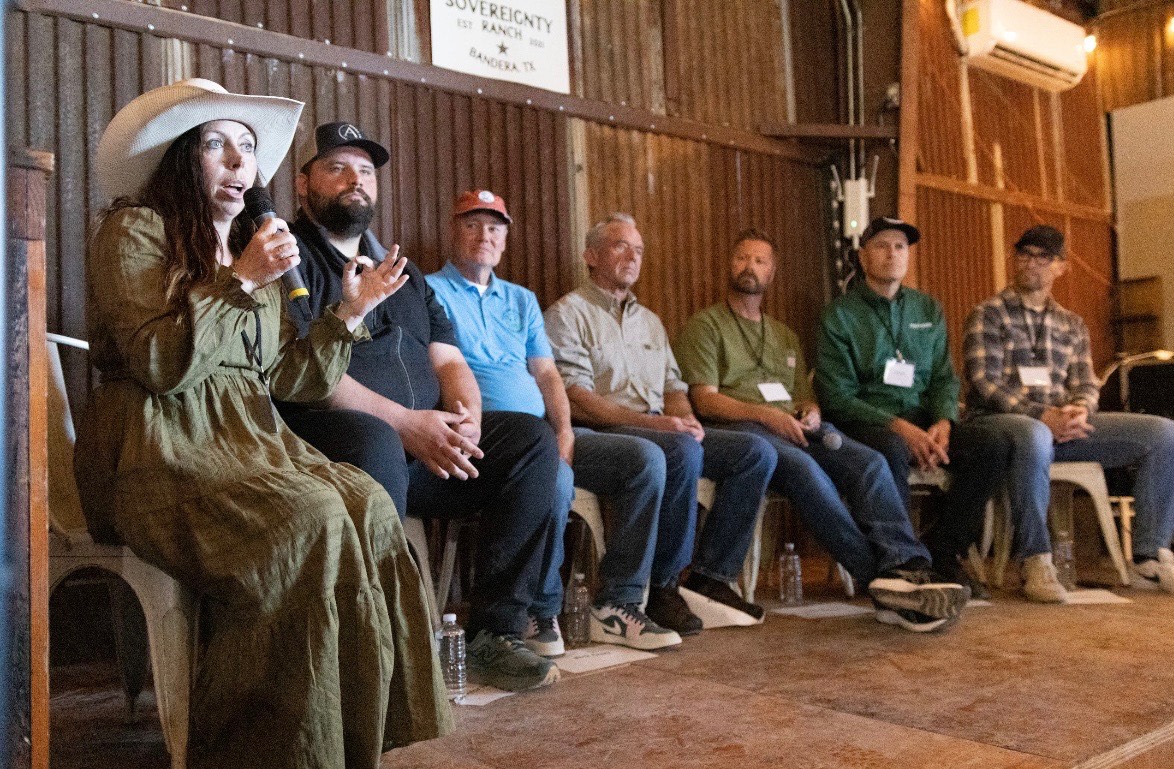
It was not just Kennedy who was coming. Jimmy Emmons from NRCS was there. Nate Sheets, the Republican candidate for Texas Agriculture Commissioner. Our state representative, Wes Virdell. The plan was tight. Arrival at 11:55. A panel to follow. My brother Ryland would open. I would moderate alongside Taylor Henry from Acres U.S.A. Then farmers and innovators would step forward to present a vision for the future.
The questions in the air were clear. How do we get off glyphosate? What is the future of farming?
We heard from Greenfield Robotics. From Rick Clark, one of the largest no-till, non-chemical farmers in the country. From FireHawk, a biological herbicide company. From Trailhead Capital, a group investing directly into regenerative agriculture. Each speaker had seven minutes to answer the same challenge. How do we help farmers step off the treadmill?
As he listened, Kennedy was quiet. Almost distant. Taking it in. But when it was his turn to speak, something shifted. He was thoughtful. Measured. At times, even vulnerable. He acknowledged the limitations of government and the reality that change does not come easily through institutions alone. He spoke about the Farm Bill vote that week and his surprise at how much public pressure had shaped the outcome.
I was sitting next to him when he said it.
“If you don’t have any nutrients, the food is not food.”
It landed in a way that statistics never could. Because everyone there knew it was true.
He went further. He described this moment as a spiritual battle. Not just over agriculture, but over health, truth, and the direction of the country. He made it clear that we are no longer operating in a true free market system. And he pointed to the people in the room, especially the mothers and families, as the force that is actually moving policy. The pressure on the Farm Bill. The growing conversation around pesticide liability protections. Those shifts are not coming from the top down. They are being forced from the ground up.
He also spoke in particular about the microbiome and its importance to human health. It is something I speak about often and hold close to my heart. The idea that our health is not separate from the living systems around us, but deeply tied to them. And yet it remains underconsidered in much of our medical system today.
The hope is not that change will come from the top down. The hope is that his platform and his voice can bring these ideas into the broader conversation. That more people come to the table. That enough pressure builds to move farming in the direction it needs to go for human health.
When I asked him questions, he was careful not to position himself as someone who tells farmers what to do. He said plainly that he does not give advice to farmers. But he was clear on one point. We have to shift subsidies away from cheap food and toward real nourishment.
After the panel, we moved out to the big field. His motorcade followed as we walked through the demonstrations. He watched the Greenfield Robotics robot move across the land, working through the field without chemicals. He stood through a rainfall simulator that showed, in real time, the difference between living soil and dead soil; water soaking in versus running off.
Fred Morales, Lee Albe from Southwest Farms, and I walked him through our no-till system and explained how we plant without disturbing the soil. Garry Stephens from Wildlife Habitat Federation spoke about rebuilding ecosystems alongside agriculture. We showed him a Hiwassee compost tea brewer capable of producing up to 1,000 gallons of on-farm fertility per hour.
It was not theoretical. It was all there in front of him. Working. Tangible. Ready.
As the day came to a close, I found myself reflecting not just on what had been said, but on what had been set in motion.
I pray that the ripple effect of the work my brother and I are doing reaches a point where it begins to move the needle in the direction that is necessary. For human health. For soil health. For the biology that supports all of it to recover.
Views expressed in this article are the opinions of the author and do not necessarily reflect the views of The Epoch Times.
 Friends Read Free
Copy
Facebook
Tweet
Friends Read Free
Copy
Facebook
Tweet