
Commentary
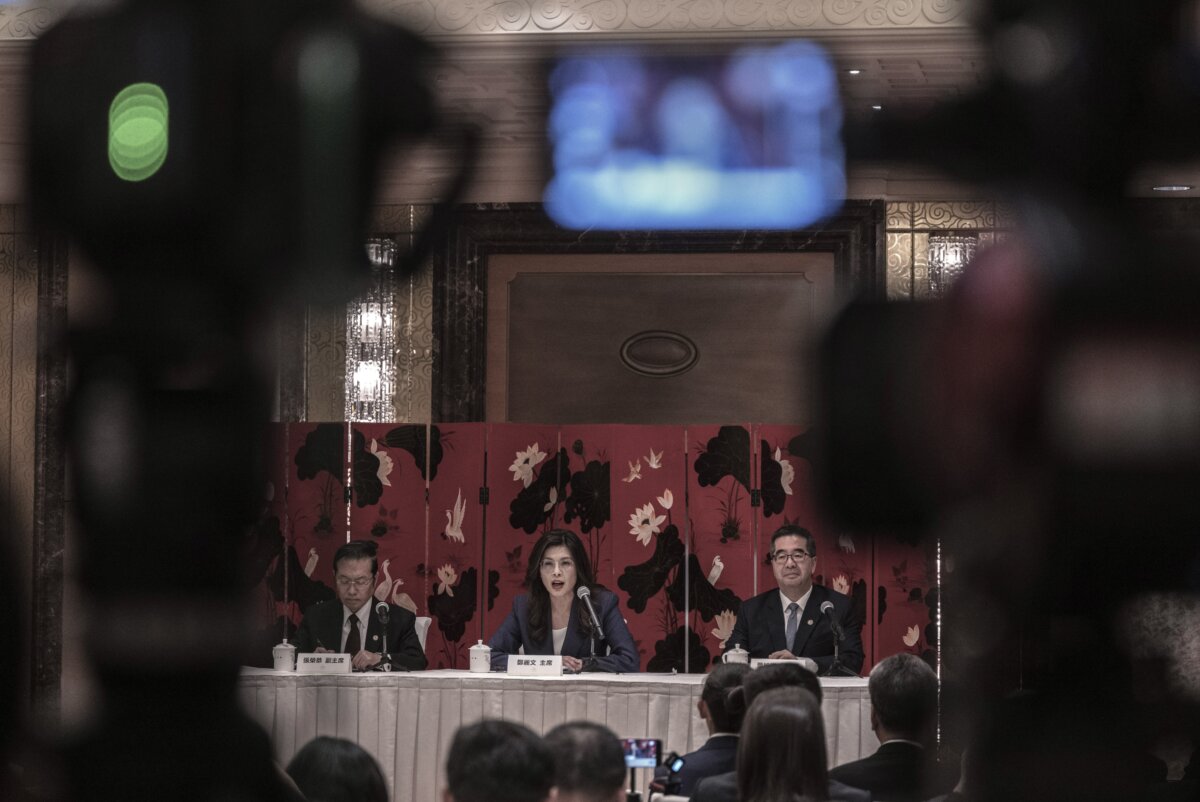
Friends of Taiwan continue to be alarmed by the antics of the Kuomintang (KMT) leadership. The latest flare is the recent visit to China by KMT leader Cheng Li-wun.
Perhaps the KMT, in their continuing drift toward accommodation with the Chinese Communist Party (CCP), are ignoring the history of (and fate) of other accommodationist political parties like Russia’s Mensheviks did a hundred years ago.
Let us examine the issue carefully.
The Mensheviks
The Mensheviks are one of history’s most instructive cautionary tales about what happens when a political party, possessing genuine legitimacy and a mass base, chooses strategic accommodation over principled opposition against a Leninist party that explicitly views politics as existential warfare.
The Mensheviks’ logic was not stupid on its face.
As a rival faction to the Bolsheviks, they believed they were the moderate, democratic socialist alternative; that they represented the urban working class; and that the Bolsheviks were radicals who would burn themselves out. The Mensheviks believed that by participating in Soviet institutions, they could preserve a check on power.
Every one of these assumptions was catastrophically wrong, for a structural reason: The Bolsheviks didn’t see political competition as a game with rules. They saw it as a war of annihilation to be won by any means. The Mensheviks were playing chess; the Bolsheviks were playing “who controls the board.”
The decapitation happened in stages, which is the important lesson. First came normalization and joint forums—the Mensheviks legitimized Bolshevik governance by participating. Then came marginalization—their press was restricted, their candidates harassed, their internal debates surveilled. Then came selective prosecution: Leadership figures were arrested on fabricated charges whenever they proved inconvenient. Finally came the formal liquidation in the early 1920s, by which point the Mensheviks had already been so hollowed out that there was almost no one left to object.
The tragedy was that each individual step of accommodation seemed, at the time, like the reasonable response to an impossible situation. The frog-boiling dynamic was nearly perfect.
The essential mechanism is this: a Leninist (or Maoist!) party never offers partnership. It offers absorption, on a timeline the target party doesn’t control.
The KMT’s Current Position
The KMT’s accommodationist stance rests on three mutually reinforcing pillars. First, a genuine electoral calculation: With the legislature in coalition with the Taiwan People’s Party and local elections coming in November 2026, a high-profile Xi meeting generates prestige among a KMT base that skews older, more business-oriented, and nostalgic for the cross-strait economic boom of the Ma Ying-jeou era.
Second, structural economic incentives: A substantial portion of KMT’s donor network has deep mainland entanglements—manufacturing, real estate, agriculture—and their interests are directly served by reduced tension.
Third, and most dangerously, a “Hong Kong model” fantasy: that a negotiated arrangement under the 1992 Consensus could preserve genuine Taiwanese autonomy as something like a special administrative region. Hong Kong has definitively answered that question.
Cheng’s recent highly publicized photo op with Xi was the first such encounter in a decade. Cheng “gladly accepted” China’s invitation, framing the visit as proof that “the two sides are not destined for war.”
That framing is the KMT’s honest pitch to the median Taiwanese voter who doesn’t want conflict, and it has real appeal (Who wants war?). The problem is that it mistakes a Leninist party’s tactical patience for genuine partnership.
What the CCP Is Offering
The public offer, as reported by the South China Morning Post, is anodyne: peace, economic normalization, tourism, trade, and reduced military pressure under a “peaceful development of relations” framework designed to cast the Democratic Progressive Party (DPP) as reckless and the KMT as responsible.
The private offer is legitimacy—an implicit promise that if unification comes, the KMT, not the DPP, will be Beijing’s governing partner in Taiwan, with senior figures rewarded and business networks preserved. They would be the party that made reunification happen peacefully.
The structural tell, however, is in the conditions. Beijing allegedly agreed to a Cheng–Xi meeting on three conditions, including that the KMT block Taiwan’s arms purchases. This is not a negotiating posture. It is a military-political strategy with a specific, material objective. Cheng reiterated her party’s opposition to Taiwan independence under the “1992 consensus” framework but stopped short of echoing Xi’s “unification” call.
The KMT apparently believes that this asymmetry protects it. It doesn’t. Every time the KMT accepts the consensus, Beijing advances its interpretation while Taiwan’s interpretation gains no international traction. The hedge has never worked, and there is no reason to believe it will now.

The Likely Trajectory
The problem is that, thanks to the KMT, the functional degradation of Taiwan’s defense posture is happening right now, in real time. In 2025, the KMT and Taiwan People’s Party passed the largest series of cuts to the Taiwanese government budget in history, scrapping close to one-third of operational government spending—including defense spending. The Lai Ching-te administration’s defense expenditure budget has subsequently been voted down more than 10 times.
If the current trajectory continues without disruption, here is how the CCP’s decapitation playbook would likely unfold:
Stage one (current): Normalize the KMT as Beijing’s preferred interlocutor. Isolate the DPP as the “warmonger” faction. Use the KMT’s legislative majority to degrade defense spending, block arms purchases, and create visible daylight between Taiwan’s government and Washington. Make the KMT politically dependent on the cross-strait relationship for its electoral identity.
Stage two: Deepen economic entanglement selectively. Offer trade benefits, agricultural purchase agreements, tourism, and business access specifically to constituencies and counties that vote KMT. Make the economic costs of DPP governance visible and the benefits of KMT accommodation tangible. Structurally bind KMT donors more deeply to mainland markets.
Stage three: Create a constitutional or political crisis that positions the KMT as the “legitimate” governing authority—possibly by leveraging its legislative majority to challenge executive power more aggressively, potentially including attempts to constrain the DPP president’s ability to conduct foreign policy or defense procurement independently.
Stage four: The “offer you can’t refuse” moment. Once Taiwan’s defensive capacity is sufficiently degraded, Beijing offers a formal political arrangement—possibly framed not as annexation but as a “confederation” or “special status” under the 1992 Consensus framework. The KMT, by this point deeply compromised, faces a choice: accept and become Beijing’s administrative partner in Taiwan, or refuse and be exposed as having enabled the situation through years of accommodation.
Stage five (the decapitation): Once unification or effective absorption is achieved, the KMT becomes what the Mensheviks became—irrelevant. The CCP does not share power with anyone. KMT figures who cooperated may receive ceremonial positions. Those who become inconvenient will be managed through the mainland’s judicial and security apparatus. The party as an independent political force ceases to exist, because, by design, independent political forces cannot exist within the CCP’s system.
Concluding Thoughts
The KMT’s legislative obstruction of defense spending is doing more strategic damage to Taiwan than a military exercise because it is self-inflicted, it is politically legitimized, and it is happening in slow motion in a way that is very difficult for democratic allies to counter without appearing to interfere in Taiwan’s internal politics.
The more optimistic among the KMT leadership believe they are playing a sophisticated balancing game by engaging Beijing enough to keep the peace while maintaining enough independence to be a real political party.
The less charitable interpretation, supported by the specificity of the alleged three conditions Beijing imposed (including blocking arms purchases), is that the party’s leadership has already crossed the line from strategic ambiguity into functional collaboration.
History suggests the optimists are wrong. No political party has successfully played this game with a Leninist/Maoist party and emerged with its independence intact. The Mensheviks tried. The Czech Social Democrats tried in 1948. The East German Christian Democratic Union tried. Every one of them ended in absorption and erasure.
The question for Taiwan is not really whether the KMT can navigate this successfully. The question is whether Taiwan’s democracy—its voters, its civil society, its DPP opposition, and its international partners—can generate enough counterpressure to interrupt the dynamic before stage three or four becomes irreversible.
It will be a close-run thing.
Views expressed in this article are the opinions of the author and do not necessarily reflect the views of The Epoch Times.
 Friends Read Free
Copy
Facebook
Tweet
Friends Read Free
Copy
Facebook
Tweet