
Commentary
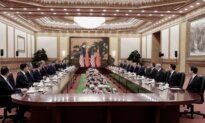
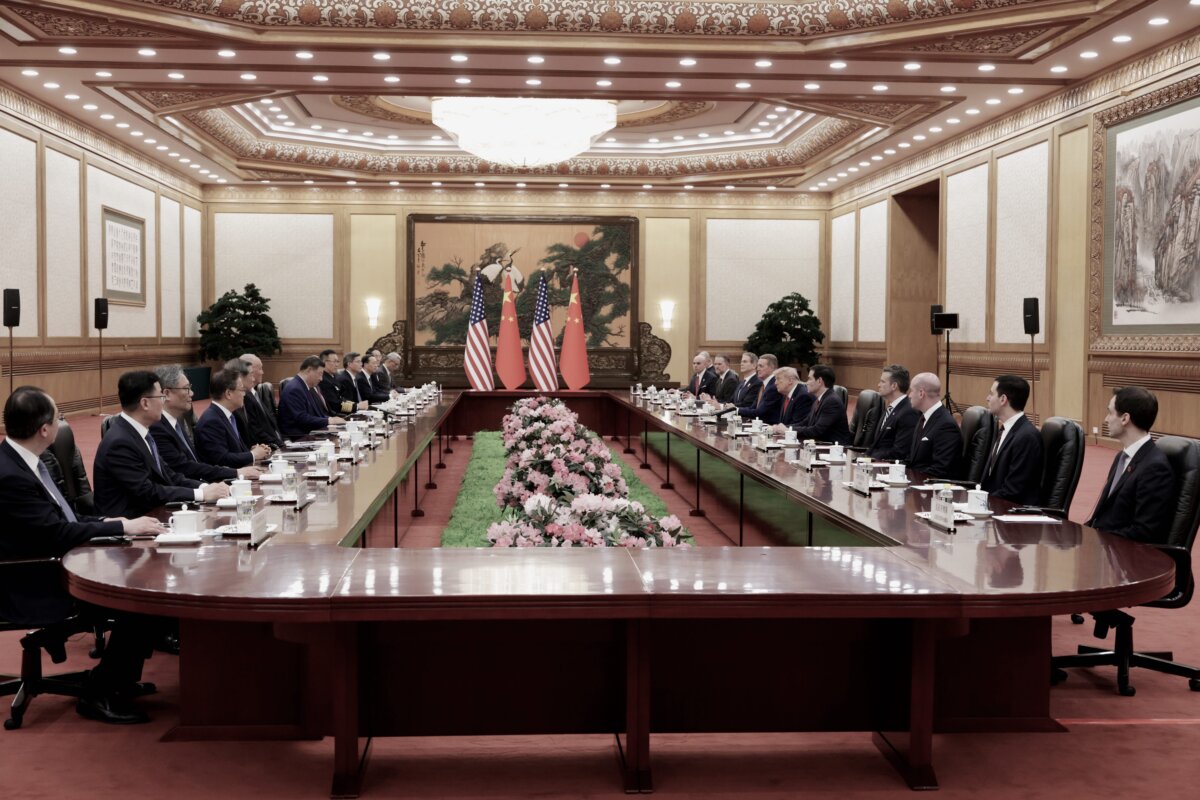
The lack of major China deals emerging from the summit between U.S. President Donald Trump and Chinese leader Xi Jinping indicates that both sides believe that time is on their side.
The regime in Beijing is likely focused on China’s record $1.2 trillion trade surplus last year and its industrial supply chain strengths. The United States, conversely, is relatively strong technologically and militarily. America’s democratic and free market principles help it gain the trust of the world and a global military footprint that is the envy of the Chinese Communist Party (CCP) and freedom’s other adversaries.
However, the lack of a deal indicates future geopolitical instability between the world’s two military-economic superpowers. Investors dislike instability, and the U.S. stock market started a sell-off on the day Trump left Beijing amid concerns about a lack of agreement. Although the White House issued a fact sheet on May 17 listing agreements that included a Chinese purchase of 200 Boeing jets and agricultural goods, Beijing did not publicly agree to these items in detail.
Trump spearheaded tough-on-China policies, including innovative approaches to tariffs on China that put downward pressure on the country’s exports and were copied by U.S. allies. However, some post-summit U.S. statements on Taiwan, including against independence, could be seen as concessions. The regime took the opportunity of the summit to publicly and pointedly warn the United States over its support of Taiwan, making the U.S. statements that followed appear weak.
In the context of a discussion of Iran’s blockade of the Strait of Hormuz, the fact sheet includes a joint agreement to the notion that “no country or organization can be allowed to charge tolls.” But Beijing issued no similar statement, and the White House statement could impinge on potential U.S. revenue sources in the future, since the United States explicitly agreed to it and China did not. Beijing could use the tactic to collect revenue, for example, in the South China Sea.
The U.S. military’s stance against Iran’s blockade of the Strait of Hormuz benefits China more than the United States, as China imports more energy through the strait than America does, and America is footing the bill to keep it open. Meanwhile, China continues to sell dual-use technologies to Iran. The strait is a regime vulnerability and could be in America’s interest to control, including with America’s own tolls, as Trump has suggested. Giving up this potential leverage with no apparent return could be a strategic error.
The agreement to establish a Board of Trade and a Board of Investment with China, one of the few points confirmed by Beijing, could also play to China’s strengths. China’s global exports are second to none. The agreement to create the boards potentially normalizes China’s continued industrial and technological growth at a technocratic level rather than at the political level of the presidency, which is more visible to U.S. voters. This could decrease U.S. political leverage on the issue and hurt U.S. exports relative to U.S. imports from China. A similar U.S.–Japan board of trade in the 1980s caused inflation and did long-term damage to U.S. industrial competitiveness.
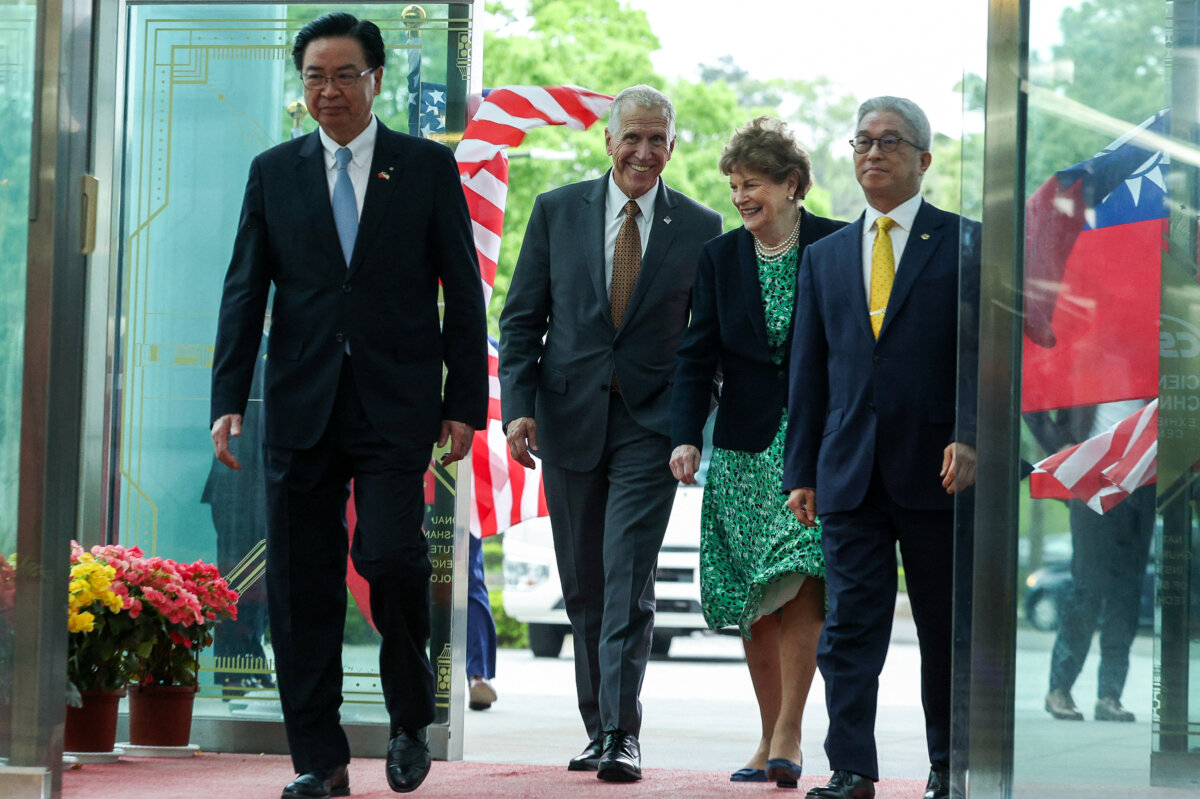
Trump has persisted in not selling out Taiwan as a “bargaining chip,” but he recently raised the question. In December, the president approved an $11 billion arms package, but it is stalled, and he is holding another $14 billion package in “abeyance.”
Given that China repeatedly reneges on many of its agreements with the United States and has not publicly agreed to those found in the latest White House fact sheet, the new Taiwan arms package should be approved as soon as possible. This would penalize Beijing for failing to agree and maximize deterrence against the People’s Liberation Army’s possible invasion of Taiwan, which would potentially involve the United States, Japan, and South Korea.
Risking Taiwan’s security and the U.S. defense sales to Taiwan as a bargaining chip with Beijing has been described as a “strategic blunder” and not part of the long-standing U.S. policy of strategic ambiguity.
Trump likely gained the ear of the Chinese leader by dangling the carrot of increased U.S. business engagement in China, bringing more than a dozen leading U.S. executives with him on his trip. The vibrant group contrasted with the CCP’s lack of business support, and spotlighted the strengths of letting the market work rather than trying to control and consequently stifle it through too much planning, as is the practice of communists. The risk of such a move is that it would be a divide-and-conquer strategy attempting to use the CEOs’ influence over Washington to Beijing’s advantage.
The summit included no jointly-recognized deals on the biggest issues that divide the United States and China, including the trade imbalance, wars in Ukraine and Iran, Beijing’s threats against Taiwan and Japan, the nuclear threat from North Korea, technology and resource controls, and human rights issues.
The CCP regime continues to train the troops of U.S. adversaries and provide them with military materiel. While other countries worked to decrease their dependence on Russian and Iranian energy after Moscow sent its army to seize Ukraine’s capital city and Iran persisted in trying to build nuclear-tipped missiles, China capitalized on the opportunities.
Since the war started in earnest in Ukraine, China has purchased more than $350 billion of Russian energy at cut-rate prices. Since 2018, Chinese car manufacturers have increased their market share in Russia from 2 percent to 57 percent.
The CCP is not America’s friend. Rather, it is America’s adversary and the adversary of our industries and allied democracies.
Whether or not the United States or China came out ahead after the latest summit, the “no deal” outcome indicates that the simmering U.S.–China “competition” will continue as what could be recognized as a “new Cold War” or “Cold War II.” Only this time, the CCP is more powerful economically and militarily than the Soviets ever were. Beijing is attempting to lead the entire developing world in the process, which Russia is now apparently included in.
The new Cold War is playing out in the form of proxy wars in Ukraine and Iran; trade wars over semiconductors, rare-earth elements, commercial jets, and agricultural goods; gray-zone military operations in the South and East China seas; and sanctions against elites and businesses on both sides of the Pacific.
Trump has called his relationship with China the “G-2.” The two countries are indeed the world’s largest economies, but the term evokes parity, which past presidents have rejected. Beijing does not use the term, which could hurt its relations with the developing world, as the U.S. use of the term likely impedes U.S. alliance relations.
Fortunately, the regime in Beijing will never approach the United States on America’s most valuable assets: the legitimacy that comes from 250 years of successful democracy, free markets, and the global defense of human rights. Neither does China have a military or technological edge over the United States.
Given that Beijing apparently believes that time is on its side, the United States should prove the regime wrong. We and our allies should take more initiative against the regime in Beijing where we are strong and the CCP is weak. Over the next decade, America’s system will be tested by its ability to approach Beijing from a strategic national security perspective rather than a purely commercial one that caters to short-term special interests.
 Friends Read Free
Copy
Facebook
Tweet
Friends Read Free
Copy
Facebook
Tweet