
Commentary
The Devil was a murderer and a liar from the beginning.
What we call evil in the world is the means by which the diabolical mind takes aim at life and truth, with a view to replacing them with death and despair.
In recent days, we have been given ample opportunity to reflect on evil’s public-facing triumphs.
The world has watched in horror as a mother stood trial for the murder of her own children.
We remember the first anniversary of the assassination of Charlie Kirk, an honest man and patriot, a husband and father, a source of hope for young people across the country and the world over.
A quarter century afterward, we recall the horrific events that took place on 9/11, which left so many families bereft, acts of mass murder that would go on to change the course of world history.
When reflecting on the work of evil, we think of how senseless and unnecessary it all seems. How could it be that mother, that assassin, and those terrorists believed that what they did would offer any relief, do any good, or bring about any justice?
Confronted with the state of mind that motivates such carefully premeditated atrocities, surely we are not wrong to cry out, “The world has gone mad.” In our darker moments, we may even be tempted to wonder what the point of a world is that allows the wicked—or evil itself, if you like—to rob the innocent of their lives, to perpetrate unthinkable acts so violent that they cannot be undone.
When tempted by such despairing thoughts, we would do well to pick up a copy of “Macbeth,” one of the most profound meditations on the psychology of evil that has ever been composed. In the Scottish play, Shakespeare warns us that the logic of evil is a counsel of despair, a diabolical temptation to regard the apparent triumph of wickedness as inevitable or final.
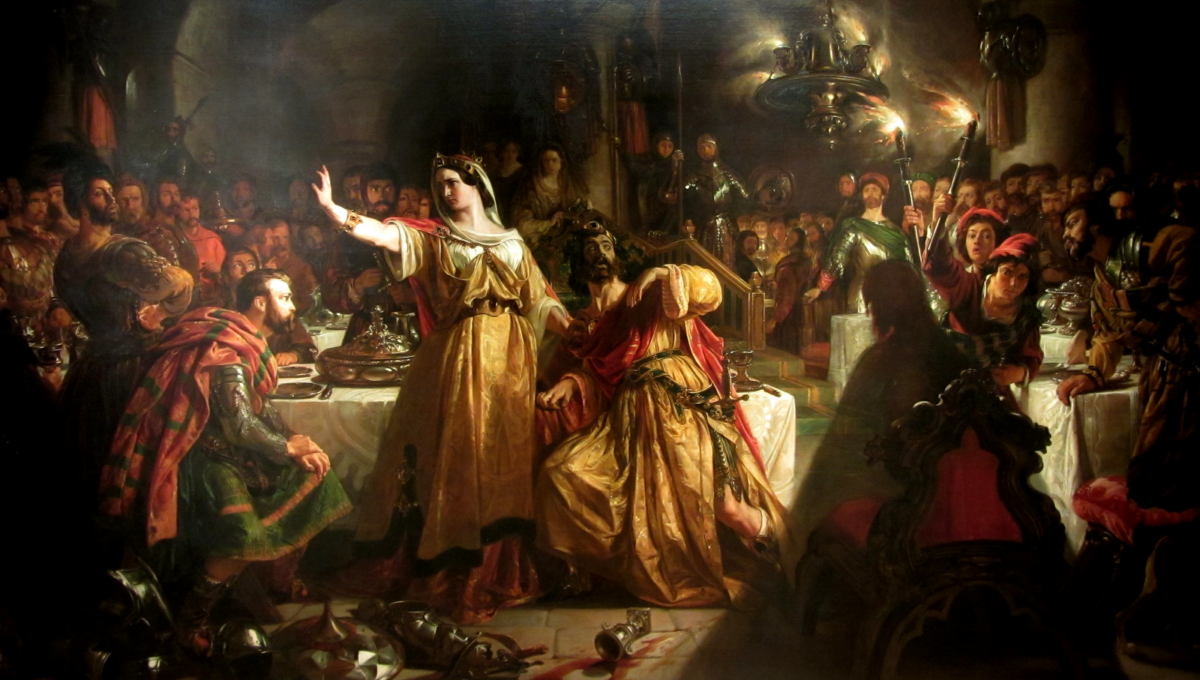
“Macbeth” is a case study of what happens to a person who countenances and then commits murder. In this masterpiece, Shakespeare made it clear that murder has a diabolical origin that also requires our assent to achieve its aims, after which the decline and fall into madness for its vessels—in this case, Macbeth and Lady Macbeth—swiftly follow.
Macbeth and his consort lose their minds by embracing a great lie that there is an ideal realm of pure spirit available to them and to them alone, where the impediments thrown up by this world may be removed simply by willing them away. All Macbeth needs to do is summon up the courage to kill Duncan, and the world will then sit at his feet.
As soon as Macbeth entertains the thought of killing his way to power, he becomes confused and begins to hallucinate. He can only see the throne, never past what it would take to get it. Lady Macbeth chastises him for a failure of will.
When the ambitious pair settle into a conspiracy to murder, they attempt the impossible: to shed their human nature. Instead, by daring to become more than human, the couple become ghoulish.
Normally a source of healing, sleep, “nature’s second course,” becomes a form of torment to Lady Macbeth and eludes Macbeth altogether. Waiting for what they want—time itself—begins to feel like “heartless cruelty.”
Where once the question of whether to commit a single murder had been the subject of much deliberation, Macbeth transforms into the kind of man who endorses the mass murder of women and children to consolidate his power, without sparing a second thought.
Evil has a way of making us believe that any good we would achieve in the world is simply a matter of will. The nature of the act is not what matters; the only measure that counts is how strong our will to achieve it is. Any limits placed on what we want comes to be regarded as a kind of injustice, mere barriers that may and ought to be removed.
This is how dark magic sells itself to us: It seems to offer a way to get around the natural course and pace of human events, collapsing the difference between wanting and having. In the realm of pure spirit shorn of the demands of human nature—where what is thought is done, where there are no customs, morals, bodies, or the natural affections native to them to impede us—time itself will not stand in our way.
But there is no such place; no “eternal moments” that Hell will let us forget.
The cost of embracing “direst cruelty” is the perfect madness of the kind of nihilist that Macbeth becomes when he realizes that he has sold his soul without an ounce of safely acquired worldly gain to show for it. Prideful to the end, he does not repent—a tedious act, he calculates—but instead curses existence itself. Black magic does not bless its practitioners; it can only ever make the world appear as a kind of curse.
There is no explaining away the evil done in this world, for to do so would be to justify it. But it is also true that evil cannot have the final say, since it cannot deliver on its promises. Like a parasite, evil both needs and devours its host; evil does not enjoy any form of existence that does not depend on the perversion or destruction of a goodness that precedes it.
Shakespeare was right to show the diabolical work of evil from the point of view of the murderous madman, whose vaulting ambition—like the Devil himself—can only ever land on death, his tales the mere sound and fury told by an idiot.
Views expressed in this article are the opinions of the author and do not necessarily reflect the views of The Epoch Times.
 Friends Read Free
Copy
Facebook
Tweet
Friends Read Free
Copy
Facebook
Tweet