
Commentary
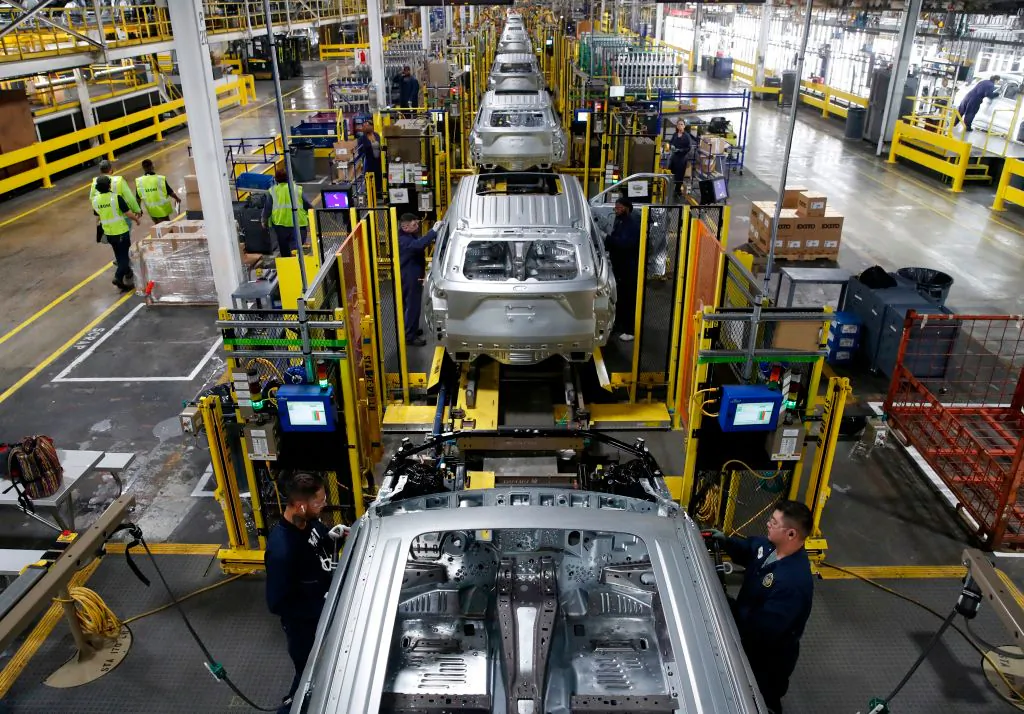
The U.S. manufacturing sector clearly outperforms all its G7 peers, especially Germany, France, and the UK. The main reason is that the United States never implemented the aggressive net-zero emissions policy that has destroyed the industry by giving the reins of industrial policy to activists.
In the latest S&P Global purchasing manager’s index (PMI) readings, the U.S. manufacturing sector is clearly expanding, while the UK is only slightly expanding, and Germany and France remain in contraction after years of decline. The United States also shows much stronger momentum in new orders and better pricing power, margins, and investment plans than its European peers. Furthermore, the United States has reduced carbon dioxide emissions and protected the environment without destroying its industrial fabric. According to federal data, the United States has reduced its greenhouse gas emissions by 17 percent between 2005 and 2023, while the European Union reduced emissions by 20 percent.
The latest flash S&P Global U.S. Manufacturing PMI stands at 51.9 for November, the 10th expansion reading in the past 11 months. On the other hand, Germany’s Manufacturing PMI has fallen back to 48.4, while France remains below 50, signaling contraction and indicating disastrous manufacturing performance in the past three years. The UK has only just edged back to 50.2, barely into growth after months of contraction. There is a clear structural difference: The United States is in a continued, broad-based expansion phase, while the euro area’s industry remains stuck in stagnation, and the UK has stabilized after years in a negative trend.
New orders show the trend in a clear way. In the U.S. survey, new orders are in positive territory, supporting output and employment. In Germany, new orders are falling again, with reports of a sharp decline in export demand and renewed drops in backlogs and jobs, and France’s manufacturers continue to report falling new business after more than three years of demand weakness, according to S&P Global. The UK is seeing some modest improvement in domestic orders but still faces a drag from exports, whereas U.S. factories benefit from a large internal market and reshoring-related demand that is largely absent in the EU.
If we analyze prices, the U.S. manufacturing sector is in a much better position to defend its margins. The S&P Global U.S. survey shows a moderate input cost increase, stable margins, and no negative impact on demand. In Germany and France, the PMI reports describe a context where manufacturers face weaker pricing power, with output prices often under pressure and a fragile demand environment. It is undeniable that there is evidence of a profitability and cashflow advantage for U.S. manufacturers.
European business surveys and experts constantly point to high energy prices, complex regulation, and climate-related policy obligations as factors negatively impacting orders, investment, and pricing, whereas U.S. producers operate with competitive domestic energy and flexible regulatory requirements. Thus, U.S. manufacturers can maintain investment and job creation plans despite slower global growth, whereas most German, British, and French firms are trying to survive in an environment of rising regulatory and tax burdens, focusing on cost cuts and capacity control.
Europe’s approach to net zero has clearly damaged the competitiveness of its energy-intensive industries. The combination of carbon pricing, a hidden tax with no discernible positive final impact, renewable support surcharges, increasing regulated costs in electricity bills, and increasingly stringent wrongly called environmental restrictions is raising operating costs for manufacturers that already face higher baseline energy prices than their U.S. counterparts. Germany’s chemical, metal, and glass sectors are often highlighted as examples of industries whose margins and investment plans have been damaged by expensive electricity and gas, aggravated by climate-related surcharges, and the rapid phase-out of nuclear and conventional energy generation.
In France, industrial firms have benefited from nuclear power and face lower energy costs than German or UK competitors but still suffer from high network charges, environmental taxes, and regulatory uncertainty related to future climate policy, all of which weigh on long-term investment decisions. UK think tanks and strategy firms point to the same points, stressing that carbon prices, green levies, and planning barriers have made energy costs structurally higher than in the United States, pushing some producers to relocate or scale back capacity. Across the three countries, leading business groups warn that accelerated decarbonization timetables, combined with insufficient support for industrial transformation, have widened the gap in input costs, making some multinationals shift incremental investment to North America or other regions, according to PwC studies.
The net zero-related burdens are direct causes of a weak PMI picture. When demand is weak and new orders are falling, as in Germany and France, higher regulatory and energy costs cannot be offset by higher selling prices, so firms respond by cutting investment, reducing capacity, and, in some cases, closing plants. In the UK, climate policy-related costs and uncertainty add another layer of concern. The United States has followed a tax-cut-driven approach to energy transition without destroying cheap alternatives, which helps PMI readings and explains stronger investment intentions than in Europe.
In the United States, firms have announced ongoing investment increases related to reshoring, supply chain diversification, and technology. In Germany and France, repeated references to prolonged downturns in new orders mean weaker investment plans, delays in large projects, and a continued focus on efficiency rather than expansion.
U.S. firms not only invest in capacity but also drive productivity-enhancing spending in digitalization and robotics, supported by a combination of fiscal incentives, more competitive energy costs, and a clearer policy environment for industrial decarbonization, according to PwC.
The U.S. manufacturing sector is clearly winning relative to Germany, France, and the UK on all fronts: volume, pricing, technology, and future capacity. The United States has focused its industrial policy on leaders of alternatives and proactive improvement, rather than giving all the power to ideologically motivated activists obsessed with regulation, limits, and taxes.
Unfortunately, nothing seems to be changing. Europe and the UK seemed to be handing the future of industry, automation, and manufacturing investment to China and other nations under a misguided view of environmental protection based on “not in my backyard,” while other countries grow and improve their environmental protection measures without abandoning key strategic sectors.
The U.S. manufacturing sector is winning because its future was not left in the hands of PowerPoint activist politicians. This is a warning for Americans: If you copy Germany, France, or the UK, you will face the stagnation and decline they are suffering.
Views expressed in this article are the opinions of the author and do not necessarily reflect the views of The Epoch Times.
 Friends Read Free
Copy
Facebook
Tweet
Friends Read Free
Copy
Facebook
Tweet