
Commentary
If men’s basketball is the most popular and professional athlete-filled team sport at the quadrennial Summer Olympic Games, then men’s ice hockey is its Winter Olympic Games analogue.
Every four years, the two-week Summer and Winter Olympics provide a respite, for NBA and NHL fans, from the annual domestic calendar. Stars who might normally be teammates instead pick up the jerseys of rival nations, competing against one another for love of home and hearth on the world’s grandest sporting stage. Each Olympic sport has had its iconic American triumphs, too: Who can forget the 1992 basketball “Dream Team” in Barcelona, Spain, or the 1980 “Miracle on Ice” in Lake Placid, New York?
But there is one major difference. The United States has dominated men’s basketball at the Summer Olympic Games, only once failing to win gold since NBA players were first allowed to compete in the Barcelona Olympics. But in men’s ice hockey, the United States hadn’t won gold since the 1980 miracle—and not once since NHL players first competed in Nagano, Japan, in 1998. Basketball, like baseball (which will return as an Olympic sport in Los Angeles in 2028), is an American invention. Not so for hockey: The bruising tough-guy game is Canadian in origin, and Canada is the winningest team in Olympic history. This year’s Canadian hockey team was touted by some as the greatest team ever assembled on ice.
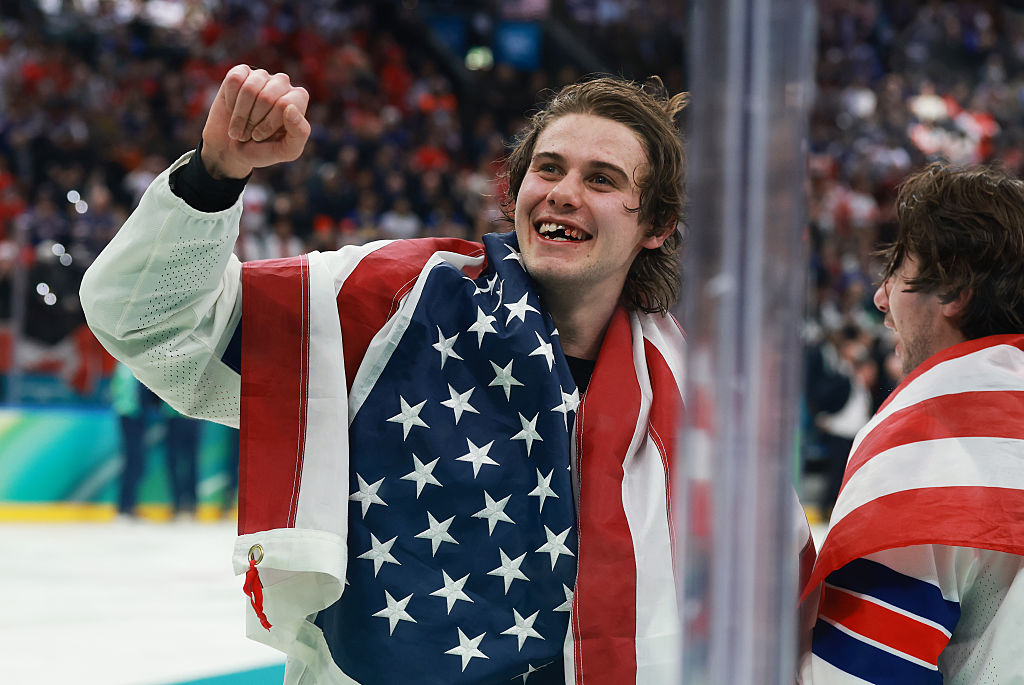
Yet, in one of the more extraordinary fixtures in recent sporting memory, the United States upset mighty Canada in Italy on Sunday, Feb. 22, to capture the Olympic gold medal in men’s ice hockey. It was a wildly entertaining affair—a bitterly contested 2–1 overtime thriller, marked by intense passion from both sides and an all-time historic performance from American netminder Connor Hellebuyck. It was a gritty upset victory over a more talented foe, made possible through determination and sheer force of will. The viral photo of golden goal-scoring forward Jack Hughes, smiling widely with two teeth missing and an American flag draped around his shoulders, instantly entered the realm of American sporting lore.
Arguably even more impressive than the victory itself, though, was the way the American team handled the aftermath. And here, some additional context is necessary.
For more than a decade, the sports establishment has increasingly embraced the left. The trend was crystallized when, in 2015, ESPN awarded Caitlyn Jenner the Arthur Ashe Courage Award at its eponymous ESPY Awards—just for being a man “identifying” as a woman. Alternative sports media outlets such as Dave Portnoy’s Barstool Sports and Clay Travis’s OutKick seized on the obvious market share void, but much of the sports establishment still leans leftward.
At the Australian Open tennis tournament in January, American stars deftly swatted away obnoxious questions from tendentious anti-Trump sports journalists. Earlier in the Milan Cortina Games, some American athletes unfortunately succumbed to similar journalistic activism; freestyle skier Chris Lillis, for example, said he was “heartbroken” about the political situation at home.
The golden American hockey men had no interest in playing this game.
FBI Director Kash Patel, a lifelong recreational hockey player and fan who was in attendance, joined the men’s team in the locker room afterward to celebrate. Patel was able to get President Donald Trump on speakerphone, and the president congratulated the team for a hard-fought and well-earned victory. He invited the team to attend the State of the Union address on Feb. 24 in Washington. The players immediately accepted, and in a viral video of the interaction, they seemed genuinely grateful for the phone call.
But in a slew of predictable subsequent interviews, a number of journalists asked the players whether they were concerned at all about appearing alongside such a divisive president. In each and every instance, the players refused to take the bait.
Golden boy Hughes encapsulated this sobriety in Miami on Feb. 23: “Everything is so political. We’re athletes. We’re so proud to represent the U.S. When you get the chance to go to [the] White House and meet the president, we’re … proud to be Americans.”
Jack’s brother Quinn Hughes, also on Team USA, even thanked the military for the victory over Canada: “It’s so special, and I want to thank our troops for allowing us to play this game.”
Two-time Stanley Cup winner Matthew Tkachuk offered a similar sentiment when asked about Trump’s locker room call: “It’s an honor hearing from the president of the United States. … We’re definitely honored to represent him and the hundreds of millions across the country and to bring a gold medal back.”
How unbelievably refreshing it all is.
Sports, at its finest, can act as a cultural common denominator for our ever fractious and divided polity. For a long time, it looked as if that might have been written off as nostalgia and forever lost to history. But perhaps not. As many noted, the instantly iconic photo of Hughes looks and feels like a throwback to a bygone era. The gold medal-winning 2026 U.S. Olympic men’s ice hockey team will inspire an entire generation of American hockey players, but if they can help us recover sports as a rare cultural totem that we share in common, and not yet another thing tearing us apart, they will make an even greater contribution to the health of the country they very clearly love.
Views expressed in this article are the opinions of the author and do not necessarily reflect the views of The Epoch Times.
 Friends Read Free
Copy
Facebook
Tweet
Friends Read Free
Copy
Facebook
Tweet