

Commentary
Iran is being pummelled by the United States and Israel, demonstrating that their technology is vastly superior to anything Iran can muster. The one-sided war is not only an indictment of Iran’s indigenous weaponry; it also reflects poorly on the Chinese-made arms Iran relies on.
The implications for China’s plans to take over Taiwan, which is armed with U.S. and Israeli technology, are undeniable. Given the real-world performance of its military technology in the Middle East, China can have little confidence in an easy takeover of Taiwan.
Neither can China be confident that Taiwan couldn’t launch humiliating pre-emptive strikes against mainland China, as Israel did against Iran, should Taiwan’s Israeli-enhanced intelligence systems determine that China was about to attack.
In a war against Taiwan, China would have an overwhelming advantage due to the size of its arsenal. This could be the case even if the United States and Japan were to come to Taiwan’s defense, as would be expected. But China’s numerical advantage would be tempered by a disadvantage in quality, as demonstrated by the current Iran war and the 12-Day Iran War of June 2025.
“The U.S. and Israel demonstrated overwhelming advantages in electronic and cyber warfare, intelligence gathering, and the integration of land, sea, air, and space assets this time,” Dennis Wilder, a professor at Georgetown University, told the South China Morning Post. “China is about 10 years behind the U.S. in terms of utilizing advanced technology.”
The United States and Israel began the current war by neutralizing Iran’s air defense systems, which include China’s fourth-generation mobile radar YLC-8B, China’s long-range surface-to-air missile HQ-9B, China’s HQ-16, China’s HQ-17AE, and China’s Beidou satellite navigation system.
All the Chinese technology proved impotent, with Iran failing to bring down a single enemy aircraft over its skies. The failure is all the more noteworthy since Iran purchased Chinese technology specifically to avoid a repeat of the 12-Day War, when Israel single-handedly took out Iran’s air defense systems.
As Taiwan’s FTV reported, Chinese radar systems failed in both large-scale air attacks on Iran. The failure of the HQ-9B, which is central to Chinese air defense, is especially significant for Taiwan’s military planners since China deploys it around Beijing and the South China Sea.
In other theaters of war, the HQ-9B failed to protect Pakistan during India’s Operation Sindoor, and China’s radar failed to protect Venezuela when the United States extracted Venezuela’s president, Nicolas Maduro, and his wife.
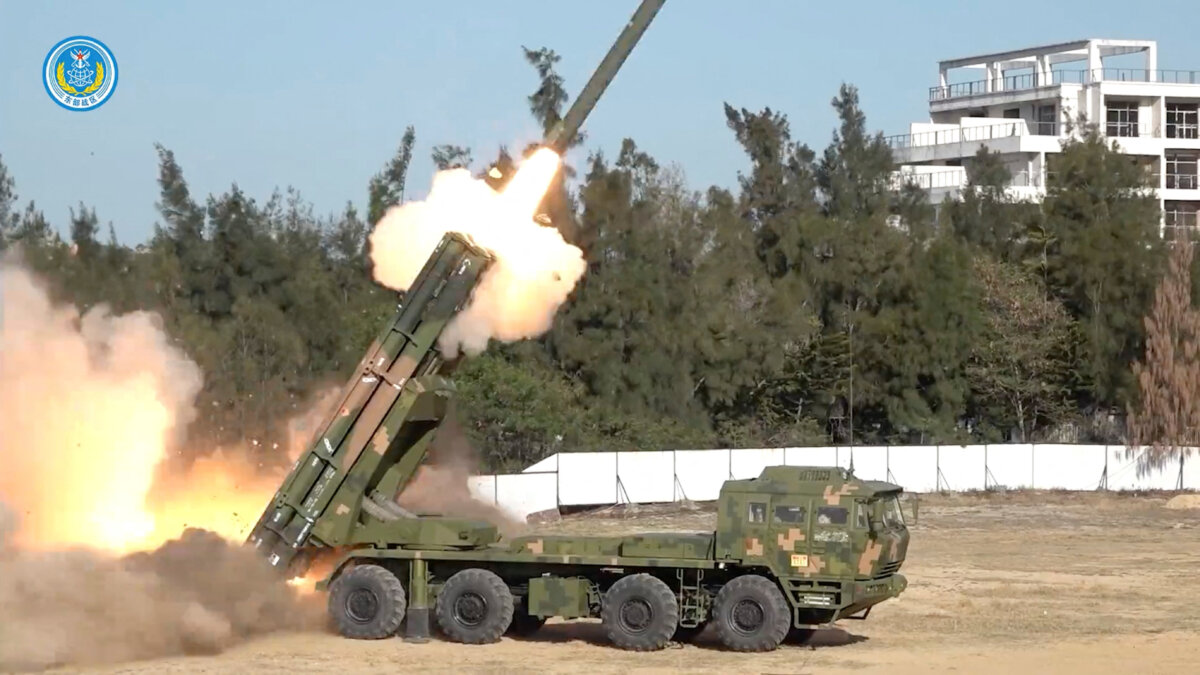
The Chinese arms have also proven feeble in their offensive capabilities. Iran has few confirmed hits, in contrast to the U.S. and Israeli tally—they report striking more than 15,000 targets because of their precision-guided munitions, among them 190 missile launchers, more than 100 naval vessels sunk or damaged, and dozens of nuclear-related sites. Iran’s tally includes minor damage to 17 U.S. sites, a failed detonation in Dubai, relatively few deaths, and scattered impacts in Israel with limited damage. Most of the weapons Iran launched were intercepted by U.S. and Israeli technology, and most of Iran’s launch platforms were destroyed, leading to a 92 percent drop in Iran’s drone and ballistic launch rates.
China’s ability to take Taiwan was suspect even before the Iran wars—most CSIS and RAND war game simulations generally showed China would fail. Following the real-world tests that Chinese technology has faced in both Iran wars, its prospects are all the worse.
War hawks in China’s ruling elite who advocate an invasion of Taiwan will now be undercut. The Iran wars confirm that China could well face the defeat that the West’s war games predict. The embarrassment of a military defeat will trump the embarrassment that would come of backing down from the threats to invade.
Views expressed in this article are the opinions of the author and do not necessarily reflect the views of The Epoch Times.
 Friends Read Free
Copy
Facebook
Tweet
Friends Read Free
Copy
Facebook
Tweet