
Commentary
The Supreme Court just did something remarkable, but it was easy to miss the implications based on the text alone.
“MILLER, JOSEPH, ET AL. V. McDONALD, COMM’R, ET AL.: The petition for a writ of certiorari is granted,” the ruling reads. “The judgment is vacated, and the case is remanded to the United States Court of Appeals for the Second Circuit for further consideration in light of Mahmoud v. Taylor, 606 U. S. 522 (2025).”
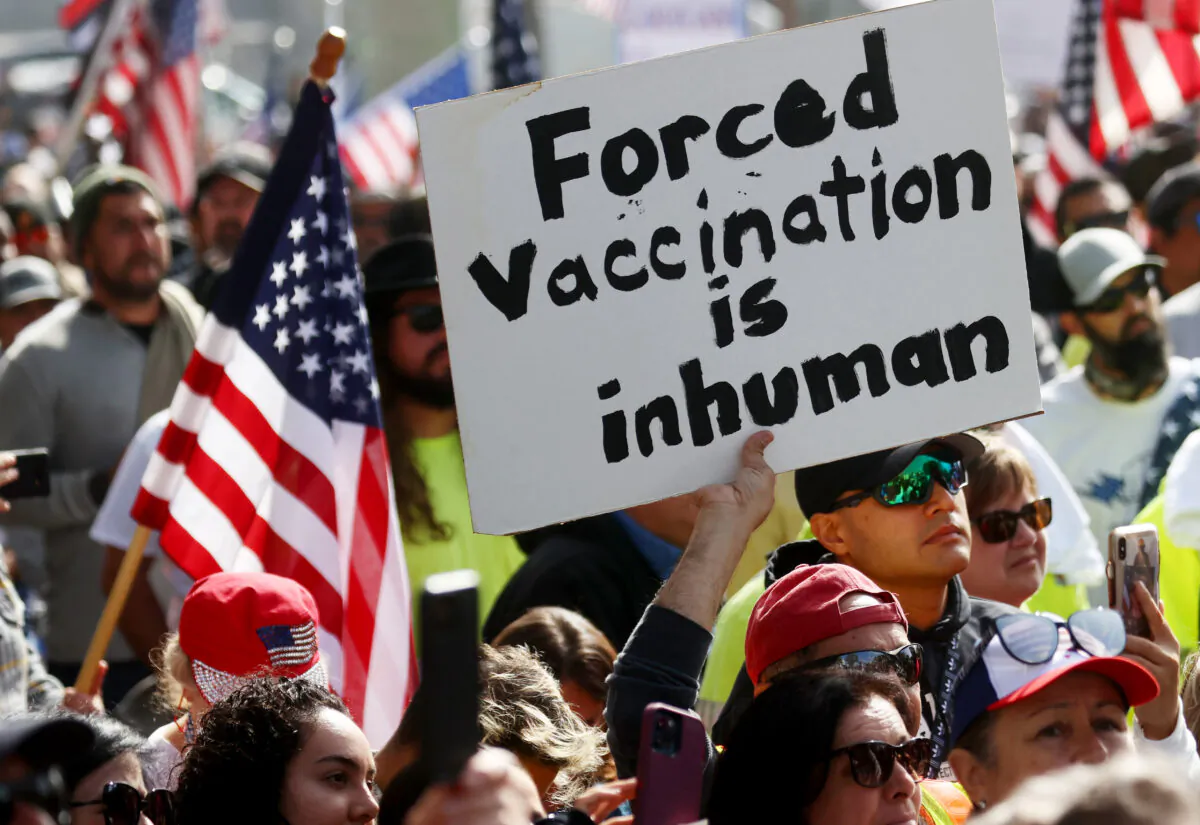
What does this mean? It means that the Supreme Court has rejected a lower court decision to uphold New York state’s law that forbids religious exemptions to its vaccine mandates.
The Epoch Times reported: “The justices directed the appeals court to reconsider its ruling in light of Mahmoud v. Taylor, a Supreme Court ruling in June that sided with parents who wanted the ability to opt their children out of interacting with books in school that promote lesbian, gay, and similar lifestyles. Justices did not say how the appeals court should ultimately rule after reviewing Mahmoud v. Taylor.”
The issue involved a coercive imposition on the Amish, who have a long tradition of rejecting conventional medical care (and have long healthy lives despite or because of that).
The ruling points out that the court already decided that parents have a right to decide, based on religious convictions, the kind of textbooks to which children can be exposed. It thereby makes sense that a religious exemption should apply to what kind of potions are injected into the body.
My friends, this is massive. Four states refuse religious exemptions for vaccines: California, Connecticut, New York, and Maine. The rest allow them, although other coastal states are currently considering imposing new ones in a revolt against trends at the Department of Health and Human Services today. This puts such efforts on pause and raises fundamental questions concerning those that exist.
This country long ago decided to require states to have freedom in the exercise of religion. When the Constitution was ratified, many states had established religions that had to be repealed to be in compliance with the new law. Protestantism and Congregationalism was in fact the state religion in many, with Christianity broadly enforced. All that went away to stay in compliance with the Bill of Rights.
Conscience comes first, the Constitution states. It was probably the first country ever to enshrine such religious freedom as a fundamental right.
In the meantime, many states, in an effort to circumscribe the use of religious conscience, especially that of Christians, have imposed various secular practices in the name of science, including vaccination. Those who invoke faith (or faith in a different scientific perspective) have been variously denied schooling and other services.
The Supreme Court appears poised to reaffirm religious liberty even insofar as it affects issues of public health.
Those words “public health” here are doing all the heavy lifting. The theory is that the decision to vaccinate is not really about the individual but about the crowd. With “herd immunity” the rate of transmission of any particular pathogen drops low enough to protect even the unvaccinated. But it must be high, at 70 percent and above. The thinking goes that religious exemptions might be a matter of religious conscience, but they endanger everyone and hence must be overruled.
In this utilitarian framework, even vaccine injury and death have to be tolerated as the price we pay for the health of all. To be sure, there are strange problems with the application of this idea in times when the definition of vaccine has been so widely broadened. It no longer has to protect against infection or even spread, which raises serious problems for the utilitarian framework. It would seem in this case that the rights of conscience should matter.
In some ways, it is remarkable that it has taken the court so very long to come around on this issue, which has been alive since the early years of the founding. George Washington imposed a vaccine mandate for his troops but allowed exemptions for natural immunity. And when James Madison signed his Act to Encourage Vaccination in 1813, it was not a mandate. It was a huge subsidy to manufacturers and a demand that carriers actually get the product to the intended recipient.
In 1822, news of the inevitable injuries spread, and the act was repealed forthwith. However, government intervention to get the population jabbed did not end there. Abraham Lincoln imposed a smallpox vaccination policy for Union troops while the Confederacy had none. Union soldiers experienced hundreds of deaths and thousands of injuries from contaminated products and needles.
The consumer revolt was on and the industry was panicked. An eventual result was the Biologics Control Act of 1902. The act predated the more famous regulation on meatpacking by four years. Its history is revealing. The year before the act, 13 kids had died from a contaminated diphtheria antitoxin in St. Louis and nine more died from tetanus-contaminated smallpox vaccines in Camden, New Jersey. This infuriated parents. Industry flew into action and lobbied the government for regulation to shore up public confidence.
This cycle has repeated itself many times: Vaccines proliferate, people get injured and die, industry fears public backlash, and government acts to bolster confidence with subsidies and mandates that impinge on religious convictions. This has been a feature of the whole of American history.
The culminating moment came in 1905 with Jacobson v. Massachusetts.
It reads, “Upon the principle of self-defense, of paramount necessity, a community has the right to protect itself against an epidemic of disease which threatens the safety of its members.”
“Real liberty for all could not exist under the operation of a principle which recognizes the right of each individual person to use his own, whether in respect of his person or his property, regardless of the injury that may be done to others,” it states.
The decision left out important considerations such as the very real risk to the individual from shots going wrong, as they have continually from the very first deployment of vaccines in U.S. history. Nor did it imagine an application to a huge range of today’s shots that actually do not protect others but rather have vague end points in testing such protection against disease severity. In other words, the unvaccinated in fact do not injure others, contrary to the Jacobson claim.
In the end, the rationale of “public health,” which certainly does have legitimacy as a conceptual framework, proves extremely weak as a basis on which to deny an individual the right to follow his or her conscience in matters of medical products and services. In fact, that seems so obvious as to not require debate. It’s sad that it is debated at all.
Families of conviction have been fleeing mandated states for many years. Meanwhile, the free states are filling up with people who want to live their lives in peace without impositions from medical masters. There seems to be no record of any families fleeing to states that have mandates to experience more “public health.”
That should tell you something. These products have always relied on various forms of government pushes, subsidies, encouragements, mandates, and liability protections, and would likely not have survived after 1901 without them. The Supreme Court would be doing the right thing finally to make receiving an injection a matter of personal choice.
Views expressed in this article are the opinions of the author and do not necessarily reflect the views of The Epoch Times.
 Friends Read Free
Copy
Facebook
Tweet
Friends Read Free
Copy
Facebook
Tweet