
Commentary
While some have aggressively demanded that we “follow the science”—as throughout the COVID-19 pandemic—this insistence often falters when faced with inconvenient evidence. Biblical archaeology, for instance, consistently unearths irrefutable evidence of an ancient and continuous Jewish presence in the region historically known as Palestine—yet these discoveries are routinely ignored or dismissed.
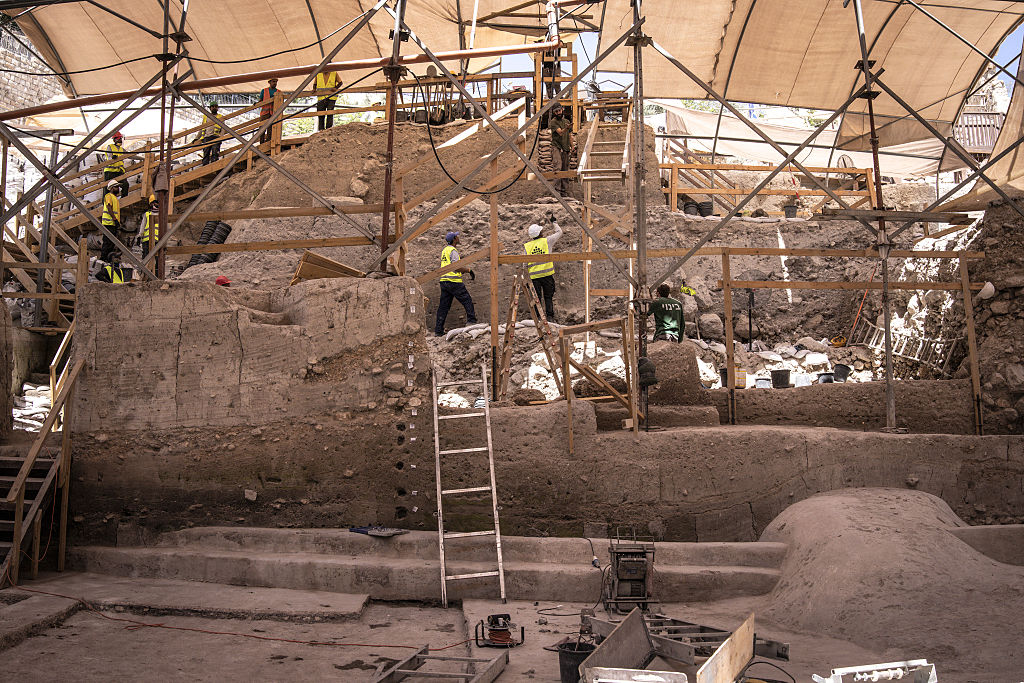
Earlier in September, Jerusalem unveiled its historic Pilgrimage Road. A ceremony marked the completion of years-long excavations, allowing the ancient stone pathway—dating to the Second Temple period and connecting the Pool of Siloam to the Temple Mount—to be fully accessible end-to-end for the first time in 2,000 years. The Pool of Siloam is where the Bible tells us Jesus healed a blind man.
Celebrating a Shared Heritage
This historic event, attended by Israeli Prime Minister Benjamin Netanyahu, U.S. Secretary of State Marco Rubio, U.S. Ambassador to Israel Mike Huckabee, and other dignitaries, marked a profound moment in archaeology, diplomacy, and faith. Regrettably, the assassination of conservative icon Charlie Kirk just five days earlier cast a shadow over the occasion, dominating headlines and limiting global attention to the unveiling. As a result, the profound significance of what took place in Jerusalem that week may have gone unnoticed by many.
While the inauguration ceremony highlighted the deep ties between the United States and Israel, grounded in their shared history and Judeo-Christian values, global events soon shifted focus. A week later, a coalition of nations, led by France, voted at the United Nations to recognize a Palestinian state. This symbolic gesture, amplified by Hamas’s recent hostage propaganda, represented a diplomatic affront to Israel’s sovereignty during its sacred high holy days.
Excavating a Biblical Legacy
The Pilgrimage Road, a vital route during the Second Temple period, was a bustling thoroughfare for Jewish pilgrims coming to worship at the Temple Mount. Unearthed in 2004 after a sewage pipe burst in the Silwan neighborhood, its excavation revealed a wealth of artifacts important to both Judaism and Christianity.
Silver coins inscribed “For the Freedom of Zion,” bronze coins from the Great Revolt (A.D. 66–70), stone weights, ornate tables, and ritual vessels indicate a wealthy, elite populace, challenging assumptions of a modest City of David. A drainage channel beneath the road yielded cooking pots, oil lamps, a Roman sword, and charred beams—evidence of Jewish rebels hiding during the destruction of Jerusalem in A.D. 70. Near the Pool of Siloam, artifacts such as jewelry and a basalt grinding bowl highlight the culture’s affluence and ritual purity practices.
Recent research attributes the road’s construction to Roman governor Pontius Pilate, dating it to the early first century. Widening to 30 meters near the Pool of Siloam, it functioned as a marketplace similar to the present-day Mahane Yehuda market. Doron Spielman, a key figure in the City of David Foundation, described it as “the original purification road” for the Temple.
“People from all over the world—Ethiopian Jews, Indian Jews, non-Jews—walked shoulder-to-shoulder to pray to one God,” Spielman said in his broadcast for JNS TV.
Stones That Speak
The ceremony, held in the parking lot above the ancient road, symbolized a shared commitment to historical truth. For his part, Netanyahu focused on Turkish President Recep Tayyip Erdogan’s repeated assertions of Turkish and Muslim claims to Jerusalem.
“This is our city, Mr. Erdogan; it’s not your city. It will always be our city. It will not be divided again,” Netanyahu said.
But there’s a little backstory most people didn’t hear.
At the Pilgrimage Road ceremony, Netanyahu highlighted Jerusalem’s deep Jewish roots, citing a 2,700-year-old Hebrew inscription from a tunnel dug by King Hezekiah, as mentioned in 2 Chronicles.
This artifact, known as the Siloam Inscription, is one of Israel’s most significant archaeological finds—except that it was discovered when the Ottoman Empire ruled the Holy Land. In June 1880, a 16-year-old Jewish boy named Jacob Eliahu accidentally discovered the Siloam Inscription while exploring the Siloam Tunnel. Under Ottoman rule, ancient artifacts found within the empire were claimed by the government. Consequently, the inscription was removed and has been housed in the Istanbul Archaeological Museum since the late 19th century. (An amazing caveat: Eliahu was later adopted by Horatio Spafford—best known for penning the Christian hymn, “It Is Well With My Soul.”)
Netanyahu said the Siloam Inscription “marks the place where two teams of diggers met.” He explained that 300 years after King David, under the rule of King Hezekiah, workers dug a channel beneath Jerusalem where it would be safe from enemies.
“And when the two teams heard one another, they started digging towards each other, and at the place where they met and completed the tunnel, they put this tablet in Hebrew. … That channel is described in the Bible,” he said.
Indeed, the Siloam Inscription is written in the Paleo-Hebrew script, an early form of the Hebrew alphabet used during the First Temple period (circa 10th to sixth centuries B.C.).
In short, it underscores Jerusalem’s status as a Jewish city for more than 3,000 years, from King David’s establishment of it as the capital to the time of Jesus—a fact that “the powers that be” would rather not acknowledge.
Netanyahu believes that the inscription is their most important artifact aside from the Dead Sea Scrolls. In 1998, he asked then-Turkish Prime Minister Mesut Yilmaz if he would return the inscription to Israel; he refused. Netanyahu asked why.
According to Netanyahu, Yilmaz told him there was “a growing Islamist constituency” headed by then-Istanbul Mayor Erdogan.
“There would be outrage from this section of the Turkish people, that we would give Israel a tablet that would show that Jerusalem was a Jewish city 2,700 years ago,” Yilmaz said.
Netanyahu then stressed the importance of where they were standing.
“Here, right next to these stones and on these pavements, the prophets of Israel prophesized, the kings of Israel walked, the pilgrims came, and some of the most poetic psalms and prophecies and proverbs in the history of humanity were written—inspiring not only our people, but all of humanity,” he said.
Recalling Trump’s 2018 decision to move the U.S. Embassy to Jerusalem, Netanyahu praised America’s steadfast support of Israel. It was a stance Rubio and Huckabee reinforced.
Rubio framed the road as “an extraordinary archaeological site,” tying it to shared values.
“The United States was founded on the principle that the rights of mankind come from their creator,” he said. “It was here that God fulfilled his promise to his people, where the lessons that formed the foundations of our laws were built. All the civilizations that conquered this city are gone. The Roman Empire is no more, but one people remain.”
As a Christian, Huckabee expressed gratitude for the Jewish foundation of his faith, stating, “Without yours, we don’t have one.”
Quoting Luke 19:40, he said, “If the crowds keep silent, the stones will cry out.”
Huckabee described the excavated artifacts as voices validating Jewish belonging.
As one writer articulated, “There have been times when a field of science—like archaeology—can prove a story related to faith—like the discovery of the Pool of Siloam—and galvanize science and faith to evangelize the masses. This discovery is one of those stories.”
Maybe it’s time to follow the science.
Views expressed in this article are the opinions of the author and do not necessarily reflect the views of The Epoch Times.
 Friends Read Free
Copy
Facebook
Tweet
Friends Read Free
Copy
Facebook
Tweet