Commentary
Among men on this Earth, there are really only two modes to human relations: friends and foes. I came to this realization recently while reading Homer’s “Odyssey” (Michael Solot’s new, beautifully translated and illustrated version).
As Odysseus makes his way circuitously back home from the Trojan War, he encounters friends or foes. Foes such as the man-eating cyclopes and friends such as the Phaeacians who ferry him home on the last leg of his journey. Some whom he encounters may shift when there is something immediate to be gained or lost—such is the case with the sorceress Circe, who is first a foe, then a friend who provides useful advice for the journey ahead.
This is all straightforward enough. However, the potency of this friend or foe dichotomy comes to the foreground with the suitors who have spent years freeloading at Odysseus’s home, courting his wife, and plotting to kill Odysseus’s son. Odysseus deems them foes and has them (and all the servant girls they were intimate with) slaughtered mercilessly. Undoubtedly, they were malicious guests, but did they deserve death? Some might say yes, although modern legal standards would say no.
The case of the suitor Leiodes is quite poignant. He was a soothsayer (or diviner) for the suitors, and begs for mercy from Odysseus, saying that he didn’t participate in the suitors’ bad deeds. However, with no practical benefit to offer, Odysseus cannot help but continue treating him as a foe:
“Divining?”—Odysseus said with a scowl on his face—
“Is that what you did for the suitors? I’ll bet you prayed often
To keep me from tasting the sweetness of coming back home—
So you’d get my wife, so the babies she bore would be yours!
That’s why your death will be ugly, why you won’t escape it.”
And that is the end of Leiodes.
Homer composed his epic poem almost 3,000 years ago in a time and place so different that any similarities we glean are highly interesting because they suggest a quintessential—and inescapable—element at the heart of the human experience. Simply put, some things never change.
Iran: Friend or Foe?
This brings us to Iran and what seems to be many people’s misunderstanding of what the United States is doing there. Is Iran a friend or foe? The resounding answer is a foe.
Besides the official military slogan—“Death to America!”—the current Iranian regime has a laundry list of offenses against the United States, beginning with taking 66 Americans hostage in 1979. You might wonder, “What reasonable justifications might the regime have had for doing that and for hating America?”
After reading “The Odyssey,” I hope you realize that it doesn’t matter. All that matters is friend or foe. If foe, then we must destroy the regime at the earliest opportunity, which is what the United States has been doing.
Recently, Joe Kent resigned as director of the U.S. National Counterterrorism Center.
He wrote in his resignation letter: “I cannot in good conscience support the ongoing war in Iran. Iran posed no imminent threat to our nation, and it is clear that we started this war due to pressure from Israel and its powerful American lobby.”
Apparently, Kent did not want to face the reality that the Iranian regime is a foe and that any opportunity to destroy the regime is a good opportunity.
Why We Are Right
The friend–foe dichotomy in “The Odyssey” is also interesting because it only applies to earthly beings. The gods, who are a frequent and decisive presence throughout the epic poem, are entirely removed from the dichotomy.
For instance, the sea god Poseidon rages against Odysseus, destroying all his ships and men, but Odysseus never dares to curse Poseidon. He even plans on honoring Poseidon with sacrifices in the end (sidenote: The animal sacrifices of the ancient Greeks were often more like sacred barbecues, and most of the meat was eaten): “That’s where I stick in my oar and do rites for Poseidon,/ Burning a ram and a bull and a sow-mounting boar.”
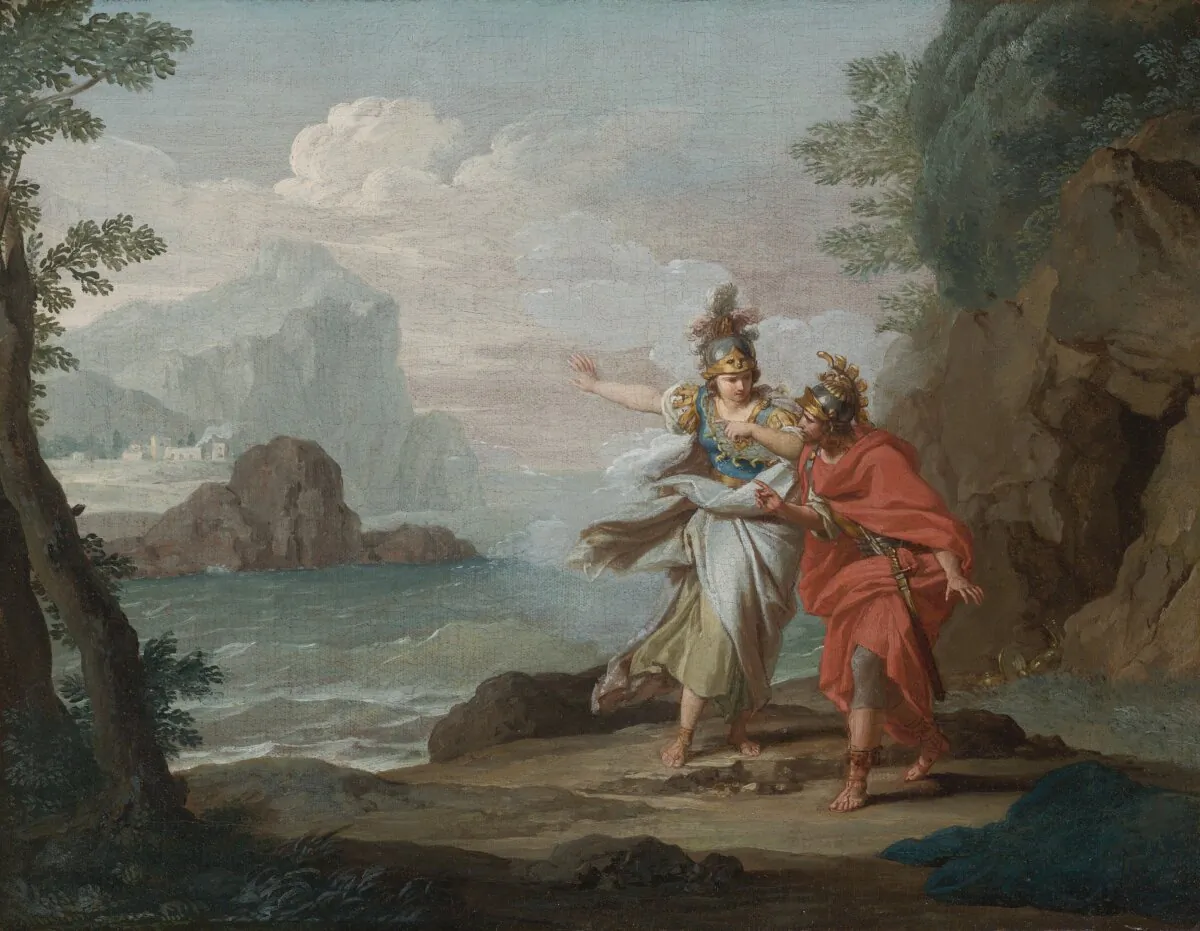
The friend–foe dichotomy is all-encompassing but only insofar as earthly matters are concerned. If there are two main gears—friend and foe—turning in the clock of human affairs, there is still someone winding the clock and deciding what time it is. In “The Odyssey,” this is clearly the goddess of wisdom, Athena, who decides that it is time for Odysseus to go home. She is there every step of the way, aiding and regulating Odysseus, even to the last line. Also, in the first few pages, it is clearly established that it is “the will of the gods” that Odysseus must finally return home.
As Americans, we may objectively claim that “the will of the gods” is on our side—as it was for Odysseus. We have a mostly functioning democracy that puts the fate of our rulers and their policies in the hands of the people. Through that mechanism, we, in a sense, acquiesce to whatever the will of heavenly forces decides. Meanwhile, the Iranian regime does not have democracy and tells the outright lie that people who die fighting in a holy war, even as terrorists and unprovoked aggressors, are martyrs who will go to heaven.
Also, Americans stand up for religious liberty around the world—not just for Christians, but for people of faith who cannot peacefully practice what they believe. This is the very first and most important point in our Bill of Rights. Meanwhile, many religions face persecution in Iran’s Shiite Muslim theocracy.
Even though society has changed significantly from ancient Greece to now, certain principles remain morally correct and transcend earthly goals. Those are the aspirations of most people in the world—basic freedom of thought, justice, and civility—and they are what America represents in the current war on Iran. Being clear on this, as Odysseus (thanks to Athena) was on his need to return home, could be the difference between success and failure for America in Iran and for the Iranian people.
Views expressed in this article are the opinions of the author and do not necessarily reflect the views of The Epoch Times.
 Friends Read Free
Copy
Facebook
Tweet
Friends Read Free
Copy
Facebook
Tweet