
Commentary
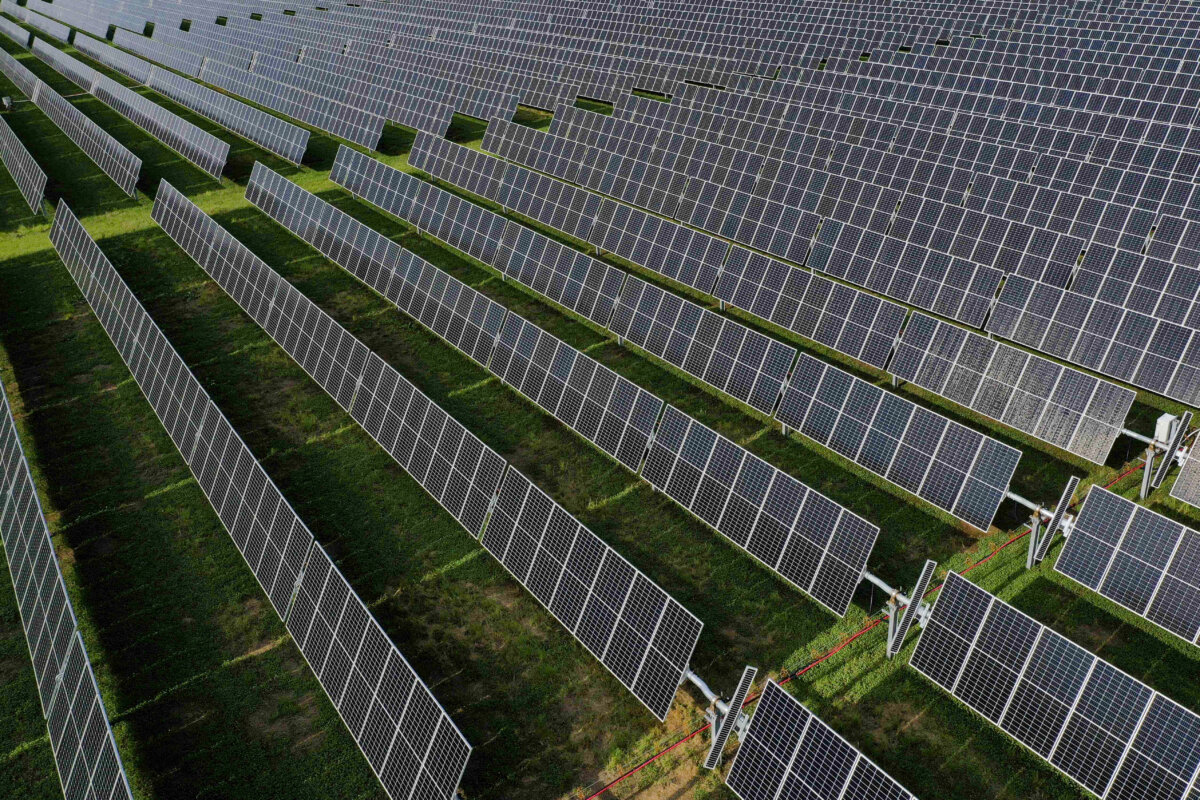
The United States has fully rebuilt its solar supply chain after decades of offshoring, with American factories now able to produce every major component of solar energy generation and storage, according to new data from the Solar Energy Industries Association (SEIA).
The national trade association noted in an Oct. 29 statement that Corning has started production of solar ingots and wafers at a new facility in Michigan, marking the last major piece of the solar supply chain to be reactivated in the United States. Corning, a materials science company, announced the milestone in its third-quarter financial results last week.
In another sign of America’s solar industry revival, First Solar, the country’s largest solar panel manufacturer, disclosed plans on Oct. 30 to build a new plant in the United States in 2026. The facility will finish production of panels started at the company’s overseas factories, with a capacity of 3.7 gigawatts (GW).
SEIA reported that 65 new or expanded solar and storage facilities have entered service in 2025, representing $4.5 billion in private investment. U.S. manufacturing capacity has grown in every major segment of the solar and storage supply chain since the end of 2024, according to the association.
Citing a “renaissance” in American solar and storage manufacturing, SEIA noted that, as of October, the United States had more than 60 GW of domestic solar module production capacity, up by 37 percent from December 2024. American solar cell production capacity has more than tripled during the same period, surging to 3.2 GW from 1 GW.
“This growth is a testament to the power of American innovation,” Abigail Ross Hopper, president and CEO of SEIA, said in a statement. “We’re building factories, hiring American workers, and showing that solar energy means made-in-America energy.”
The solar energy industry relies on a complex supply chain that includes modules (solar panels), mounting systems for panels, power electronics and grid technologies, and batteries. Each major segment of the supply chain breaks down further into an array of components; for example, the modules supply chain includes polysilicon, ingots, wafers, photovoltaic (PV) cells, and other parts.
America led the world in solar manufacturing until the 1990s, but solar dominance subsequently shifted to Japan, Germany, and finally China as the U.S. industry struggled because of offshoring. China’s global market share in all manufacturing stages of solar panels today exceeds 80 percent, according to the International Energy Agency. Notably, this figure is more than double China’s share of global PV demand, the result of major government investments leading to overcapacity.
China’s rise as a solar manufacturing power has helped spur American policies to reshore solar production with the goal of strengthening U.S. competitiveness and energy security. The Inflation Reduction Act, signed into law in 2022, allocated about $369 billion to support clean energy technologies and climate-related programs, including tax credits for solar projects.
“The Inflation Reduction Act took on the economic and national security challenges posed by China’s unfair industrial subsidies and the decades-long decline in U.S. manufacturing,” reads a May report prepared by Democratic members of the U.S. Congress Joint Economic Committee.
President Donald Trump and congressional Republicans have acted to roll back various energy and manufacturing tax cuts in the Inflation Reduction Act. The One Big Beautiful Bill Act, signed in July, features a renewed focus on fossil fuels, including expansion of oil and gas production on federal lands and waters, while sunsetting tax credits for wind and solar projects.
Secretary of Energy Chris Wright has argued that decades of federal subsidies for intermittent energy sources such as wind and solar have resulted in higher electricity prices and a more unstable power grid. More than 75 percent of U.S. electricity is generated by natural gas, nuclear, and coal—sources that supply power 24/7 regardless of weather conditions, he noted.
Despite the controversy over federal funding, private investment and corporate demand continue to drive the expansion of the solar industry. Cloud providers are a growing source of demand, funding new solar farms or contracting with solar services providers to help power their data centers. Roughly half of the new U.S. electric generating capacity planned to come online this year will be solar, according to an analysis in August by the Energy Information Administration (EIA).
The falling cost of solar energy generation is a key factor enabling the buildout of new capacity in the United States and could reduce the importance of government support.
“Solar PV LCOE [levelized cost of electricity] is lower than natural gas combined-cycle LCOE on average and, in most regions, even without the tax credit,” reads an April report by the EIA.
LCOE measures the estimated cost of electricity generation over the lifetime of a system.
The drive to restore American self-sufficiency in solar power is part of a reshoring trend that has seen significant investments in U.S. manufacturing in sectors such as semiconductors, industrial equipment, chemicals, automative, and aerospace. More than 2 million jobs driven by reshoring and foreign direct investment have been announced since 2010, of which 1.7 million have been filled, according to a report by the nonprofit Reshoring Initiative.
Views expressed in this article are the opinions of the author and do not necessarily reflect the views of The Epoch Times.
 Friends Read Free
Copy
Facebook
Tweet
Friends Read Free
Copy
Facebook
Tweet