Commentary
About 20 years ago, when I was married to my first husband, his brother—and one of my closest childhood friends—went to federal prison for marijuana. In full honesty, we were all in the marijuana industry at the time. We operated inside California’s laws as they stood then; he stepped outside of them.
When he went away, I took his parrot, Reggie. I had never owned a parrot and didn’t fully understand what that responsibility meant. It simply felt like the right thing to do, one of many responsibilities I was taking on for him while he was gone.
What I did not understand was that parrots are not solitary creatures. They are flock animals—socially complex, emotionally intelligent, wired for bonding. They do not do well alone.
So we got Reggie a companion. Her name was Lola. Lola promptly flew away.
When we finally gave up looking for her, we began searching for another companion for Reggie. That search led us to Mikey.
Mikey was a green-wing macaw who had worked Venice Beach in the ’90s, perched on a rollerblading photographer’s shoulder while tourists paid for pictures. He and another macaw named Sarge had even appeared in the background of “L.A. Story.” The two birds—both male—had bonded deeply.
When parrots bond to other parrots, they often become less manageable for business. Mikey had been locked in a garage while Sarge continued working. When we went to see him, Mikey screamed for Sarge, and Sarge screamed back. It was heartbreaking.
The owner wanted $1,500. His feathers were plucked, and he was older. I thought the price was absurd, and we left.
The next morning, I walked into the bathroom where my husband was showering. He was crying. “I can’t get my brother out of prison,” he said, “but I can go get that bird.” We went back for Mikey.
Two days later, a neighbor returned Lola. Just like that, we were bird people.
Mikey never stopped calling for Sarge, so we found him a female macaw. Her name was Yoshimi, a military macaw somewhere in her mid-teens. It took years, but eventually she and Mikey bonded. They preened each other, laid eggs, and settled into a partnership that felt as close to natural as captivity allows.
Mikey died in 2023, likely in his late 40s or early 50s. The vet had warned me when I adopted him that he might not live long, but with changes to his diet and environment, he outlived expectations.
When he died, it was sudden. A stroke or seizure—it happened quickly. Yoshimi stood over him with her wings open as his body failed. She guarded him until all the life had passed out of him. Then she nudged him again and again, as if asking him to rise. For hours, she remained there, refusing to move.
Eventually, she stepped aside and allowed us to bury him.
You do not stand vigil like that without some awareness of loss.
Over the years, I unintentionally became an informal bird rescue. I built larger aviaries. People surrendered parrots when they realized how long they live and how demanding they are. Parrots often pass through multiple homes in their first decade of life. Even I did not fully understand the magnitude of the commitment when I began.
This winter, during a hard freeze, something changed. Despite plastic walls and heaters, the dry cold damaged Yoshimi’s beak. It cracked and broke off.
At the vet, my husband quietly wondered whether this might be the end. She is in her 40s. But the vet said she was remarkably healthy and could live another 25 years—if we hand-fed her until the beak regrew.
Six months, maybe more.
I have four young children, a farm, a restaurant, and very little idle margin. There was a real moment when I considered saying it had been a good run. I prayed about it. Putting her down did not feel right.
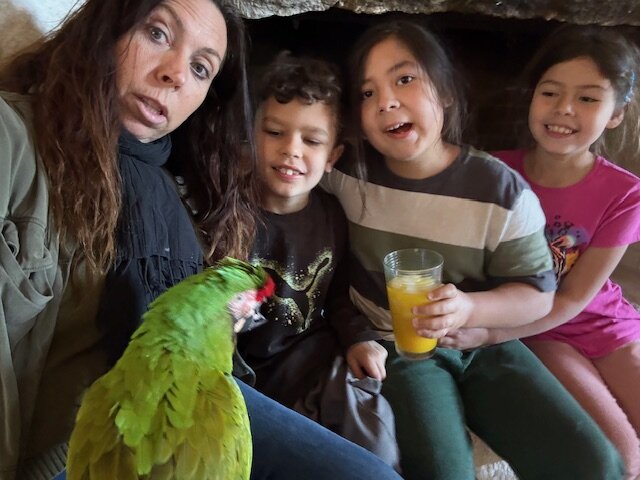
So we surrendered our dining room table to a macaw.
What has fascinated me is not the inconvenience but the transformation. For more than 20 years, Yoshimi was independent. Friendly, yes—she tolerated scratches—but she was not cuddly or needy.
Now, she cannot climb. She cannot eat without help. She is entirely dependent.
And her personality has shifted.
She presses her head under my chin. She reaches for me with one claw when I walk past. She leans into my side and rests there. This is not a projection; I have known this bird for decades. I know her baseline.
In the wild, a flock would not nurse her back to health. A macaw that cannot eat would not survive long.
But this is not the rainforest.
In captivity, her flock includes humans—humans who have surrendered their table and their time so she can live. Whether we call it intelligence or relationship, she seems to recognize the shift. Instead of lashing out in fear, she has softened.
It feels like gratitude.
Three of the original four parrots who began this chapter of my life are now gone. Reggie was taken by a hawk. Lola died from a prolapse. Mikey died beneath Yoshimi’s guarded wings. Yoshimi alone remains, a living thread connecting the woman I was 20 years ago to the woman I am now.
It turns out that parrots and humans both do better in a flock. In this season, her flock is more human than bird.
Humans, too, have drifted from our nature. We prize independence. We scatter from family. We isolate behind screens. We forget that we were built for shared burden.
When one member of the flock is weak, someone else carries more.
Whatever comes at us—illness, loss, strain, aging—we do best when we remember to tend our flock. Even if that flock looks different from what we imagined. Even if, for a season, it is a green bird at the dining room table, reminding us that surrender is not weakness and that love sometimes looks like staying when it would be easier to let go.
Views expressed in this article are the opinions of the author and do not necessarily reflect the views of The Epoch Times.
 Friends Read Free
Copy
Facebook
Tweet
Friends Read Free
Copy
Facebook
Tweet