Commentary
Chinese consumers are buying gold at a pace that has stunned even seasoned market watchers.
Retail investors purchased 432 metric tons of gold last year alone—a 28 percent jump from the year before, and fully one-third of all global gold bar and coin purchases. In the first eight months of 2026, China’s gold imports have already topped 1,000 metric tons.
This isn’t speculative mania. It’s a flight to safety by a population that has systematically run out of places to put its money, and a regime that may be quietly preparing gold as a weapon against the dollar itself.
The Housing Wealth That Went Away
For two decades, real estate was where Chinese families parked their savings. Property accounted for nearly 70 percent of household wealth in China.
That wealth is fast evaporating.
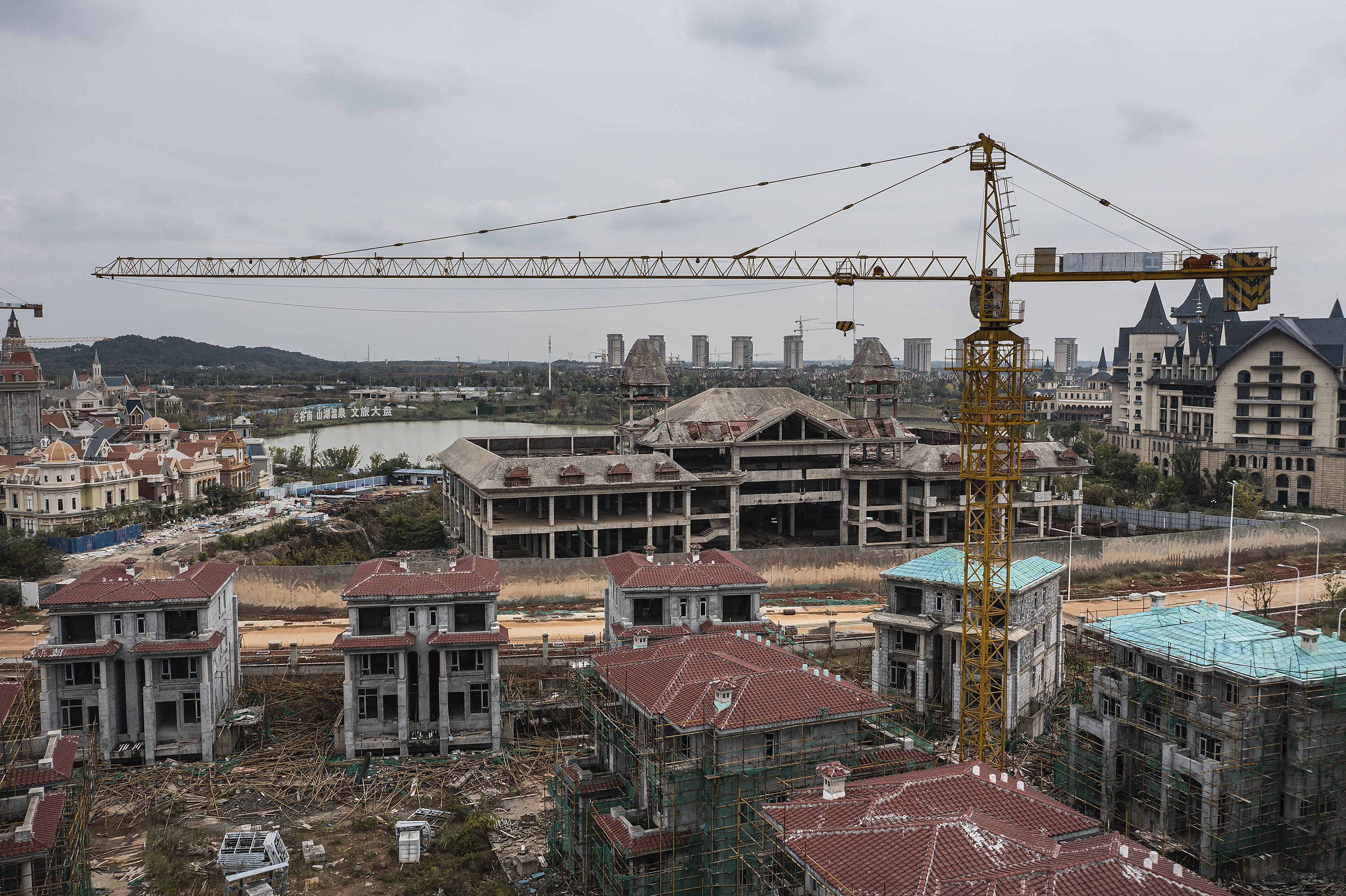 An aerial view shows the Evergrande Wuhan culture-oriented travel city left unfinished amid a liquidity crisis on Oct. 18, 2021. (Getty Images)
According to Bloomberg Economics, every 5 percent decline in home values wipes out roughly 19 trillion yuan—about $2.7 trillion—in household wealth.
When the largest store of family wealth in the country is bleeding out month after month, families go looking for something that can’t be built into oversupply.
A Stock Market Rigged for Beijing’s Own
The stock market is an obvious alternative for Chinese investors, but it too is tainted. Beijing has spent the past year prosecuting a wave of insider trading and manipulation cases, placing at least 21 controlling shareholders, chairmen, and senior executives under investigation in the first half of 2026 alone.
Regulators issued a record 661 penalty decisions last year and collected more than 15 billion yuan in fines and illicit profits. Investigations even reached the former chairman of China’s own securities regulator.
The deeper problem isn’t the fraud Beijing prosecutes, but that fraud itself is built into the system’s architecture. China’s stock markets function as an extension of state policy, with the Chinese Communist Party (CCP) using listings to prop up favored state-owned enterprises while keeping the largest, most strategically sensitive tech companies entirely out of foreign audits.
A U.S. congressional committee has separately documented coordinated “pump-and-dump” schemes that CCP-linked networks use to defraud American retail investors, exploiting the very information asymmetry and insider access that ordinary Chinese savers face at home every day.
When the house always seems to know which way the cards are stacked, why would anyone without connections to the CCP sit down at that table?
A Paycheck That Buys Less Every Year
Meanwhile, the paychecks that might otherwise fund other investments are stagnating amid falling prices.
China has now logged roughly 10 consecutive quarters of deflationary pressure, the longest such stretch since the country’s transition to a market economy in the late 1970s. Urban unemployment climbed to 5.3 percent in August, the highest reading since March, while youth unemployment (ages 16 to 24, excluding students) sat at 18.9 percent the same month.
Stagnant wages, a wrecked property market, and the absence of a real social safety net have left Chinese households too anxious to spend and too anxious to trust paper assets of any kind.
The World Is Closing Its Doors, Too
But China’s troubles aren’t confined within its borders.
Trading partners that once welcomed Chinese exports and investment are now actively pushing back. The European Union’s trade deficit in goods with China rose from 306 billion euros in 2024 to 360 billion euros in 2025, and is on pace to reach 400 billion euros this year.
It’s gotten so bad that EU officials have formally labeled the trade gap with China a “strategic challenge.” Brussels has responded with new anti-circumvention tariff mechanisms specifically designed to stop Chinese companies from routing goods through third countries to dodge existing duties.
What’s more, foreign capital is fleeing China.
Annual foreign direct investment (FDI) into China peaked at $189 billion in 2022; by 2025 it had collapsed to an estimated $104.66 billion, the lowest level since 2010. Cumulative FDI through the first five months of 2026 was down another 8.6 percent year-over-year, with Western investors leading the retreat.
Fewer factories, fewer joint ventures, and fewer foreign-funded jobs mean fewer investment opportunities of every kind for ordinary Chinese citizens and the businesses that might otherwise employ them.
Beijing’s Golden Endgame
Squeezed from every side, Chinese households are doing exactly what the Party itself has been doing for nearly two years running: buying gold.
The People’s Bank of China (PBOC) has extended its gold-buying streak to at least 21 consecutive months, lifting official holdings to roughly 2,346 metric tons, according to the World Gold Council. That’s about 8 percent of total reserves, up from a historical norm well below 5 percent.
This is not simply prudent diversification. Rather, analysts describe it as the foundation for a gold-backed yuan designed to chip away at the dollar’s dominance of the global financial system.
One financial strategist from Gold Mountain Assets Management put it plainly: “Both the central bank and private investors are diversifying their reserves and savings towards an asset with no counterparty risk, as part of a broader long-term wealth preservation strategy.”
Beijing has already built out gold-backed settlement mechanisms for trade with Russia and Iran, a Shanghai gold-trading hub, and a benchmark gold price index for Asian trading hours. It’s all part of what one analysis calls “one insurance policy, three moves”: limiting the yuan’s value, buying the metal, and constructing payment channels that route around the dollar entirely.
Some analysts go further still, speculating that Beijing may eventually reveal audited gold reserves far larger than currently disclosed, using the surprise to launch an internationally tradable, gold-indexed offshore yuan. Such a currency would compete directly with the dollar for global reserve status, even while the domestic currency used by everyday Chinese citizens remains tightly controlled.
For now, however, the yuan remains a bit player on the world stage, accounting for under 3 percent of global SWIFT payments, compared to the dollar’s 51 percent. But every ounce added to the PBOC’s vaults is a brick laid toward a financial architecture that no longer depends on Washington’s goodwill or its sanctions.
A ‘No Confidence’ Vote in the System
What’s unfolding in China right now is a quiet referendum on the CCP’s entire economic model. Real estate, once the bedrock of family wealth, is gone. The stock market is a casino tilted toward the politically connected. Wages are flat while prices grind sideways to down.
Meanwhile, the world beyond China’s borders is shutting doors that Beijing spent decades prying open. And the regime that created every one of these conditions is now hoarding the one asset that has outlasted every currency and every dynasty in human history.
In their own way, both bets are no-confidence votes in the system the CCP has created.
Views expressed in this article are the opinions of the author and do not necessarily reflect the views of The Epoch Times.
 Friends Read Free
Copy
Facebook
Tweet