
Commentary
As I write this, I am being told that I may need to replace a large, modern, perfectly functional septic system on my ranch because members of the public visit the property. Nobody is claiming that the system has failed. Nobody is claiming that it has caused harm. Yet because of how the regulations are written, I may be expected to absorb a cost approaching $80,000. The official enforcing the rule is not a bad person. Most of the bureaucrats I encounter are simply doing the job they have been assigned. What concerns me is the philosophy behind the system and the priorities it reveals.
The experience has forced me to think about property rights. Not the way politicians talk about them, but what they actually mean in practice. We often discuss property rights as though they are about permits, setbacks, zoning maps, and paperwork. Increasingly, however, it seems that property rights mean the government’s ability to tell you what you can do on your land while offering far less protection from what others may do that affects your land.
For 12 years, I lived in Knollwood Country Club Estates in California. At the time, I considered it a luxury. The fairways were beautiful, the landscaping was immaculate, and homes along the course carried a premium because of the view. Years later, I learned more about the chemicals commonly used to maintain those perfectly manicured landscapes. Research has raised concerns about links between certain pesticide exposures and neurological diseases such as Parkinson’s. Whether every study proves correct is not the point. The point is that I paid extra to live next to something that may have carried risks that I never fully understood, and those risks were not contained neatly within property lines.
The same question appears in agriculture, industry, and increasingly in the debate surrounding data centers. A recent Yale study found an association between higher cancer rates and counties with large concentrations of industrial livestock operations. Along portions of the Mississippi River corridor, communities have spent decades raising concerns about pollution in an area now commonly referred to as Cancer Alley. Across rural America, residents are debating the impact of massive data centers that operate around the clock and consume extraordinary amounts of electricity and water. Whether every concern ultimately proves valid is not the central issue. The larger question is who bears responsibility when the impacts of one property extend beyond its boundaries and affect someone else’s enjoyment, use, or health.
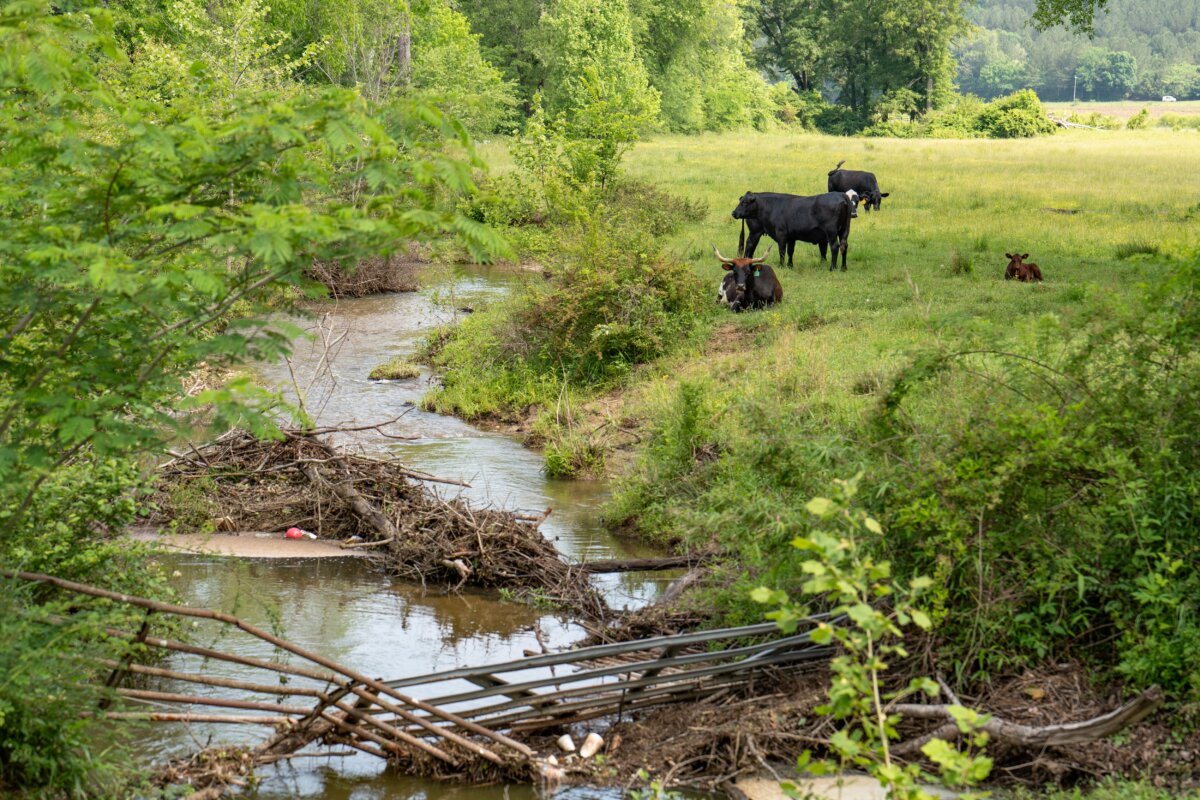
One person who has framed this issue better than almost anyone is Joel Salatin. For decades, Salatin has argued that property rights provide a remarkably simple framework for resolving many disputes. If my cows get onto a neighbor’s property and destroy his crops, I am responsible. If my livestock contaminate a neighbor’s well, I am responsible. If I damage someone else’s property, I should pay for the damage. Most Americans understand this principle instinctively because it feels fair.
What is interesting is how inconsistently we apply that principle. When the actor is a homeowner, a small business owner, a farmer, or a rancher, responsibility is usually clear. If I have the wrong septic system, it is my responsibility. If I violate a permit requirement, it is my responsibility. If I fail an inspection, it is my responsibility. Government knows exactly who should bear the cost and exactly who should be held accountable.
The picture becomes far less clear when larger institutions are involved. If pesticide drift reaches a neighboring property, responsibility becomes complicated. If industrial pollution enters a watershed, responsibility becomes complicated. If a facility creates noise, light, or environmental impacts affecting surrounding properties, responsibility becomes complicated. Layers of agencies, permits, studies, exemptions, and legal processes often stand between the affected citizen and meaningful accountability.
At the same time, regulations continue to accumulate in ways that shape entire industries. Consider Ventura County, where agricultural rules historically allowed one farmworker dwelling for every 40 acres. Whether intended or not, such a rule favors a particular kind of agriculture. It favors large-scale, mechanized operations where one worker can manage many acres. A diversified vegetable farm, greenhouse operation, or labor-intensive market garden may require many more people per acre. The regulation is not merely governing housing. It is shaping what kinds of farms can exist and what kinds of businesses can survive.
Then the restrictions begin stacking on top of one another. Limits on worker housing. Restrictions on RV living. Additional permits. Additional inspections. Additional compliance costs. Each rule may seem reasonable in isolation. Together, they determine who can afford to participate in the future and who cannot. Large organizations can absorb compliance costs with teams of lawyers, consultants, engineers, and regulatory specialists. Family farms and small businesses often cannot.
To be clear, I am not arguing that corporations should not have property rights. I believe that they should because I believe property rights matter. A data center has property rights. A factory has property rights. A golf course has property rights. A family farm has property rights. The issue is not whether large organizations have rights. The issue is whether government remembers who it exists to protect and whether the rules are being applied consistently.
The American system was founded on the idea that rights belong to people and that government exists to secure those rights. Yet much of modern governance seems focused on regulating the conduct of individuals while treating large-scale impacts as unavoidable costs of economic development. The individual must justify his septic system, his housing, his permits, and his business model. Meanwhile, risks imposed on entire communities are often met with studies, committees, negotiations, and discussions about economic necessity.
I am not arguing for a world without rules. I am arguing for a world in which responsibility is applied evenly. The person causing damage should bear the cost of that damage. The person creating pollution should be responsible for cleaning up the pollution. The person imposing costs on others should not be allowed to simply externalize those costs onto neighbors, communities, or future generations. That principle should apply whether the actor is a homeowner, a family farm, a multinational corporation, or a government agency.
The question is not whether we need regulations. The question is whether we have become so focused on regulating the individual that we have forgotten the purpose of government in the first place. The individual was never supposed to be an afterthought. The individual was supposed to be the point.
Views expressed in this article are the opinions of the author and do not necessarily reflect the views of The Epoch Times.
 Friends Read Free
Copy
Facebook
Tweet
Friends Read Free
Copy
Facebook
Tweet