
Commentary
In the heated debates over the status of Iran’s nuclear weapons program, some pundits try to make the case that even if Iran does get the bomb, “because we’ve learned to coexist with North Korea’s nuclear arsenal, we could do the same with Iran.” After all, both are rogue regimes spewing bellicose rhetoric and defying international norms by pursuing weapons of mass destruction amid sanctions and isolation. But by digging just a little, we see this is an apples-to-oranges comparison. North Korea, under Kim Jong Un, is a survivalist dictatorship focused on self-preservation, with no grand ideology to export, unless you count “life is miserable, then you cease to exist” as being a viable export. In sharp contrast, the Khomeinist regime is controlled by those promoting a transcendental “martyrdom culture” that incentivizes risk by promising eternal rewards. This makes Iran’s expansionist Islamic supremacism far more contagious and harder to deter than North Korea’s secular dreariness and abject poverty.
To understand the threat posed by Iran, we must first grasp the scale and context of the country itself. Iran is not only a much bigger country than North Korea—93 million vs. 26 million people, and 1.65 million vs. 123,000 square kilometers—but is the world’s leader in state-sponsored terrorism. While its economy has been impacted by sanctions, it still is the 24th-largest economy in the world, and its purchasing power parity-adjusted gross domestic product is nearly 50 times that of North Korea’s, $1.93 trillion vs. $40 billion. Further, Iran stands third in the world in terms of proven oil reserves, about 11 percent to 12 percent versus North Korea’s zero percent.
For 47 years, Iran has been ruled by a revolutionary strain of Twelver Shiism that views global expansion as a divine, completely non-optional mandate. Founded by Ayatollah Ruhollah Khomeini in 1979, this worldview holds that the Hidden Imam’s return will establish justice via militant anti-imperialism. Khomeinists see the world divided into the oppressed (mustazafin) and oppressors (mustakbirin), with the United States as the “Great Satan” and Israel as the “Little Satan.”
Their constitution mandates exporting the revolution, and they’ve done so relentlessly through the Islamic Revolutionary Guard Corps (IRGC), which arms and trains proxies such as Hezbollah in Lebanon, the Houthis in Yemen, Shia militias in Iraq, and the Palestinian Islamic Jihad in Gaza and beyond. Hezbollah’s 1983 Beirut, Lebanon, barracks bombing killed 241 U.S. Marines, and Iranian-backed attacks have claimed thousands of lives in the Middle East. Iran funds Hamas and Palestinian Islamic Jihad, fueling conflicts with Israel, and its drones and missiles have targeted Saudi oil facilities and U.S. forces. Iran’s Khomeinists have spent decades sowing chaos, death, and destruction, chanting “Death to America” and branding the United States the “Great Satan.” Allowing Iran to go nuclear wouldn’t just be risky—it would be suicidal for global stability.
As noted earlier, Iran’s Khomeinist leaders are all about advancing an Islamic supremacist drive for a global caliphate under Shia dominance, and having nuclear weapons would help supercharge their efforts. As senior research scholar Ely Karmon of the International Institute for Counter-Terrorism has pointed out, the nuclear program is deeply tied to this revolutionary agenda:
“Iran’s stated goal of exporting the Islamic revolution and leading the Islamic world, together with the wide range of support it provides various terrorist groups, such as Hezbollah and Hamas, would be vastly facilitated by a nuclear weapon, which would reduce the likelihood and scope of possible retaliation against Tehran.”
Karmon made the case that nuclear weapons would act as a “nuclear umbrella” that would not only deter attacks on Iran but would also grant it near-impunity to escalate its proxy wars, terrorist sponsorship, and ideological expansion.
Beyond funding terrorism, Iran is ideally positioned to shut down the waterway responsible for 20 percent of the world’s oil shipments—the Strait of Hormuz. To do so, Iran does not need a massive navy; instead, a combination of mines, hundreds of small attack boats, anti-ship missiles, and drones would be more than adequate for the job.
But Can an Air Campaign Stop Iran From Getting the Bomb?
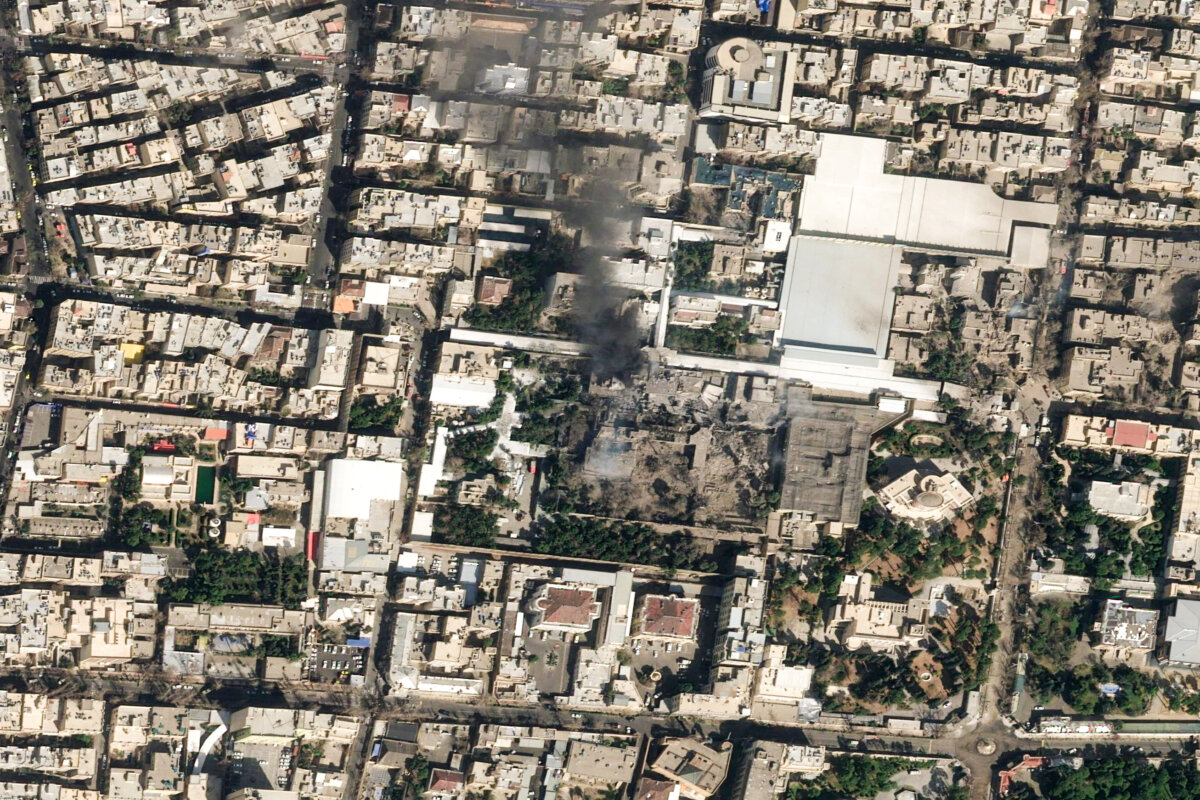
All this adds up to making the acquisition of nuclear weapons by Iran unacceptable, and as such, it does justify military action to prevent said acquisition. With that said, can a four- to five-week air campaign destroy Iran’s ability to get the bomb? Almost certainly not, as since the Midnight Hammer bunker-bomb attack of June, Iran has taken steps to make it even harder to take out its nuclear weapons program. U.S. Secretary of State Marco Rubio kind of admitted this when he recently said the U.S. airstrikes are about destroying Iran’s missile-building capability and did not mention destroying Iran’s nuclear weapons facilities.
Still, while the current air campaign will destroy some of Iran’s ability to build ballistic missiles, it cannot completely shut down Iran’s ability to build ballistic missiles, and, as has been the case with Iran’s nuclear weapons program, its response will be to move factories into deeply buried facilities that will be well-nigh impossible to take out even with conventional bunker-buster bombs. Ultimately, as long as Khomeinist Islamists remain in power, Iran is going to continue to build ballistic missiles and will almost certainly get the bomb. How long that will take is anyone’s guess, but I personally believe that Iran is closer to the bomb than what we have been hearing from official sources and that the current attacks reflect that reality.
Air Strikes Are More About Regime Change Than Anything Else
However, while the attacks are only convincing the remaining Khomeinist leaders of the need for the nuclear weapons they are planning on getting, come hell or high water, they have been successful in killing key Khomeinist leaders, weakening, at least temporarily, the Khomeinist hold on Iran. Given that polling shows that Khomeinists are actually a minority that has retained power through ruthless and brutal application of power, which was recently seen with the slaughter of tens of thousands of their own people, the real end goal and hope is that airstrikes will create an opportunity for the majority of Iranians to rise and remove the Khomeinists from power. To this end, the airstrikes are also being used to destroy and suppress IRGC forces.
Regime Change or Boots on the Ground Are the Only Way to Stop Iran From Getting the Bomb
At this time, we have no idea whether the Iranian people will take advantage of the opportunity the airstrikes are giving them or whether they will be successful in removing the Khomeinists from power. If they do, then there is an excellent chance Iran will not get the bomb, as the new leaders of Iran would almost certainly be willing to negotiate away Iran’s nuclear weapons program to achieve sanctions relief and get their oil fully back on the market, returning prosperity to their people.
However, if this does not happen, then the only remaining option that would guarantee Iran not getting the bomb would be boots on the ground, as airpower alone will not do the job. And that presents a whole different calculus than vastly less risky airstrikes.
Views expressed in this article are the opinions of the author and do not necessarily reflect the views of The Epoch Times.
 Friends Read Free
Copy
Facebook
Tweet
Friends Read Free
Copy
Facebook
Tweet