Commentary
A new regulation from China’s Supreme People’s Court, which went into effect on Sept. 1, has fueled widespread criticism online.
Titled “Interpretation II on the Application of Law in Labor Dispute Cases,” this document invalidates any agreements between employers and employees that allow them to bypass contributions to the social security system, known as “shebao.” Additionally, it grants financial compensation to workers who resign because of unpaid contributions.
While intended to protect employees, the policy—dubbed “mandatory shebao” by online critics—has fueled public outrage.
China’s social security system includes five types of insurance programs—retirement, health care, unemployment, workplace accidents, and maternity—as well as a housing fund. However, it faces significant challenges, including high costs, regional disparities, and a lack of transparency. Both employers and employees are required to contribute to most of these programs. Still, the contribution rates vary by province, leading to confusion. State-run media have rushed to defend the policy, but public distrust in this flawed system has sparked a strong backlash.
A Desperate Bid to Shift Economic Burdens
The new mandatory social security policy is being rolled out by Beijing amid a struggling economy and rising unemployment. In August, youth unemployment (ages 16–24) reached 18.9 percent, the highest level since revised metrics began in late 2023. Given this situation, the timing of the shebao mandate—which requires employers and workers to contribute to social insurance—seems disconnected from the current economic reality.
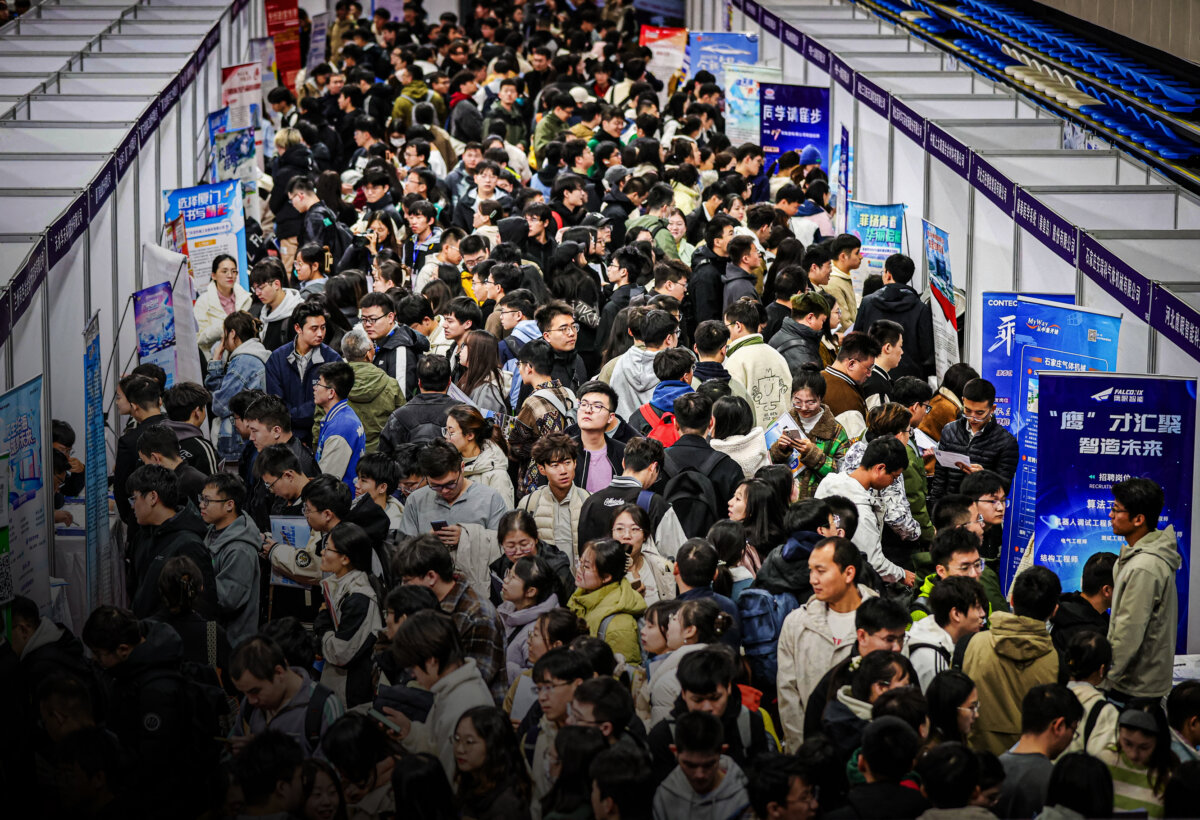
A rational government might do the opposite—reduce or defer social insurance payments to help both sides. In fact, Beijing has done so before.
In 2020, during the COVID-19 pandemic, the Chinese authorities enacted widespread waivers, reductions, and deferrals on social insurance contributions to alleviate corporate burdens and stimulate economic recovery.
So why the sudden reversal now?
The answer lies in China’s crumbling social security system, which has run deficits for more than a decade, propped up by massive subsidies. With government revenues shrinking and local finances strained, Beijing is eager to address the shortfall.
Online commentators have summed it up bluntly: “It’s not that you need shebao—it’s that shebao needs you.”
In short, this mandatory shebao campaign is less about protecting workers and more about forcing the public to shoulder the CCP’s financial crisis. It’s a sign of growing desperation—and of a regime losing control of its economic playbook, a situation worse than that during the COVID-19 pandemic.
High Social Insurance Costs Push Workers, Businesses to the Brink
China’s social insurance system is crushing workers and businesses with sky-high contribution rates, worsened by rapidly rising official average wages. These wages, set by local authorities, are used to calculate contributions, pensions, and benefits, but they often exceed what most workers earn, inflating costs.
A 2015 report by China’s state-run CCTV ranked the country’s social security contribution rates as the highest among 181 nations—double those of BRICS nations, triple those of Nordic countries, 2.8 times those of the G7, and 4.6 times those of China’s East Asian neighbors.
The Chinese regime’s relentless increases in the contribution base drive these costs. Per the Chinese-language newspaper Lianhe Zaobao, Shanghai’s minimum social security contribution base surged by 55.57 percent from 2019 to 2023, rising from 4,699 yuan ($660) to 7,310 yuan ($1,025). Beijing’s nearly doubled, from 3,613 yuan ($507) to 7,162 yuan ($1,005).
Yet as China’s economy stalls in 2025, wage growth has plummeted. According to Lianhe Zaobao, the provincial average wage growth last year was between 1 percent and 2 percent, a significant slowdown from previous years. Beijing saw its wage growth decrease from 4.11 percent in 2024 to 1.5 percent, while Shanghai’s growth stagnated at 1.03 percent for the second consecutive year.
With wallets thinning, the CCP’s demand for substantial shebao payments is pushing ordinary Chinese citizens to their breaking point.
China’s Social Security System Serves the Privileged
China’s social security system, intended as a lifelong safety net, has become a tool of inequality under the CCP, benefiting a privileged few.
The system categorizes recipients into three groups: retirees from government or public institutions, retirees from enterprises, and urban–rural residents.
The first category of retirees comprises former employees of state-run bodies, such as government offices, schools, hospitals, and other public-sector organizations—think civil servants, teachers, and doctors.
Retirees from enterprises include workers from state-owned enterprises, private companies, and factories, similar to blue- and white-collar employees in the private sector.
The last category is a catch-all for non-wage earners, including farmers, self-employed individuals, homemakers, and low-income urbanites without formal jobs.
Pension disparities are stark. In 2023, official statistics showed that 172.68 million urban and rural residents received an average monthly pension of 222.6 yuan ($31.20), with national spending of 461.3 billion yuan ($64.7 billion).
Although the CCP hasn’t released nationwide figures on retired public-sector and enterprise workers, a NetEase study published in July 2024 offers a glimpse of the disparity.
Citing China’s Ministry of Finance, NetEase reported that 21.99 million public-sector retirees received an average monthly pension of 6,164 yuan ($865), 119.97 million enterprise retirees got 3,088 yuan ($433.30), and urban and rural residents averaged just 217 yuan ($30.40), yielding a pension ratio of 1:2:0.07. This lopsided system directs benefits to a comparatively small group.
Chinese researchers point to resistance from vested interests as the main barrier to reform, while the CCP has exacerbated the divide, increasing the gap between the elite and ordinary citizens.
Conclusion
China’s social security system is riddled with problems, and public trust in it remains low. According to a financial report published on Chinese news portal Sina.com, as of March, more than 42 million people nationwide had stopped paying into social insurance—roughly equivalent to the entire population of eastern Fujian Province. Of these cases, 37 percent were due to employers’ failure to make contributions; 38 percent were self-employed or gig workers, and 31.7 percent comprised individuals aged 25 to 35.
Although the exact sources of these figures are unclear, they reflect the broader picture of China’s economic downturn and the growing pessimism among its citizens about the country’s future.
Now, the CCP’s push for mandatory social insurance is akin to kicking a hornet’s nest. Rather than fixing the deep deficits in the system, it has only provoked public anger and intensified social tensions.
Views expressed in this article are the opinions of the author and do not necessarily reflect the views of The Epoch Times.
 Friends Read Free
Copy
Facebook
Tweet
Friends Read Free
Copy
Facebook
Tweet