
Commentary
The latest jobs report brought better news than was expected.
“Private companies added a net 98,000 jobs in June after adding 122,000 jobs in May,” according to reports, while unemployment remained stable at 4.2 percent.
That’s not great, but it is suitable and stable, neither boom nor bust, and enough for recession watchers to believe that not much is happening of any concern.
At the same time, there are aspects of this report that raise genuine questions. They pertain to the very willingness of people to participate in economic life. It’s a problem especially on either end of the career spectrum, young workers and those older than 55.
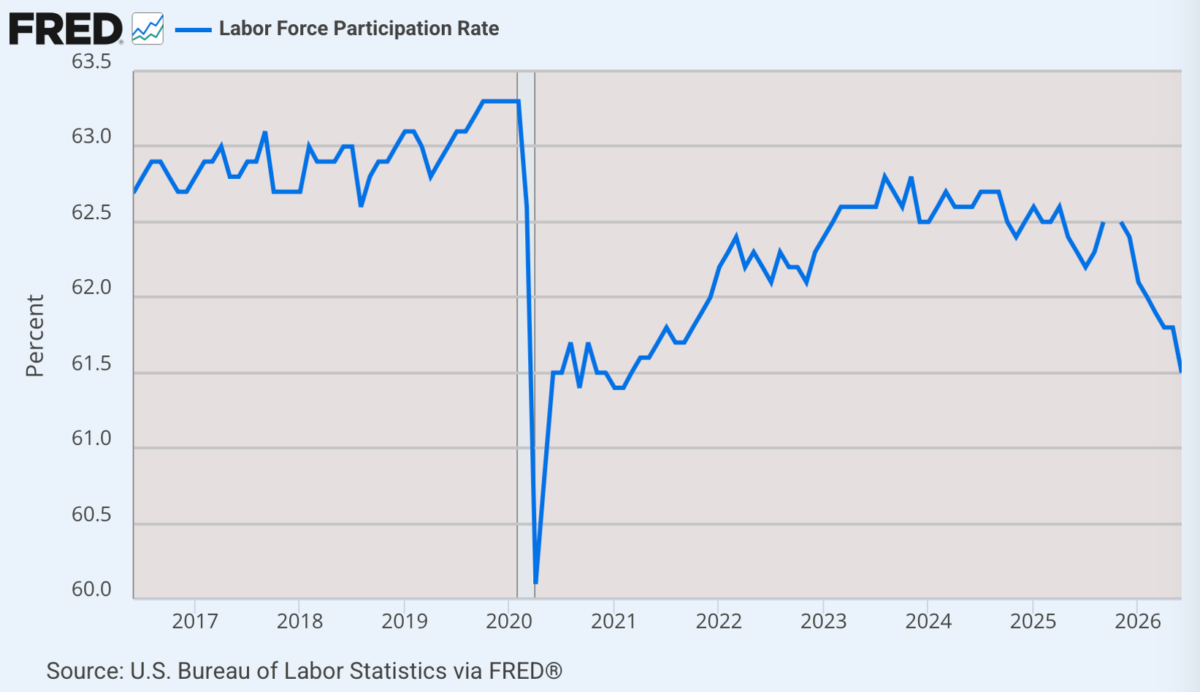
Labor force participation had hit 63.3 percent in January 2020. That’s not a record. The record was set 20 years earlier at 67.2 percent. It fell after the turn of the millennium. A recovery began in President Donald Trump’s first term. That lasted until the COVID-19 pandemic lockdown disaster of March, which led to mass dropouts by design.
Participation hit a low of 60.1 percent at peak disease frenzy and began to recover afterward. It appeared that we were on track to recover. Here is when the trouble began. Starting in August 2023, as inflation raged and life was not easing back into normalcy, a new fall began that has not stopped. Now we are hitting new lows for the period, coming in at 61.5 percent.
How does this compare historically? It’s very difficult to compare these numbers with pre-1980 numbers. That’s because the composition of the workforce changed dramatically after the late 1970s inflation gutted household income. If we think of the household as a unit—and we should, even if economists rarely think this way—it was more common than not in the before times that households would have one income stream. In 1950, only 20 percent of households with children younger than 18 had more than one income earner; today, it is more than 60 percent.
After 1985, mothers were sent to work and expectations began to change. This is the single most dramatic shift in the American standard of living, because it was no longer the norm that a husband and father could and would support a household on a middle-class income. It was no longer possible. The invention of the “professional working woman” as a hero who could do it all fundamentally transformed family life.
After that, labor participation was far higher, but not necessarily as a good sign for American prosperity. Instead, it reflected a kind of desperate clamor to keep up with social and economic ambitions, with a house, two cars, and support for the kids’ college education. The hedonic hamster wheel started turning and has not stopped.
No surprise, the divorce rate climbed. People were marrying later. The birth rate began to fall. Women’s expectations for adult life changed from the security of home to preparation for a career, while the kids and their interests fell through the cracks.
It seems like the lockdowns of 2020 broke this psychology. Many women were forced to stay home and become instant homeschool teachers, while husbands who could cobbled together remote work when possible and otherwise kept food on the table. That even seems to have changed the psychology of American work life.
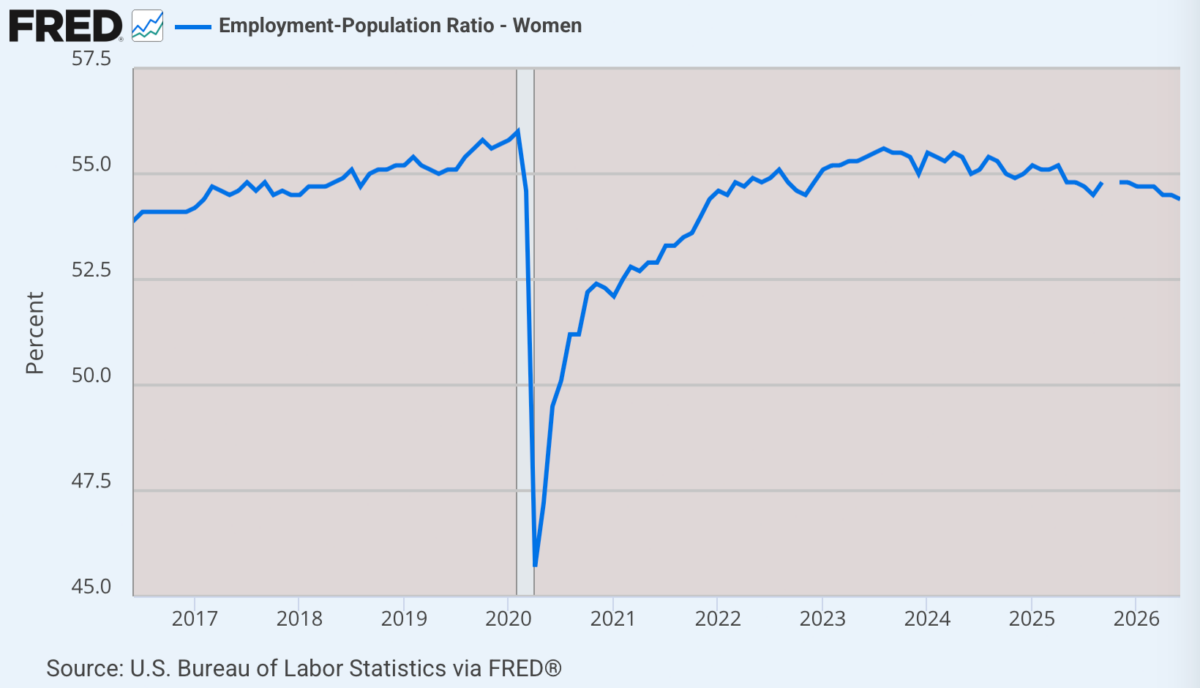
This had a notable effect on women, as might have been expected. Their worker population ratio has fallen to 54.4 percent from 56 percent and continues to fall.
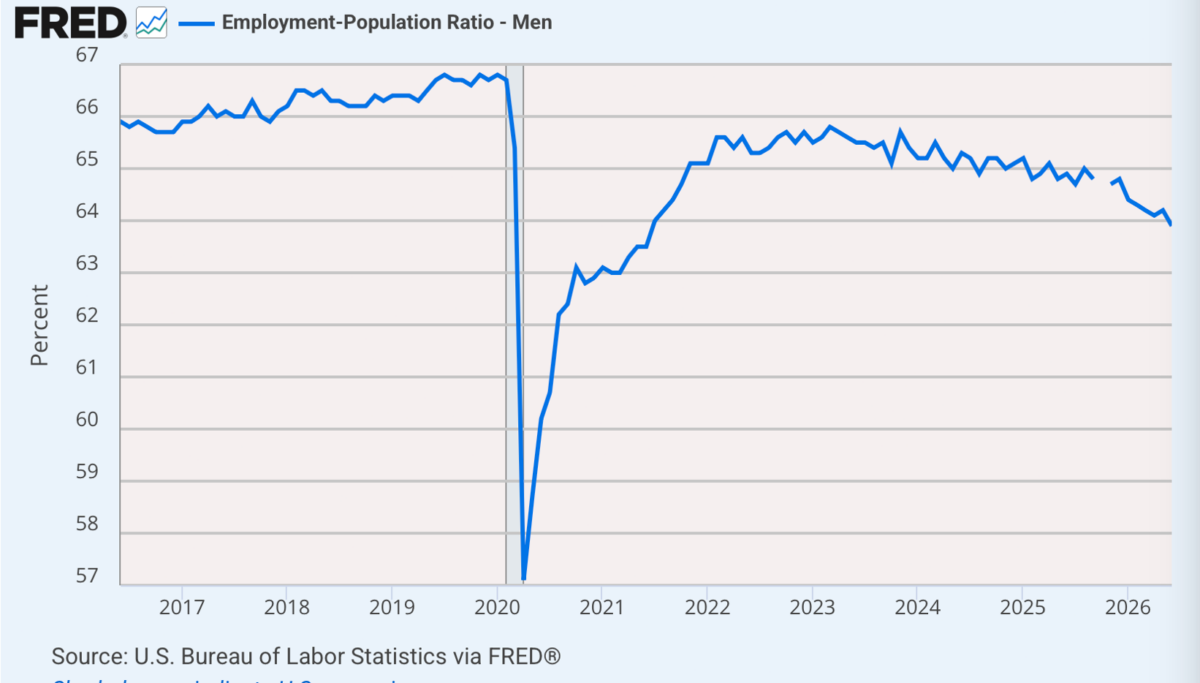
Oddly, the dropout effect has even more severely affected men, whose worker population rate was 66.7 percent before lockdowns and now stands at 63.9 percent. That’s a huge drop and the trend line does not look good.
The only group to have increased its amount of work after lockdowns are those aged 16 to 19, but even here there is an issue. In the 1950s, it was equally common that this age group would be working a job.
Now less than one-third have jobs, meaning that many kids in college will graduate without having the slightest bit of experience in the job market. That explains in part why they are having such a hard time gaining employment today.
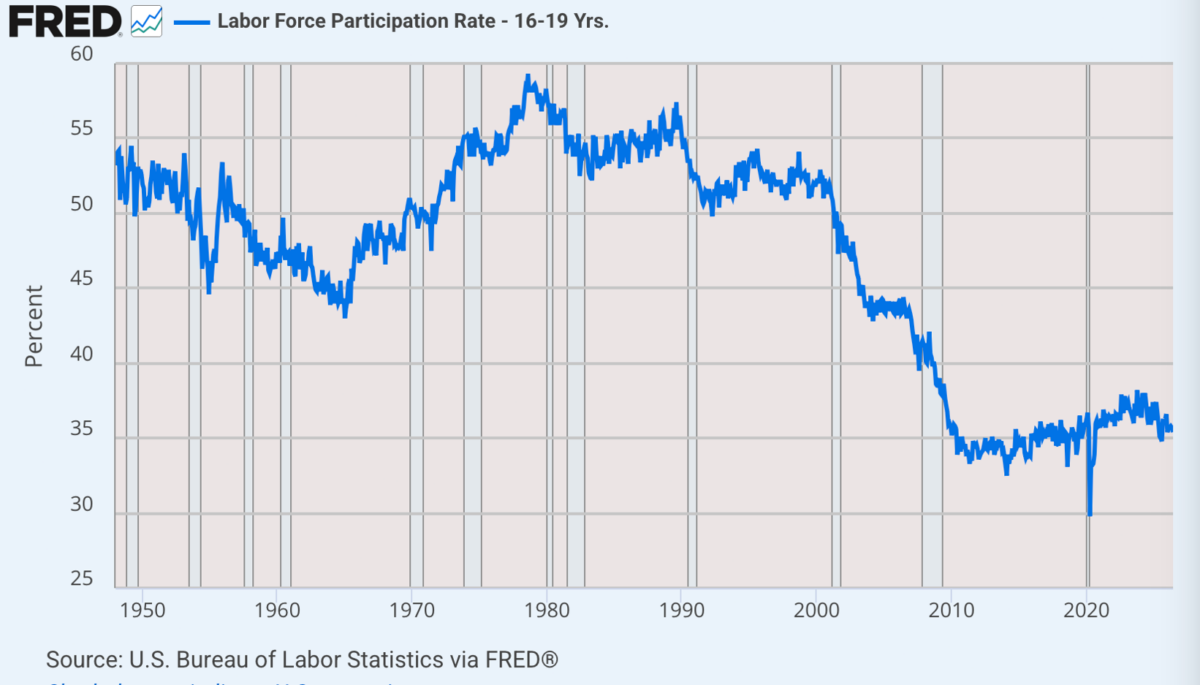
It’s absurd. In the heart of the most important learning years, society has made it nearly impossible for young people to work and get paid. We stick them in classrooms for years and give them a piece of paper that few employers respect at all. It’s no wonder they have a hard time adjusting and turn to human resources with every slight at the office.
Their work ethic has taken a huge hit, and this was made much worse for members of Generation Z, who were told to sit in their bedrooms and scroll the internet for two years.
The biggest hit to labor participation has come from those older than 55. Here we see the biggest change from the postwar years, in which 43 percent of people worked at a time when nearly every able-bodied male of that age held a job. Today we are down to 37.1 percent, which is an incredible drop.
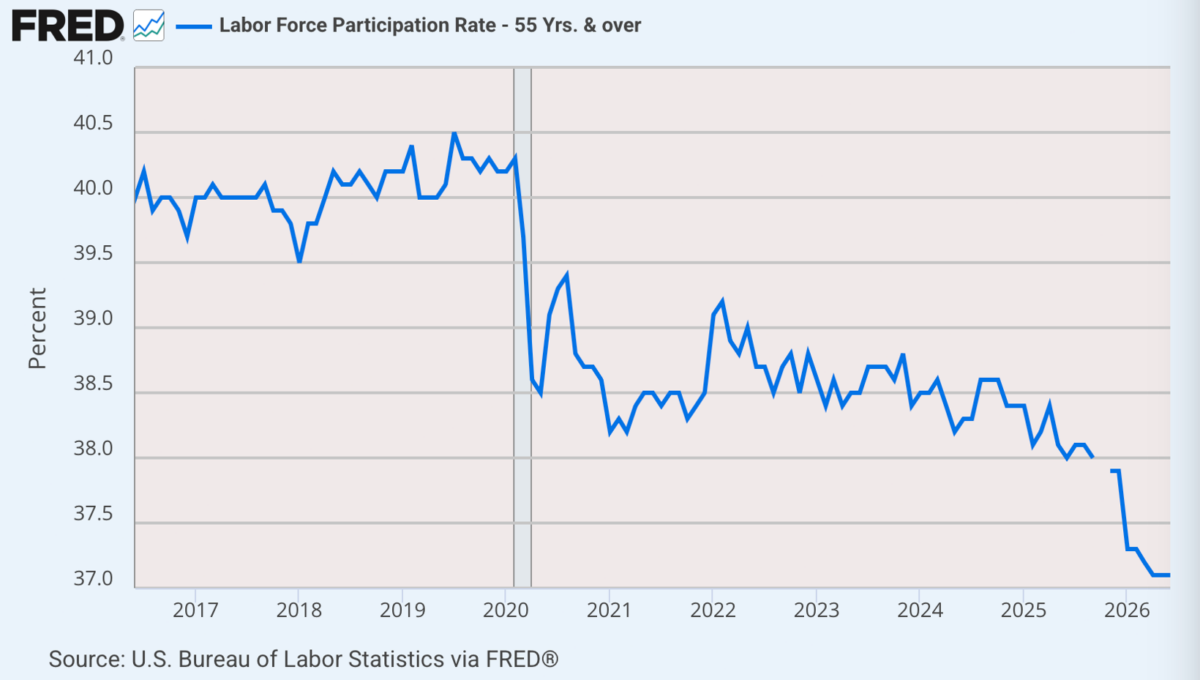
Why is this? Welfare, disability, or lack of interest stemming from demoralization of one or another type might be the main culprits. In general, it’s peculiar. These are peak earning years, with women most likely facing empty nests and men carrying vast professional experience. Why have they dropped out? Why are only 37 percent of Americans older than 55 holding jobs at all?
This reality is reflected in the broadest measure of unemployment, or U-6. After the economy got going again, this number fell to 6.6 percent but now stands at 7.9 percent. This suggests some genuine breakage in the labor markets.
Essentially, we have one in three working-age men who have left the labor force, mainly because of disability, the rates of which have skyrocketed by an additional 7 million people since 2021.
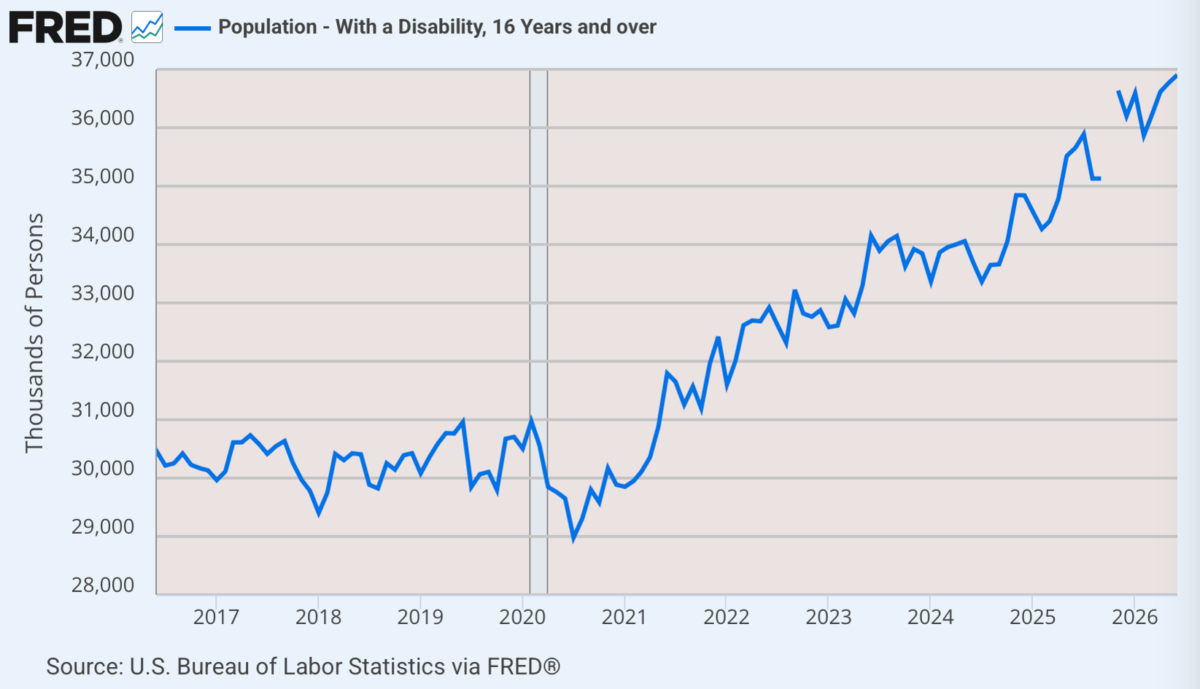
Nor can this be attributed to greater degrees of benefits or the rise of fraud, because they are surveys independent of benefits. These are people who are reporting themselves as disabled. At this point, journalistic convention requires that I not mention that 2021 was the year of the COVID-19 shot that turned out to be enormously dangerous to the population.
That said, we are not obeying convention here. The shot surely has something to do with it, but it is difficult to prove because the numbers and connections are extremely hard to find. They are mostly hidden behind walls in industry vaults. Not even government agencies have had full success in gaining access.
We might have a silent mass injury on our hands here. If not, it would be nice to know either way.
Human beings are the most valuable economic resource—not only their hands, but also their judgment, imagination, and willingness to take great risks. Machines cannot do this. With millions of people absent from today’s labor force, we are missing out on a major source of prosperity.
Meanwhile, labor markets are very sticky, and much of the reason traces to problems in the health insurance industry. Companies are required to provide it, but the expense is rising to the point at which many companies are reluctant to hire because doing so is too risky. The law needs to be changed—with the trigger for health insurance requirements moved from 50 employees to 500—but Congress is not in the mood. The Affordable Care Act is coming apart at the seams, and yet very few lawmakers know what to do about it.
More broadly, there are major problems affecting young people in their 20s who are trying to gain a foothold in labor markets. They are unprepared to do so for a whole variety of reasons. Since December 2021, we have seen a recession-level fall in new hires. This undoubtedly affects young people disproportionately to the rest of the population.
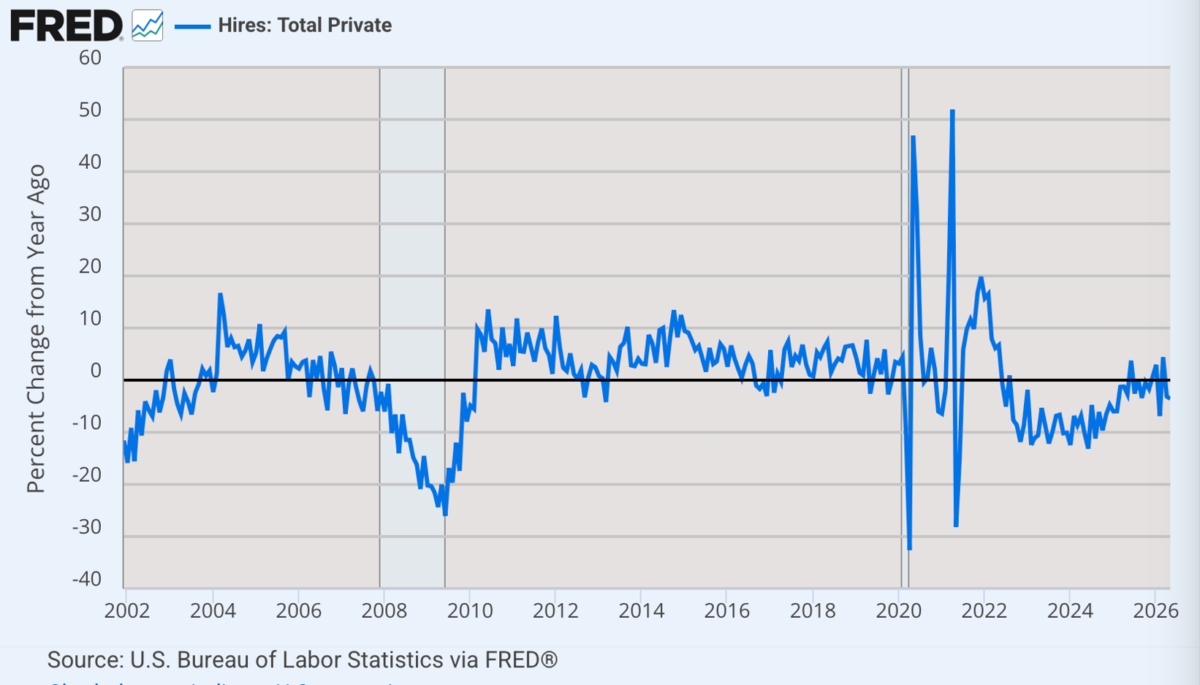
All these trends together amount to a kind of hollowing out of the workforce. We cannot blame artificial intelligence here, even if this makes a convenient scapegoat. The American jobs machine can come back to life quickly, but it is going to require major changes in policy and culture to cause it to happen.
Views expressed in this article are the opinions of the author and do not necessarily reflect the views of The Epoch Times.
 Friends Read Free
Copy
Facebook
Tweet
Friends Read Free
Copy
Facebook
Tweet