Commentary
For centuries, Roman armies had manned two long defensive lines along the Rhine and Danube rivers, keeping back the migrating tribes that longed to loot and plunder the cities of the empire. When holding the line failed, tribesmen were encouraged to settle down in the border areas and provide troops for Rome. As the fourth century ended, many of the empire’s best generals and most loyal soldiers were of barbarian extraction, but mistreatment of the tribes by Roman authorities and conflicting rivalries among tribal leaders, imperial officials, and ambitious leaders of the legions led to decades of turmoil and fighting.
In the year 395, a German soldier named Alaric became leader of the Visigoths, a people who had been admitted inside Roman borders after fleeing from the Huns. Under Alaric, the Visigoths wandered through the Roman Empire for years looking for a place to settle, battling other barbarians at times, at other times fighting Roman forces. In 396, the tribe pressed south into Greece and sacked Athens, leading the eastern Roman regime to hire them to battle western generals and to offer them land in the Balkans.
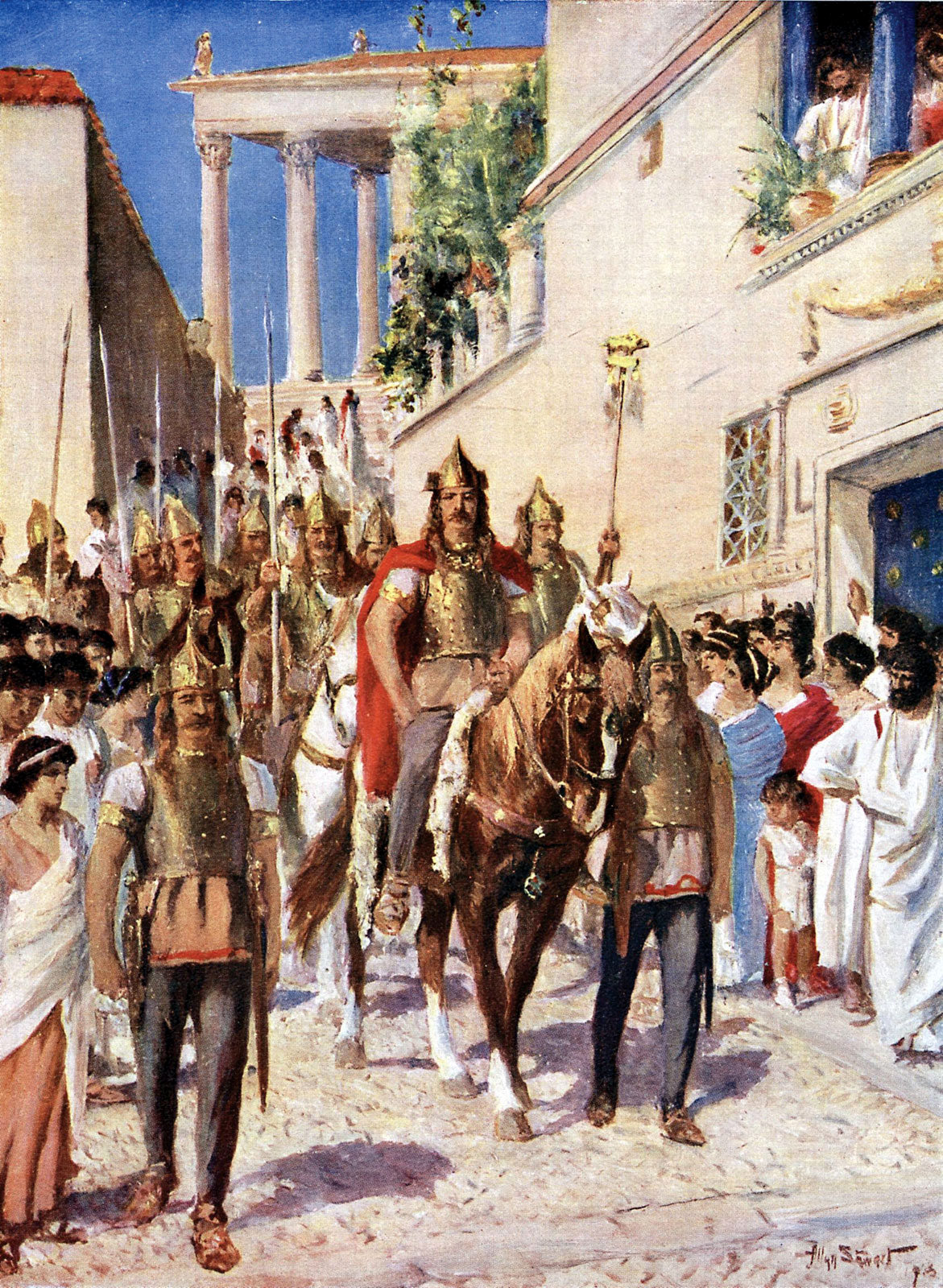
This solution worked well until 401, when a change of administration in Athens resulted in Alaric losing his official rank and his people being deprived of provisions. Coupled with an influx of other barbarians crossing the border, this prompted more battles and endless rounds of switching allegiances. Alaric found he could threaten Italy and be paid thousands of pounds of gold to go away—and he would have gone away and happily supported the Roman Empire had they given him a suitable title and agreed to feed his followers. Alas, Emperor Honorius was an incompetent leader who preferred raising chickens to governing sensibly, and Alaric was declared an enemy of Rome.
Alaric proved to be a cunning adversary, forcing Rome to fork over yet another ransom and even appointing, for a time, a puppet emperor to rival Honorius. In the summer of 410, the Visigothic horde under Alaric trudged down the Italian peninsula. The bribes, diplomacy, and military force that had kept the Goths at bay were now absent; Alaric had besieged Rome twice before and now that his extortionate demands (5,000 pounds of gold and 30,000 pounds of silver) were being rebuffed by Honorius (safe behind the marshes in Ravenna), he meant to take and loot Rome.
By this time, Rome was no longer a politically important city; the capital of the West was in Ravenna, and the East was governed from Constantinople. It had been bled dry of its wealth by earlier barbarian threats, but it was still a large and prosperous town that Alaric was intent on plundering.
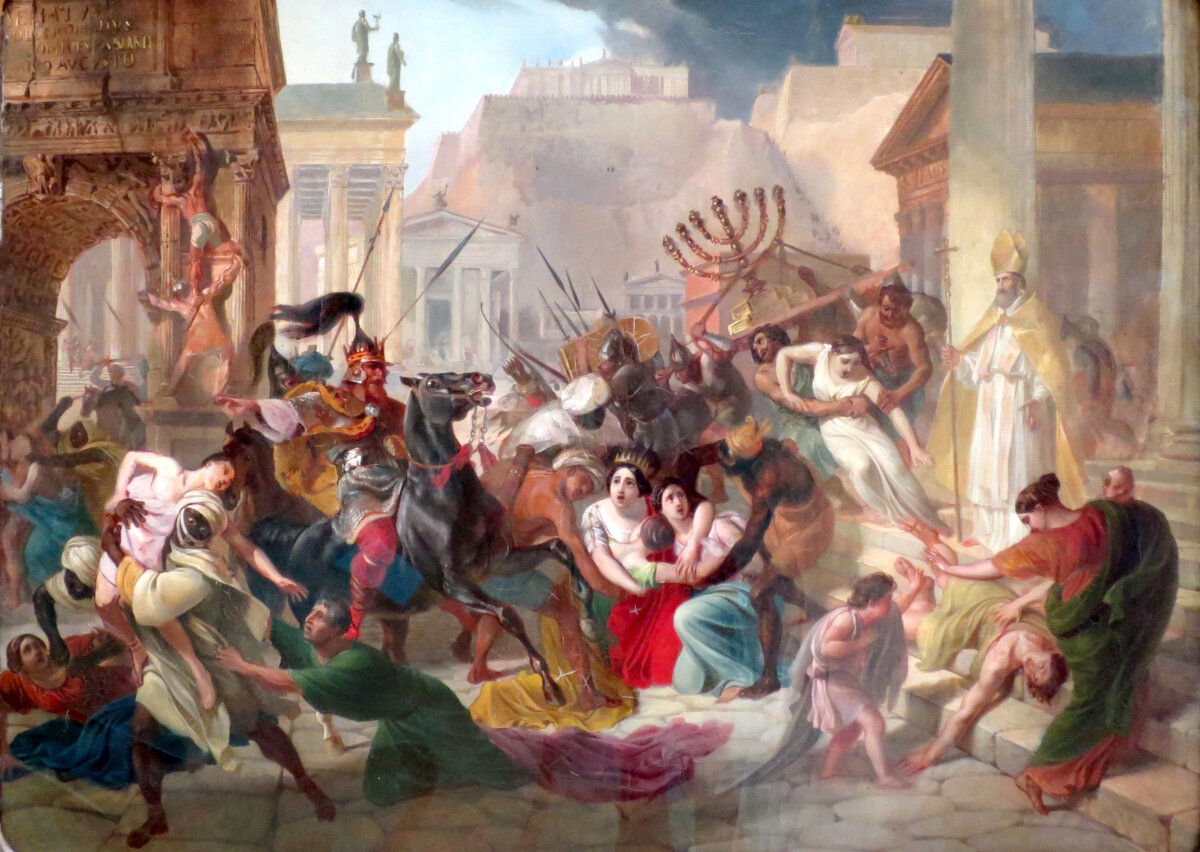
On Aug. 24, his troops entered the city—the first time Rome had been successfully captured by an enemy in over 700 years. The sack was thorough but not notably atrocious. The Visigoths were by this time Christians (though of the Arian variety, now out of fashion in Rome) and they allowed some churches to be used as sanctuary. Nevertheless, there were the usual few days of murder, rape, pillaging, and slave-taking before Alaric called a halt and his forces withdrew.
(Alaric would not long survive his conquest, dying of a fever a few months later. His people would eventually migrate north and settle in southern Gaul and Spain where they set up an independent kingdom in the ruins of the empire.)
Rome, in physical terms, would undergo worse treatment by invaders. In 455, the Vandals launched a much more harmful attack; in 846, 11,000 Arab raiders looted St. Peter’s Basilica; and in 1527, German troops, many of them Lutherans, sacked Rome in what was probably the most destructive attack the city ever endured. But the psychological effect of the fall of Rome in 410 was enormous. It was, said St. Jerome, as if “the city which had taken the whole world was itself taken.” It appalled the ancient world and led many to blame the adoption of Christianity for the destruction. This charge summoned forth St. Augustine’s epic “The City of God,” which not only rebutted such accusations but laid forth a Christian scheme for understanding all of history.
In the long run, the 410 attack would be overshadowed by the fall of the entire Roman Empire in the West. In 476, a barbarian general took the imperial crown from the last emperor, the young Romulus Augustus, and sent the boy home.
Views expressed in this article are the opinions of the author and do not necessarily reflect the views of The Epoch Times.