Commentary
As we approach the 250th anniversary of July 4, 1776, the sticklers of historical fact have a quick correction to make. It is this: The Declaration of Independence did not create the United States as we understand it. That didn’t happen until the Constitution was drafted and fully ratified a dozen years later. Why celebrate 1776 so much more than 1787?
It’s a good question. It forces Americans to recall their political origins, which is always a good thing. More deeply, it asks them to address the differences between the Declaration and the Constitution, the civic ideals of the one and the nuts-and-bolts layout of the other.
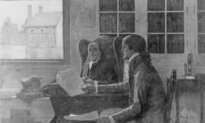
Thomas Jefferson’s opening paragraphs of the Declaration are masterful and high-minded. The other Founders chose this young man, only in his early 30s, to compose a first draft because he’d shown himself in previous writings to be an elegant composer of prose. He was not enlisted to express original thoughts or to show his brilliance, but to expound in eloquent and civilized phrases universal truths and political points. He did it well enough in the first part of the document, before getting to specific grievances leveled against the king, that the men who were entrusted to review the draft—mainly Benjamin Franklin and John Adams—didn’t push very many revisions. People in Europe, too, didn’t dispute much that the political philosophy voiced in section one; they saved most of their criticisms for specific claims of the grievances.
The Declaration didn’t design a government. The 13 colonies, although now declared entities independent of the Mother Country, maintained political independence from one another as well. Nor did the Articles of Confederation produce the unity of the federal government that exists today. That would have to wait for the Constitution.
Nevertheless, the Fourth of July has magical status. We do have Constitution Day, but it’s not so revered, and it isn’t hard to see why. The Fourth of July has the merit of an origin story. It was a first step, a risky one that might have ended with every signer declared a traitor and punished. They put everything on the line, and not for reasons of money and power, but for an idea, a hoped-for civic destiny, a special moment in history. They were challenging one of the great military forces of the time, but that wasn’t the only thing that made their resolutions extraordinary and brash. They were putting into practice liberal ideals as they had never been realized before. The Fourth of July started the process that brought our system of government to life.
The process was bumpy, to be sure. The Articles of Confederation failed. The Constitution was formed and approved out of compromise, debate, delay, and politicking, precisely the kind of concrete politics that the Declaration largely escaped. This is what makes the Declaration easier to memorialize. It’s why President Abraham Lincoln in the Gettysburg Address said “Four score and seven,” not “Three score and 16.” The Declaration announced that “all men are created equal,” while the Constitution allowed for slavery. The Declaration speaks of happiness, the Constitution of taxes and elections. The Declaration emphasizes the unity of all Americans, while the Constitution accepts the inevitable reality of factions.
So, yes, let the Fourth of July stand as the most important day in U.S. history. But let’s revive a custom that has slipped in recent times. In the old days, a particular ritual took place in every hamlet and town square. It wasn’t the lighting of fireworks or the grilling of hot dogs. People assembled for another reason: a public reading, word for word, of the Declaration itself, which was the best affirmation of what it said and why we honor the occasion. The words out loud, ringing with monumental import, composed 2 1/2 centuries ago but living today as much as any civic promise: Make them the center of celebration once more, on the steps of the state capitols and county seats, in schools and libraries, and at the dinner table.
Views expressed in this article are the opinions of the author and do not necessarily reflect the views of The Epoch Times.
 Friends Read Free
Copy
Facebook
Tweet
Friends Read Free
Copy
Facebook
Tweet