Commentary
Every June, the Chinese Communist Party (CCP) confronts a problem it cannot fully solve.
The tanks that rolled through Beijing and the machine-gun-toting soldiers from the Wuhan military district in 1989 are gone. Many of the students who filled Tiananmen Square are dead, imprisoned, or dispersed throughout the world. Nearly four decades have passed since one of the defining confrontations between liberty and dictatorship in modern history. Yet every year, the regime expends enormous effort censoring references to the events, restricting discussion, suppressing commemoration, and attempting to ensure that younger generations know as little as possible about what happened.
The question is straightforward. Why does one of the most powerful regimes in the world remain so fearful of an event that occurred 37 years ago?
The answer reaches beyond Tiananmen Square itself.
Every tyranny eventually discovers that controlling people is not enough. It must also control memory; it must be at the helm of history, turning it in any direction it chooses. The state must determine what can be remembered, what can be forgotten, and what future generations are permitted to know about their own history. This is one reason that civic and historical education are so critical to every civilization.
This is hardly a new phenomenon. The Soviet Union spent decades changing and deleting photographs; altering official histories; having students rip up parts of textbooks, suppressing information about famine and political purges; and erasing the memory of individuals who had fallen from favor. The purpose was not merely propaganda. It was political control. A population disconnected from historical memory is easier to govern than a population capable of knowing actual history.
George Orwell captured this instinct in “1984” when he wrote: “Who controls the past controls the future. Who controls the present controls the past.”
The CCP did not need to read Orwell to understand the principle.
It had already implemented it.
In 1966, Mao Zedong launched a campaign that essentially put China’s own history on trial. It wasn’t just a political purge; it was a deliberate tearing-away of the country’s civilizational roots. Under the slogan of smashing the “Four Olds”—old ideas, culture, customs, and habits—the regime turned everyday life upside down. Red Guards smashed ancient artifacts, burned libraries, and dragged teachers into the streets for public humiliation. It got dark quickly: kids turned on their parents, and students betrayed the very people who taught them, transforming centuries of tradition into immediate political liabilities. The destruction was not accidental.
A revolutionary regime seeking to create a new political order often regards history as a competitor. Existing traditions, inherited institutions, religious beliefs, cultural memory, and historical continuity all represent loyalties beyond the state itself. If the Party is to become the ultimate source of truth, alternative sources of truth must be weakened or eliminated.
The tragedy of the Cultural Revolution therefore extended beyond the physical suffering it inflicted. It was also an attempt to break the continuity of Chinese civilization and replace historical memory with revolutionary mythology.
Although Mao died in 1976, the Party’s fear of memory survived him.
Tiananmen provides perhaps the clearest example.
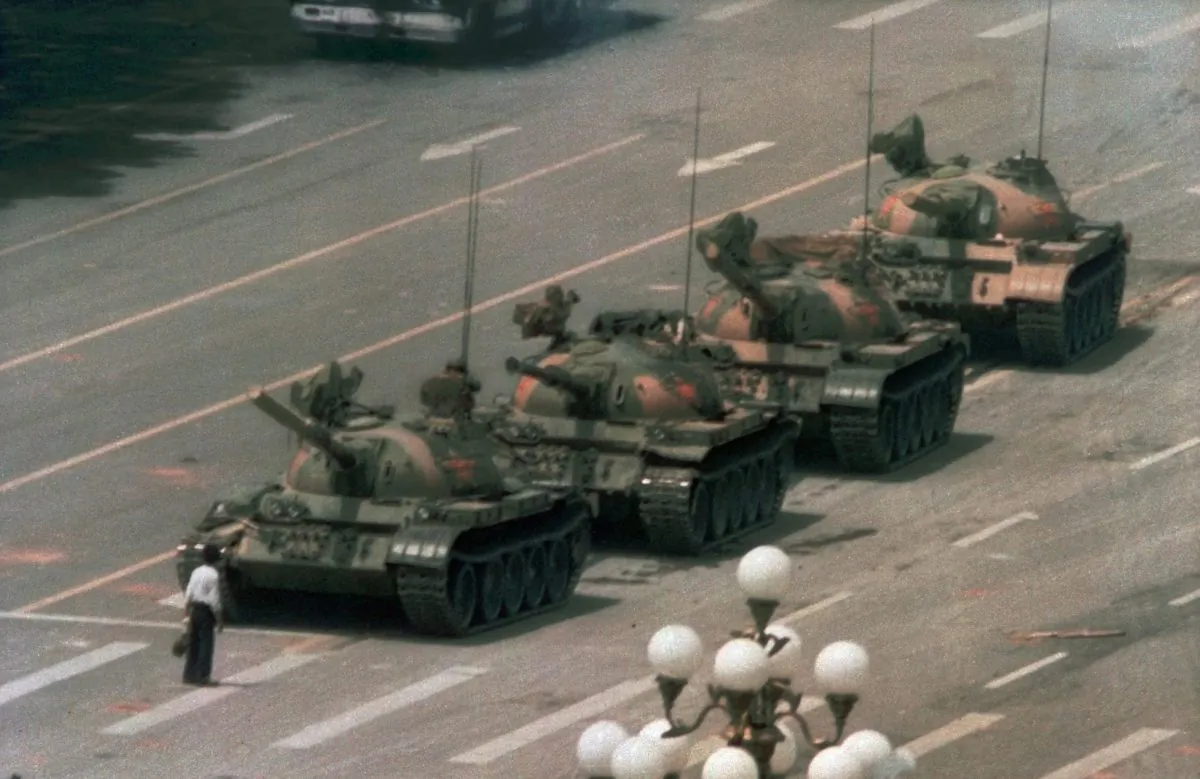
Western audiences often remember the famous image of a lone man standing before a column of tanks. The photograph deserves its place among the iconic images of the 20th century. Yet the larger significance of Tiananmen lies in the regime’s behavior afterward. The CCP did not simply suppress the demonstrations. It attempted to erase them from public consciousness.
The events themselves were not confined to Beijing. Demonstrations and unrest broke out in cities across China. Workers joined students, and a multitude of others then joined them. Calls for reform, especially anti-corruption, went well beyond the capital. The movement represented a challenge to the Party’s monopoly on political authority. When the suppression came, it was not merely a response to a gathering in one square. It was an effort to extinguish a broader movement; more than that, it was designed to crush the spirit represented by the Goddess of Democracy statue. It could have been the opening act in a Chinese democratic revolution; it was the greatest threat to the CCP since Mao’s takeover.
The regime has spent decades trying to ensure that future generations never fully understand what occurred.
That effort reveals a deeper truth about tyranny itself.
The Party fears memory because memory preserves alternatives. The memory of Tiananmen reminds Chinese citizens that opposition existed. It reminds them that students challenged the state. It reminds them that ordinary citizens demanded accountability from those who governed them. It reminds them that the current political order was not inevitable.
Most importantly, memory reminds people that history did not unfold exactly as the regime claims.
This pattern extends far beyond communist China.
Dictatorships are universally terrified of the past. Whether it’s the Soviet Union, North Korea, or the regime in Tehran, every autocrat eventually realizes that the dead are a political liability. When you oppress someone, memory turns them into a symbol—and dead symbols are a lot harder to control than living people. You can silence a critic today, but you can’t dictate how they’ll be remembered tomorrow.
That’s why these governments invest vast resources in locking down archives, rewriting school textbooks, and tracking citizens through tools like social credit systems. At the end of the day, they aren’t just fighting over history textbooks; they are scrambling for their own survival. This helps explain why authoritarian and totalitarian regimes devote such energy to controlling information, education, archives, media, and public commemoration. They must employ an army of thousands of security officials and informants, and now a vast array of technological surveillance and analysis systems. The struggle is never merely over facts. It is a struggle over legitimacy.
If a regime controls memory, it gains greater control over the future.
If it loses control of memory, its monopoly on truth begins to weaken.
The institutions most frequently targeted by tyrannies are often those that preserve memory independently of the state. Religious communities preserve memory. Families preserve memory. Local communities preserve memory. Independent historians preserve memory. A free press preserves memory. Universities, when functioning properly, preserve memory. Each represents a potential challenge because each can maintain truths that political authorities would prefer forgotten.
This is especially true when dealing with religion. Belief in God requires governments and people to submit to God’s laws, His jurisdiction, His rules, and His order. No national entity or group can claim sovereignty over Him. God’s existence threatens these regimes root and branch.
Aleksandr Solzhenitsyn understood this relationship well. His writings represented an act of memory against a system built upon enforced forgetting. By documenting the realities of the gulag, he challenged the Soviet state’s ability to define reality itself.
John Paul II understood it as well. Throughout his struggle against communism, he repeatedly appealed to Poland’s historical, cultural, and spiritual memory. The communist authorities understood the danger. A people that remembers who it is becomes more difficult to dominate, as political and economic power are the only things that matter to those in charge.
The same principle applies today.
The CCP fears Tiananmen not because the students still occupy the square. The Iranian regime fears memorials not because the dead continue to protest. Dictators fear memory because memory preserves truth, and truth places limits on power. Dictators, unlike some in the West, recognize that truth is not relative; there is no “my truth” or “your truth,” only truth.
That is why Beijing still censors Tiananmen. That is why dictatorships fear archives, historians, anniversaries, memorials, and witnesses. They understand something many free people take for granted.
Memory preserves truth. And truth remains the one adversary every tyranny ultimately fears, for how can it be defeated in the long run by bullies, bombs, and bullets?
Views expressed in this article are the opinions of the author and do not necessarily reflect the views of The Epoch Times.
 Friends Read Free
Copy
Facebook
Tweet
Friends Read Free
Copy
Facebook
Tweet