



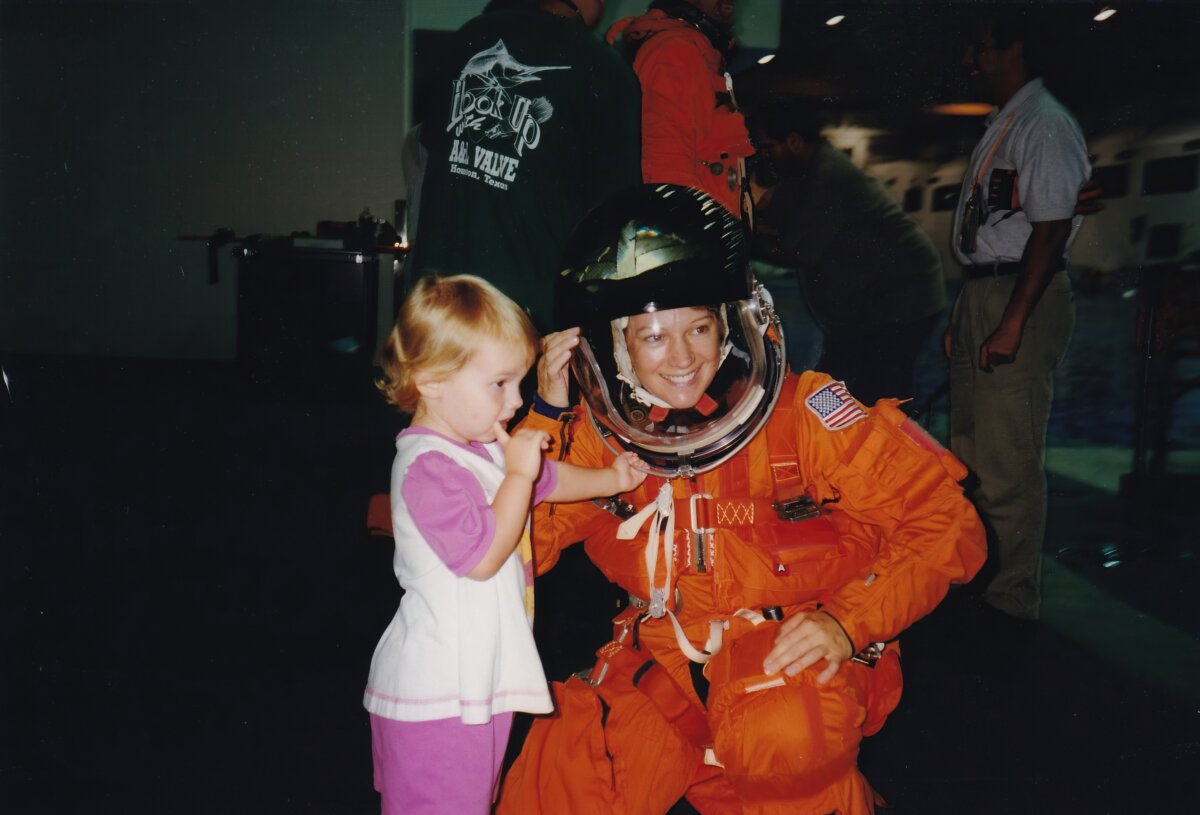
After reading a story about the Gemini astronauts in the Junior Scholastic Magazine in her fourth-grade classroom, Eileen Collins had her future decided.
“I just wanted to be just like those guys,” the retired U.S. Air Force colonel told The Epoch Times in a recent interview.
“I remember reading this thinking, ‘Oh man, that’s what I want to do.’ Eventually, I learned that they were pilots. They were test pilots. They were military pilots. And so I decided that’s what I was going to do. I got the flying bug.”
From that moment on, Collins—whose story comes to life in the new documentary “Spacewoman,” opening in select theaters March 20—focused her energies toward that goal.
“No one in my family was a pilot,” said the Elmira, New York native who grew up in a working-class household. At the local library, Collins devoured books on all topics, but those on aviation were especially appealing.
“Fate is the Hunter” by Ernest K. Gann, “God is my Co-Pilot” by Robert L. Scott, and “The Stars at Noon” by Jacqueline Cochran gave her a glimpse of a life up in the skies.
“I try to encourage young people to read books because that’s what got me to understand what it’s like for a pilot to fly an airplane and also what kind of lives the pilots lived,” said Collins. “When they weren’t in the sky, what were they doing on the ground? I just wanted to do that.”
To make her dream start to become a reality, Collins cleaned her high school’s halls as a janitor, helped customers at a home goods store, and worked at a pizza shop, all while still a student, to save the $1,000 she needed for flying lessons.
“And that is no exaggeration,” she said. “That’s exactly what I saved up. The money went in the bank. I didn’t spend it on clothes or anything like that. I wanted to take flying lessons.”
In her later college years, while studying Math and Economics at Syracuse University, Collins signed up to be one of the first women to participate in an experimental test-pilot program for the United States Air Force. The Air Force was the gateway to her distinguished 28-year career at NASA.
The film, inspired by her memoir, “Through the Glass Ceiling to the Stars: The Story of the First American Woman to Command a Space Mission” shares the trailblazing path that took Collins from her working-class start in Elmira to her celebrated work at NASA, where she commanded four space shuttle missions, and navigated the pressures on her family as a married mother of two.
It includes archival materials and interviews that highlight both the monumental dangers of spaceflight and the incredible achievements of the shuttle program, including her leadership on STS-114, the first mission after the Columbia tragedy.
While reading about aviation, pilots and astronauts opened her world to a different kind of future for herself; it was her parents’ fortitude that gave her the will to pursue her dreams relentlessly.
“They inspired me because [what] I watched them go through,” she explained.
“They both struggled through their own personal issues in life. And I would watch them rebound over and over and over again and just keep working and just keep raising their kids. They never gave up. They just kept going.”
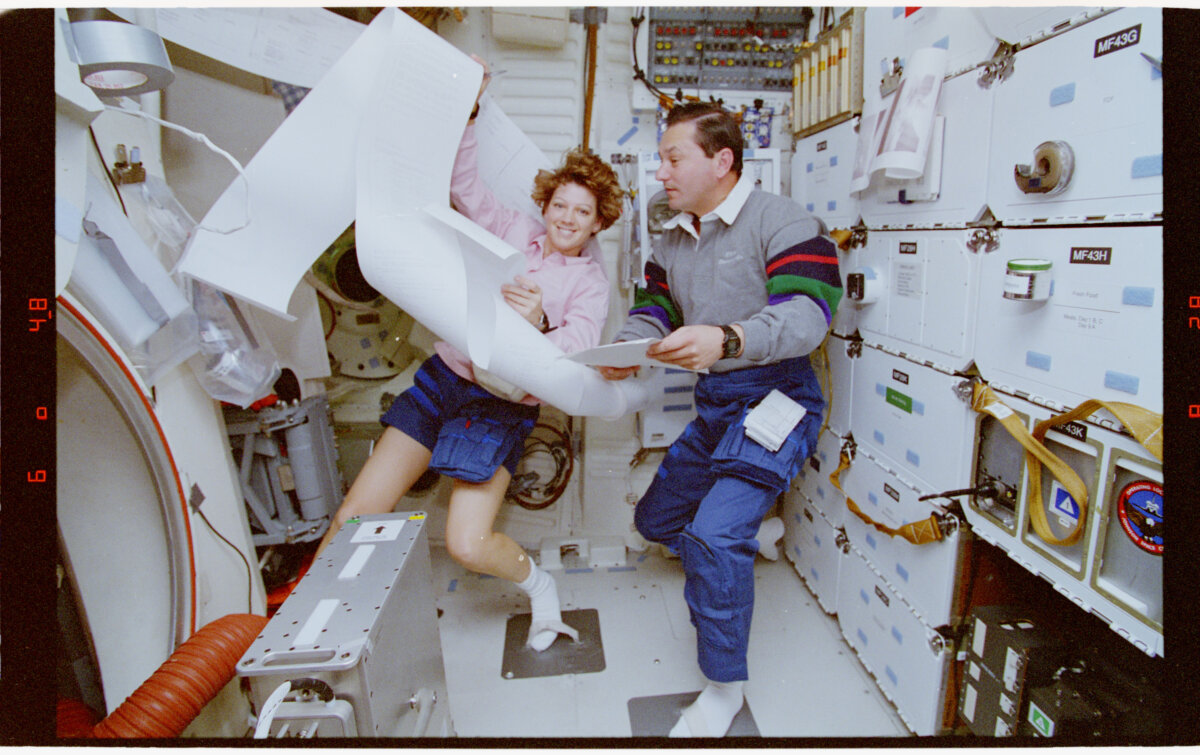
After graduating from the Air Force Test Pilot School at Edwards Air Force Base, California, in 1990, Collins was selected by NASA and became an astronaut in July 1991.
After tours at Kennedy Space Center (shuttle launch and landing) and Johnson Space Center (shuttle engineer and capsule communicator), she flew the space shuttle as pilot in 1995 aboard Discovery.
She was also the pilot of Atlantis in 1997, during which her crew docked with the Russian Space Station MIR.
Collins became the first woman to command a U.S. spacecraft with the 1999 Columbia shuttle mission to deploy the Chandra X-Ray Observatory. Her final spaceflight was as commander of Discovery in 2005, the “Return to Flight Mission” following the tragic loss of Columbia. She has logged more than 6,751 hours in 30 different types of aircraft and more than 872 hours in space as a veteran of four space flights.
Retired from the Air Force in January 2005 and from NASA in May 2006 after a 28-year distinguished career, Collins currently serves on several boards and advisory panels and is a professional speaker and an aerospace consultant.
She’s enthusiastic about renewable energy and resources, and is now focused on America’s space strategy that will return the United States to the Moon and ultimately to Mars.
“I am a hundred percent behind the Artemis program,” she said.
“All the equipment that we are going to be using on Mars that could kill us, like our water recycling, our air recycling, carbon dioxide, converting back to oxygen. How are we going to eat? Things that would keep us alive, they must be tested on the moon before we go to Mars. The fact that the moon is only three days away, we can send them spare parts if they need them. Mars is six months. That equipment has to work. So we are not ready to go to Mars until that equipment is working.”
To gain an appreciation of how funds spent on space travel are money well spent, given all the country’s priorities, Collins is persuasive when she talks about humans’ history of exploration and the greater wisdom to be obtained.
“But a more practical reason is we will eventually run out of the resources on earth and we need to go to the moon and Mars for resources,” she said.
“We are eventually going to have to get off planet Earth and find other planets like Earth in other parts of the solar system. And generations after us will figure out how to do that. But for us, we’re taking baby steps and you’ve got to take those baby steps.”
And while Collins was reluctant at first to write her book and then have it turned into a film, as she approaches her 70th birthday this November, she is starting to realize the value of her legacy.
“Every once in a while, I think about the Apollo astronauts who are passing away,” she reflected.
“Of the 12 men that walked on the moon, there’s only four that are still with us. They were my heroes. But now our generation is replacing them and we have all these younger astronauts. So that transition, I have to think about that and crunch it through my thought process that I am now the older generation.
“There’s things that I know and that I experienced that I have a responsibility to pass on because they’re not just mine. They belong to the people in the world. I went into space. I have a responsibility to share this. People need to learn from our generation,” she added.
