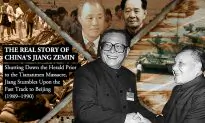
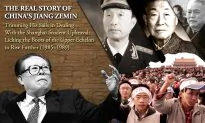
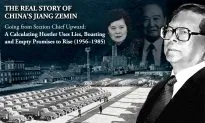
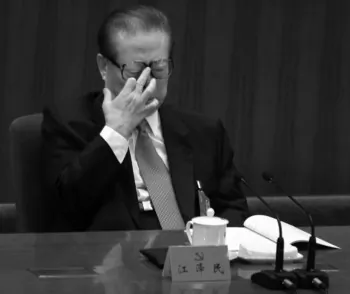
Earlier on Deng had nominated Qiao Shi and Li Ruihuan, but Chen Yun had advocated strongly for JiangZemin. Li Xiannian and Bo Yibo played a pivotal role in Deng's switching to JiangZemin.
He covers its rapid rise in the early 1990s, with up to 100 million practitioners in China, followed by the 1999 persecution ordered by then-Chinese Communist Party (CCP) leader JiangZemin.
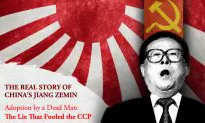
Our family had little to eat, sometimes no food at all." [3]
Jiang Zehui's words undermine the biography's claim that JiangZemin was adopted. Born in March 1938, Jiang Zehui was 11 years younger than JiangZemin.
"I believe suing JiangZemin is very appropriate from both the standpoint of the law or justice," he said. "My colleagues and I all believe that suing JiangZemin is a very encouraging phenomenon.
On Nov. 18 Spain’s National Court issued arrest warrants against former Communist Party head JiangZemin and four other high-ranking, former Chinese regime officials as part of an ongoing investigation into genocide in Tibet.
Instead, online it is now synonymous with the former leader of the Chinese Communist Party, JiangZemin—initially perhaps because of what Chinese Internet users see as his toad-like appearance, and later because it is one way to refer to Jiang without
The first reaffirmed the countries’ “comprehensive strategic partnership” and extended the China–Russia friendship treaty, originally signed 25 years ago under Chinese leader JiangZemin.
The persecution of Falun Gong was launched by then-Chinese Communist Party leader JiangZemin in 1999, after authorities estimated that around 70 million to 100 million had taken up the practice.
China's then-Communist Party leader JiangZemin launched a persecution of the practice in 1999, fearing its popularity would jeopardize the regime's rule.
Then-Chinese leader JiangZemin, who found Falun Gong’s popularity unacceptable, demanded that the practice be wiped out.
Wang Youmei, in an undated photo.
The logic, if it can be called that, of former Chinese Communist Party leader JiangZemin on the night of April 25, 1999, will go down in the annals of history.
He further said Li maintained long-standing ties with the family of former CCP leader Deng Xiaoping, while Wei had connections linked to the political network of former Chinese regime leader JiangZemin.
Take the three most recent CCP top leaders as examples: JiangZemin took power in 1989 at age 63, Hu Jintao in 2002 at age 60, and Xi in 2012 at age 59.
The faction with bloody hands—the officials former CCP head JiangZemin promoted in order to carry out the persecution—is seeking to avoid accountability for their crimes and to continue the campaign.
JiangZemin changed his mind, however, when he saw that Bo actively followed him. Jiang started to rely on Bo and promoted Bo step by step while making him rich.
For example, Xi arrested Xu Caihou and Guo Boxiong—former vice chairmen of the CMC—in 2014 and 2015, respectively, to subdue the military influence of his predecessor, JiangZemin.