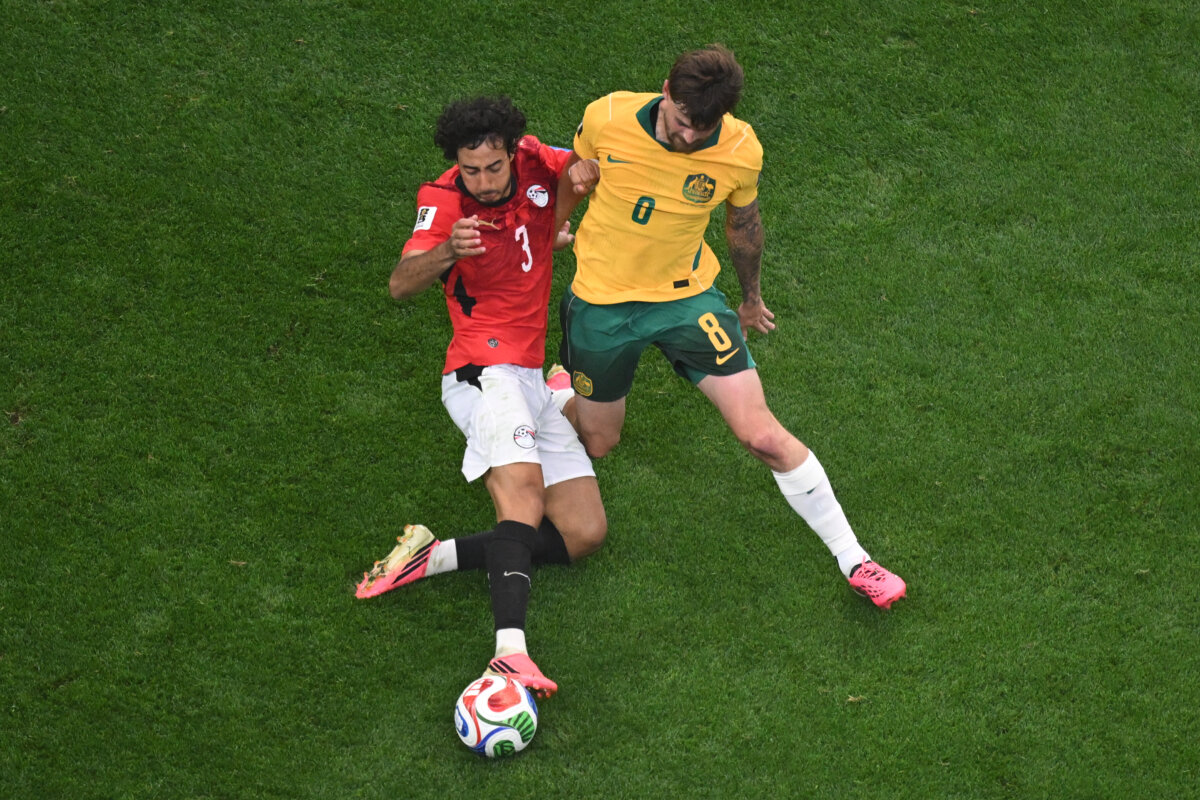

Substitute Hossam Abdelmaguid buried a right-footed shot into the back left corner of the goal to beat Australia in the overtime penalty shootout and send his nation to the round of 16.
The winning strike came after Australia’s Lucas Herrington, an 18-year-old defender, struck the crossbar on his penalty kick. The Socceroos’ first-kick taker, team captain Harry Souttar, leaned back and sent the ball about five feet over the crossbar.
The score was 1–1 at the end of regulation. Late in second-half stoppage time, Australia’s starting goalkeeper Patrick Beach made what might be considered the best save of the tournament so far. He stopped a header from Ramy Rabia at close range, initially diving right but adjusting his left hand to reach the ball that was going the other way and tipping the ball over the goal with his fingertips.
Backup goalkeeper Matthew Ryan, considered a kick-stopping specialist, was subbed in for Beach before the final whistle of the second half of overtime.
All four Egyptian players who took penalty shots, including captain and star player Mohamed Salah, converted their shots.
“It hurts when you get that close, and unfortunately we bow out in a penalty shootout,” Australia coach Tony Popovic said during the post-match press conference, adding that he doesn’t regret the goalkeeper change considering Ryan’s record and experience in penalty shootouts.
“Patrick is new as a goalkeeper. Not just with the national team but even in club football,” he said, adding that the loss is not due to Ryan’s lack of ability or poor judgement in attempting saves. “They [Egypt] took really good penalties.”
Egypt was unbeaten in group play, with a win and two ties. Australia got off to a solid start in the tournament, beating Türkiye 2–0, but had not scored in the other two matches.
Egypt began with a slow buildup, looking for gaps to the outside. Australia, ready to win aerial balls and clog up passing lanes deep in its own end, began with a compact back line consisting of big defenders, three of them over 6-foot-3, in addition to some tall defensive-minded midfielders.
Australia had the first scoring opportunity; striker Cristian Volpato took a left-footed strike from about 25 yards out, shooting it high. He took another shot from distance in first-half stoppage time, sending the ball diagonally from right to left in front of the Egyptian goal but failing to curl it closer to the goal post.
Egypt broke the deadlock in the 13th minute after a free kick just outside the penalty box. Australian defenders blocked the kick, but Egypt immediately regained possession. A cross from Karim Hafez found the path of midfielder Emam Ashour, who struck the ball with his head hard and low past Beach.
Australia equalized 10 minutes into the second half. Midfielder Aiden O’Neill took a free kick to the left of the penalty box. He struck the ball with his right foot, sending an inswinger toward the goal instead of curling the ball back. Plenty of Australian shirts were around the ball, but Egyptian defender Mohamed Hany approached the ball against taller Australian opponents indecisively, and it skipped off the top of his head for an own goal.
Australia continued its aerial attacking game into the second half. Egypt countered with some of its own crosses in the air and skillful ball handling deep into the penalty box by Salah and substitute Haissem Hassan.
Both sides played more conservatively in the 30 minutes of extra time. Australia almost stole the game in the 121st minute when Mohamed Touré got a head on the ball at close range to the goal line, but Egyptian goalkeeper Mostafa Shobeir made the stop.
Popovic said his squad battled elite teams in both group play and the knockout round. It’s quite an accomplishment, he added, considering how young and inexperienced his players are. He’s looking forward to competing in more international friendlies and the Asian Cup to prepare for the next World Cup and earn a reputation as an elite team.
“We certainly played our part,” he said. “The players will be fine.”
This is Egypt’s best-ever World Cup performance. In 1934, it became the first African nation and the first Arab nation to qualify for a World Cup.
The Pharaohs will play the winner of the Argentia/Cape Verde match on July 7 in Atlanta.
Coach Hossam Hassan said he thought just before the penalty shootout, “God, please, make the Egyptian people happy.”
He is proud of his players for sustaining Australia’s physical play and long-ball tactics, which put a lot of pressure on the Egypt back line.
“We made such a strong game from the beginning to the last minute,” he said through a FIFA interpreter at the post-match press conference. “I hope the Egyptian people are happy with our performance.”
 Friends Read Free
Copy
Facebook
Tweet
Friends Read Free
Copy
Facebook
Tweet