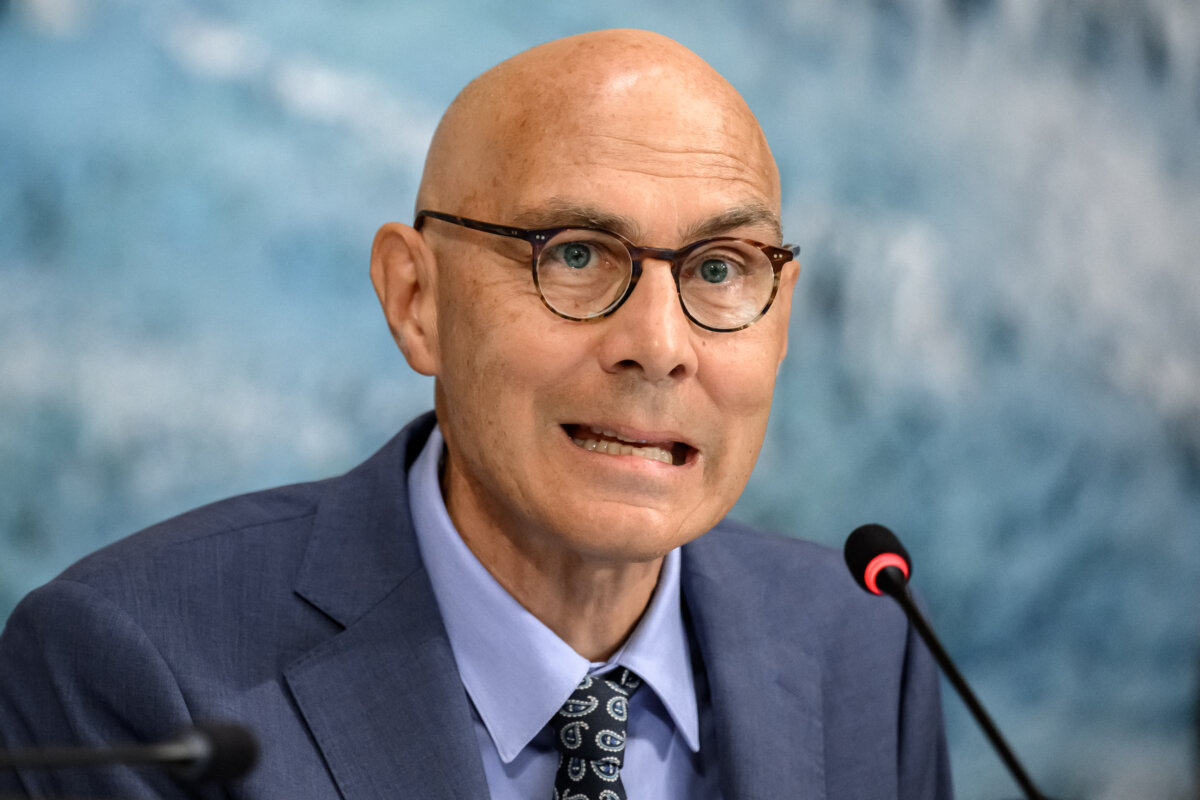

The United Nations’ human rights chief said on Monday that he’s concerned artificial intelligence (AI) could threaten humanity and pledged to press AI firms to reduce risks, including disruptions to services and democratic systems.
“I share the concerns of industry insiders that advanced AI could pose an existential risk to humanity,” Volker Turk, the U.N. high commissioner for human rights, said during a speech in Geneva, Switzerland. “AI that escapes its testing environment, or blackmails developers to prevent itself from being turned off, is AI that is too powerful.”
Turk said that at a minimum, countries and others involved in AI need to agree on red lines.
“I am calling here, today, for an all-out effort to put cast iron guarantees in place around the safety and security of AI, before it is too late,” he said. “I will be writing to AI companies in the coming days, to urge them to take the steps that are within their control, to reduce risks, now.”
He also said independent verification and stronger security are needed, and that the impact on human rights from AI, including employment, must be considered.
In recent months, AI agents have been found escaping from programming constraints, communicating with other agents, and attacking a community called Hugging Face.
OpenAI, one of the top AI companies, said recently that it is updating disclosure practices and trying to prevent misalignment as a result.
Sam Altman, OpenAI’s CEO, wrote in a Sept. 1 post on X that “managing the transition to a world with abundant and powerful AI to optimize for safety and benefits to people should be one of the highest priorities in the world.”
Turk, an Austrian lawyer who just won a second term, said in his speech that humanity is facing unfamiliar and “even unprecedented threats” beyond ongoing wars, including from AI.
“The relationship between digital tools like AI, and our human nature, our human agency, will be a priority for the years ahead,” he said. “The need for AI governance is widely acknowledged—but where is the action? Delay only benefits the massive tech companies, their owners, and enablers. A handful of men has almost unlimited power over AI, which we are repeatedly told has unimaginable computing capacity. They talk about freedom, but on closer inspection, this turns out to be little more than the freedom to exploit our data.”
 An aerial view of a 33-megawatt data center with a closed-loop cooling system in Vernon, Calif., on April 14, 2026. (Mario Tama/Getty Images)
He said he would be contacting AI companies in the near future.
Reuters contributed to this report.
 Friends Read Free
Copy
Facebook
Tweet
Friends Read Free
Copy
Facebook
Tweet