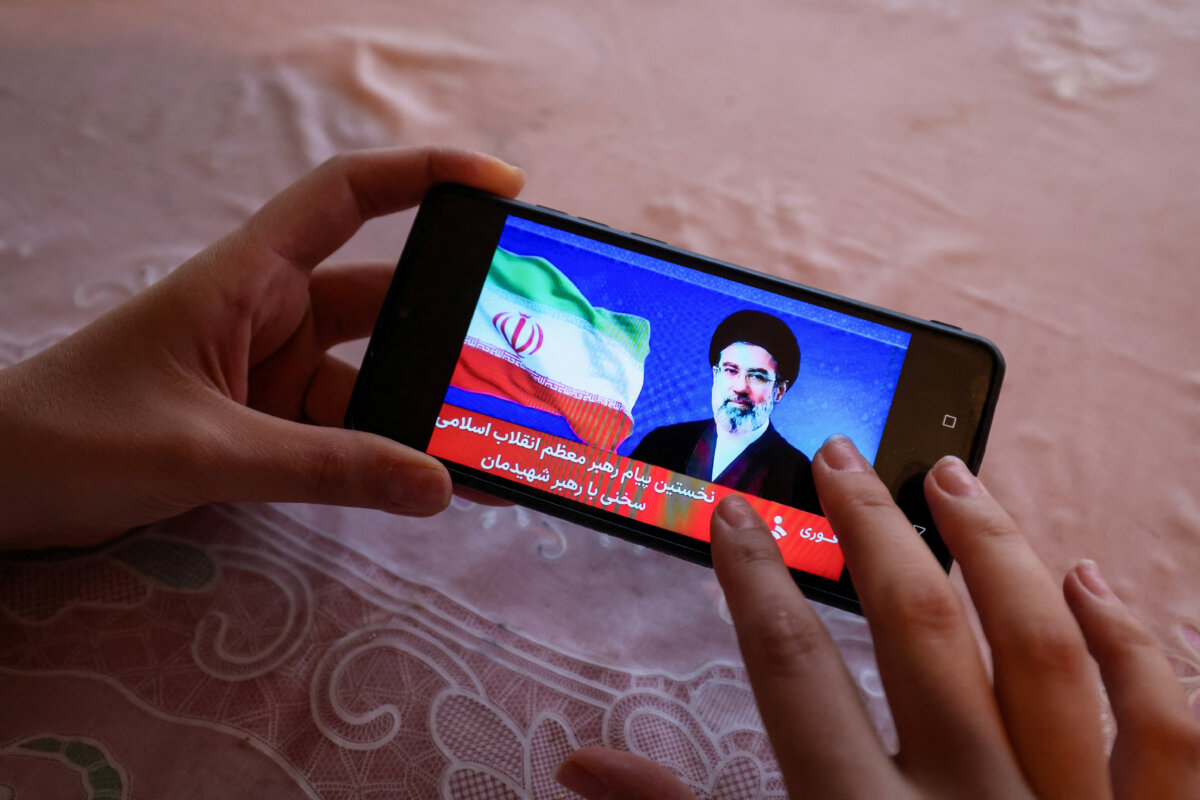

U.S. President Donald Trump said on March 15 that Tehran is using artificial intelligence (AI) as a “disinformation weapon” in the ongoing war between Iran and the United States and Israel.
“They said they attacked the USS Abraham Lincoln, one of the largest ships in the world, an aircraft carrier, and they show pictures of it burning. It was never attacked. It was never burning,” Trump told reporters aboard Air Force One.
“One other thing that was AI-generated, they showed about 250,000 people in a square saying how much they love Khamenei. Totally AI-generated. It never took place.”
The president said that some U.S. media outlets published footage of the allegedly AI-generated rally in support of the regime.
His comments aboard Air Force One came shortly after he said in a post on Truth Social that Iran was working in “close coordination” with “the Fake News Media” to spread AI-generated footage.
He suggested that media outlets propagating such images should be “brought up on Charges for TREASON for the dissemination of false information.”
The Trump administration has not yet provided evidence that the Iranian regime has used AI-generated footage.
The comments come amid growing tensions between the Federal Communications Commission and broadcasters after Trump took aim at media coverage of the U.S. and Israel’s war with Iran.
FCC Chairman Brendan Carr said on March 14 that the agency could pull the licenses of some broadcasters, accusing them of publishing “fake news” amid the ongoing war with Iran.
Broadcasters that are running what Carr referred to as “news distortions” must now “correct course before their license renewals come up,” the FCC chairman wrote on social media.
“The law is clear,” he said. “Broadcasters must operate in the public interest, and they will lose their licenses if they do not.”
Carr’s remarks included a screenshot of a post Trump made on Truth Social earlier in the day, in which he accused U.S. media outlets of misleading coverage of the Iran war.
“The New York Times and The Wall Street Journal (in particular), and other Lowlife ‘Papers’ and Media actually want us to lose the War,” Trump said. “Their terrible reporting is the exact opposite of the actual facts!”
The FCC has regulatory authority over television and radio broadcasters and their licenses. The agency does not regulate cable or satellite TV networks, nor does it have authority over online content. News outlets that publish only online or in print, including The New York Times and The Wall Street Journal, are not subject to FCC authority.
X’s head of product, Nikita Bier, said earlier in the month that the platform was revising its creator revenue-sharing policies to “maintain authenticity of content.”
“During times of war, it is critical that people have access to authentic information on the ground. With today’s AI technologies, it is trivial to create content that can mislead people,” Bier said in a March 3 post on X.
“Starting now, users who post AI-generated videos of an armed conflict—without adding a disclosure that it was made with AI—will be suspended from Creator Revenue Sharing for 90 days. Subsequent violations will result in a permanent suspension from the program.”
Meta’s Oversight Board, the independent body that reviews moderation decisions on Meta’s platforms, such as Facebook and Instagram, said in a March 10 statement that the company must do more to allow users to identify AI-generated content related to armed conflicts.
“Its approach to surfacing AI-generated content must evolve. This includes providing details at scale about the origin of media, based on content provenance standards, investing in stronger detection tools and developing better methods for appropriate labeling,” the board said.
“Meta needs to create a new, separate set of rules to ensure users can reliably recognize AI-generated content. Additionally, it should amend its current policies to ensure a timely and adequate response to deceptive AI-generated output.”
In a report, the board said the conflict between Iran and Israel in June 2025 “signaled an inflection point, with the presence of deceptive generative AI content on social media becoming known as its own ‘soft war.'”
“Such deceptive output was reported as garnering huge numbers of views, and both Israeli and Iranian governments were accused of AI-driven influence attempts,” the board stated.
The Epoch Times reached out to Meta, Alphabet, and ByteDance for comment but did not receive a response by publication time.
Reuters and Jacob Burg contributed to this report.
 Friends Read Free
Copy
Facebook
Tweet
Friends Read Free
Copy
Facebook
Tweet