
The Trump administration on July 23 recommended strengthening export controls to verify the location of advanced artificial intelligence (AI) chips; part of wider efforts to ensure they do not find their way into the hands of foreign adversaries such as China.
The White House revealed the recommendations in “America’s AI Action Plan,” which centers on three main pillars: innovation, infrastructure, and international diplomacy and security.
“Advanced AI compute is essential to the AI era, enabling both economic dynamism and novel military capabilities,” the plan states. “Denying our foreign adversaries access to this resource, then, is a matter of both geostrategic competition and national security. Therefore, we should pursue creative approaches to export control enforcement.”
The plan recommends that the Department of Commerce (DOC), the Office of Science and Technology Policy, and the National Security Council, in collaboration with industry, explore “leveraging new and existing location verification features on advanced AI compute to ensure that the chips are not in countries of concern.”
Though the United States implemented strict export controls to block the Chinese Communist Party (CCP) from obtaining advanced semiconductor chips during the Biden administration, lawmakers have raised concerns that the CCP continues to access them because of loopholes and smuggling.
The plan also recommends establishing a new effort, led by the DOC, to collaborate with intelligence community officials on global chip export control enforcement.
This would include monitoring emerging technology developments in AI computing to “ensure full coverage of possible countries or regions where chips are being diverted,” according to the proposal.
“This enhanced monitoring could then be used to expand and increase end-use monitoring in countries where there is a high risk of diversion of advanced, U.S.-origin AI compute, especially where there is not a Bureau of Industry and Security Export Control Officer present in-country,” the plan states.
The recommendations drew support from congressional lawmakers on both sides of the political aisle.
“I was encouraged to see that the recommended export control policy includes location verification mechanisms and aligns closely with our bipartisan Chip Security Act,” Rep. Bill Foster (D-Ill.) said. “I look forward to learning more of the technical details and next steps for end-use verification.”
In May, Foster joined other lawmakers in introducing legislation aimed at preventing the smuggling of advanced AI chips to unauthorized countries and end users.
Sen. Tom Cotton (R-Ark.) wrote on X on July 23 that he was “pleased to see President Trump’s plan endorse strong and creative controls on AI-enabling technologies, including location verification.”
Cotton said that location verification is a key provision in the Chip Security Act that “will help ensure our advanced chips do not end up in China.”

In response to the legislative proposal, Joseph Hoefer, a Washington-based government relations strategist focused on artificial intelligence, told Texas-based nonprofit Tech Policy Press in May that “rather than attempting to impose a geofence on hardware,” Congress should focus on strategies that track value, behavior, and intent—such as monitoring who is acquiring high-end chips, how they are being used, and whether end users pose diversion risks.”
“Location-tracking chips may sound tough, but the reality is far more fragile,” Hoefer said. “This approach risks creating new vulnerabilities, imposing major costs on trusted US firms, and doing little to stop the next DeepSeek.”
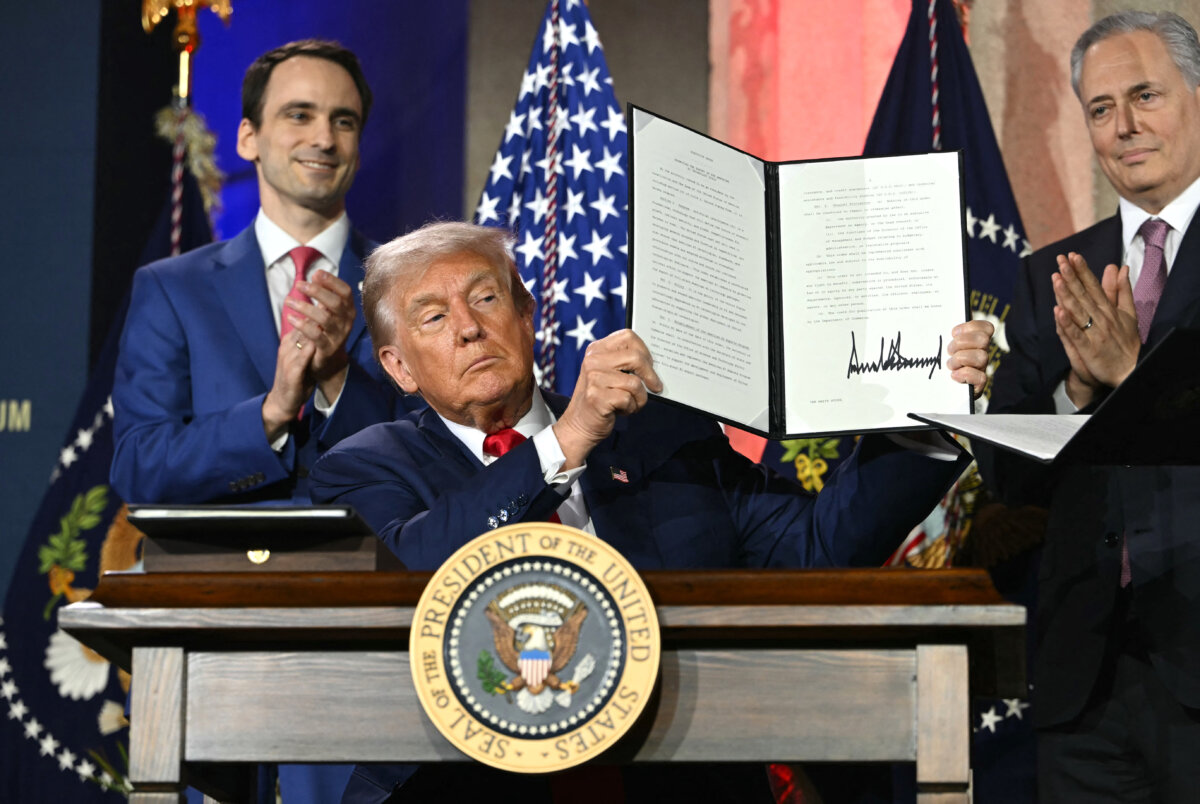
America’s AI plan was published on the same day that President Donald Trump signed three executive orders aimed at bolstering America’s competitive advantage within the AI field, including one facilitating the construction of data centers by accelerating the permitting process at the federal level, and another promoting the export of American AI technology packages.
A third order is aimed at ensuring AI models procured by the federal government “prioritize truthfulness and ideological neutrality” and protect “Americans from biased AI outputs driven by ideologies like diversity, equity, and inclusion (DEI) at the cost of accuracy.”
Reuters contributed to this report.
 Friends Read Free
Copy
Facebook
Tweet
Friends Read Free
Copy
Facebook
Tweet