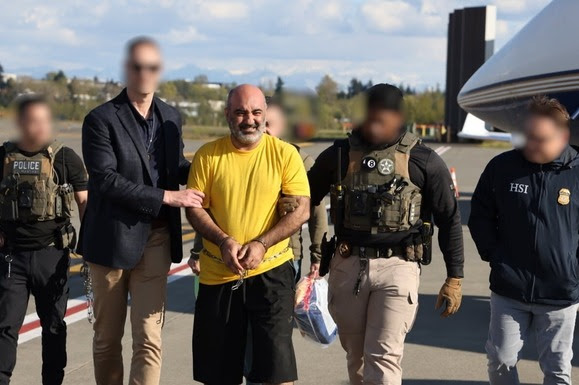

Nearly a dozen years after he was indicted, a 44-year-old Iranian citizen has been extradited from Panama to face U.S. charges in an alleged goods-trading scheme.
Reza Dindar, also known as Renda Dindar, is accused of conspiring with others to benefit his native country with U.S.-made, military-related technology.
“The members of this conspiracy thought they could evade export restrictions by shipping goods through a third country—in this case, China,” First Assistant U.S. Attorney Neil Floyd said in a statement.
But law enforcement uncovered the scheme, and a grand jury approved a nine-count indictment in August 2014, finally leading to Dindar’s court appearance in Seattle on April 20.
Authorities unsealed the indictment last week after Dindar arrived in the United States to face the charges, according to a Justice Department statement.
The department’s Office of International Affairs worked with the Government of Panama to secure Dindar’s arrest in July 2025 in that Central American country, followed by his recent extradition to face the charges in the United States.
Legal proceedings in Dindar’s old case are advancing while another Iranian national, Shamim Mafi, 44, faces fresh charges. Mafi is charged with “brokering the sale of drones, bombs, bomb fuses, and millions of rounds of ammunition manufactured by Iran and sold to Sudan,” according to Bill Essayli, first assistant U.S. attorney for the Central District of California.
Mafi was arrested on April 18 at Los Angeles International Airport “for trafficking arms on behalf of the government of Iran,” Essayli said in a post on X.
The charges in both cases are serious, carrying potential prison sentences of up to 20 years upon conviction.
These two separate cases against Iranian nationals are occurring while the United States and Iran are negotiating to end hostilities. The United States launched its Operation Epic Fury attacks on Iran on Feb. 28, and U.S. officials, including President Donald Trump, have said that the airstrikes are aimed at halting Iran’s progress toward developing a nuclear weapon. At the same time, Israel began its Operation Roaring Lion air campaign against Iran.

‘Multiple Entities’ in Iran Received Goods
The Justice Department statement and the indictment further describe the accusations against Dindar.
According to the indictment, he allegedly obtained U.S.-made sonar systems “on behalf of multiple entities located in Iran” while falsely claiming that China was the “ultimate destination” for the equipment. The items were then “surreptitiously trans-shipped” from China to Iran.
That alleged conduct would violate U.S. trade sanctions that U.S. presidents imposed against Iran in 1995 and 2001, authorities said.
“[Those orders] prohibit the unauthorized exportation, re-exportation, sale, or supply … of any [U.S.] goods, technology, or services to Iran or the Government of Iran,” the Justice Department said.
Further, the orders prohibit working with intermediaries to transfer those goods to Iran.
According to the indictment, Dindar managed New Port Sourcing Solutions in Xi’an, China, from 2010 to 2014.
In 2011 and 2012, Dindar and unnamed co-conspirators allegedly “used deception to purchase parts for three military sonar systems” from a business in Washington state, asserting that those systems would be used by a company in China, the Justice Department stated.
“[However,] at all times, the plan was to ship the parts through China to Iran in violation of export controls,” the statement reads.
Dindar is charged with conspiracy, two counts of export to an embargoed country, two counts of smuggling goods from the United States, two counts of money laundering for $97,600 that his company sent to the United States for the sonar purchases, and two counts of filing false export records.
Homeland Security Investigations (HSI) worked with other partners, including the U.S. Department of Commerce Bureau of Industry and Security–Office of Export Enforcement, on the case.
Dindar’s extradition demonstrates that “actors who attempt to exploit the U.S. trade system and to provide sensitive technology to foreign threats will face consequences despite their efforts to evade justice abroad,” HSI Los Angeles Special Agent in Charge Eddy Wang said in the statement.
U.S. Attorney Todd Greenberg is handling the court case against Dindar.
 Friends Read Free
Copy
Facebook
Tweet
Friends Read Free
Copy
Facebook
Tweet