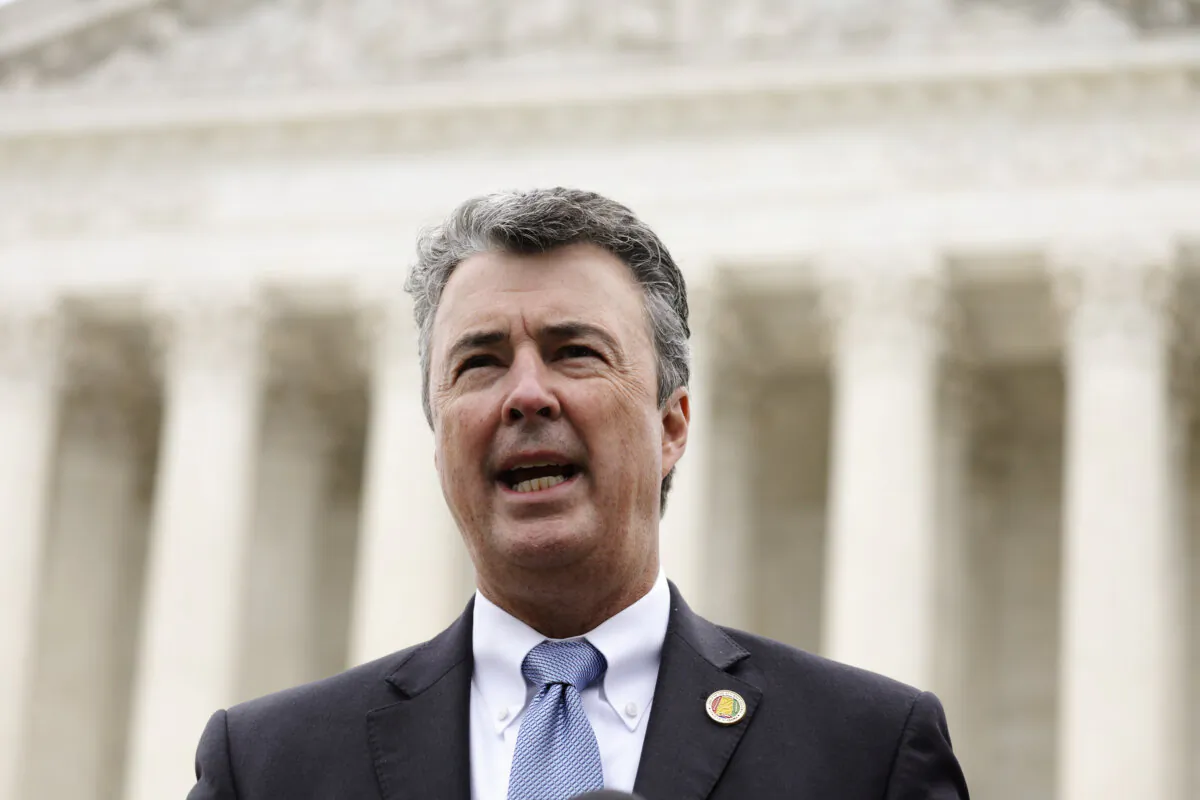

Alabama asked the U.S. Supreme Court on May 27 to allow the state to use a congressional map that removed one of two black-majority districts.
The request came after a three-judge federal district court panel ordered Alabama the day before to continue using court-ordered districts from a 2024 map for elections to the U.S. House of Representatives.
Of the state’s seven congressional districts, five are currently held by Republicans, while two are held by Democrats.
Attorneys for black voters had argued that the new map—which would give Republicans a six to one advantage over Democrats—discriminated against black voters.
The panel’s ruling held that the newest redistricting plan was “tainted by intentional race-based discrimination.”
The new emergency application asks the justices to temporarily pause the panel’s ruling.
The application was addressed to Justice Clarence Thomas, who handles emergency appeals from Alabama. He directed attorneys for those challenging the map to respond to the application by 4 p.m. on June 1. Thomas may act on the application alone, or he may refer it to the full Supreme Court.
The state argues that there is a “fair prospect” that the Supreme Court will reverse the panel’s finding of “intentional discrimination.”
The panel’s decision comes out of a long-running dispute over how congressional district lines are drawn in Alabama.
After the 2020 U.S. census, the Republican-controlled Legislature drew a map that contained one majority-black district.
Black voters and activist groups sued, citing Section 2 nondiscrimination provisions of the federal Voting Rights Act to argue that the map diluted minority voting power. The Supreme Court ruled 5–4 in Allen v. Milligan (2023) that the map violated the act and held that the state must create a second black-majority district.
However, in April, the Supreme Court in Louisiana v. Callais narrowed how Section 2 can be used to contest maps. The high court ruled that race may only be a minor factor in redistricting rationales, not the predominant, overriding reason for how congressional districts are drawn.
The Alabama Legislature then redrew the congressional map so it gave Republicans a six to one advantage over Democrats.
The panel said in its ruling that the Legislature’s new map “doubled down on racially discriminatory vote dilution” after both the panel and the Supreme Court found that it was “racially discriminatory vote dilution.”
It is clear that the Legislature did not have “party politics in mind,” and the only evidence as to intent indicates that “considerations of race were the key reason,” the panel said.
The Supreme Court has held that gerrymandering, or the manipulation of electoral district boundaries to benefit a particular party or constituency, passes constitutional muster when it is done to boost partisan fortunes.
“We do not lightly intrude in state affairs, but our previous review of the undisputed evidence left us in no doubt that Alabama’s legislatively enacted plan intentionally discriminated based on race in violation of the Constitution,” the panel said. “Our re-examination in light of Callais yields the same conclusion.”
The panel said the Legislature knew that approving a plan without an additional black-majority district “would dilute Black Alabamians’ opportunity to participate in the political process, and it intentionally enacted that very plan.”
After the Callais decision, Alabama went forward with its May 19 primary elections, but postponed four of the congressional races, which are expected to be decided in a special election on Aug. 11.
In the application, Alabama argues that the panel ignored the important legal principle that a court should presume that a state legislature is acting in good faith. This presumption “reflects … due respect for the judgment of state legislators, who are similarly bound by an oath to follow the Constitution,” and tries to avoid accusations “that the legislature engaged in ‘offensive and demeaning’ conduct,” state attorneys said, citing a previous legal precedent.
Although Republican lawmakers in Alabama rejected a redistricting plan “that was more favorable to Democrats,” enacting “the one that most favored Republicans,” this does not amount to a “smoking-gun proof of an illicit racial purpose,” the application states.
The U.S. Department of Justice also weighed in, filing a brief supporting Alabama’s request to stay the panel’s decision.
The district court erred when it found that the state “engaged in intentional racial discrimination when adopting the 2023 map and choosing to reinstate that map in time for the 2026 midterms,” Solicitor General D. John Sauer said.
“[The lower court] fundamentally erred in suggesting that Callais sheds no light on ‘the standard for intentional discrimination,’” he said.
Alabama Attorney General Steve Marshall said on May 27 that although the panel’s decision was disappointing, it was not surprising.
“The Supreme Court made it clear in Callais that courts should not impose or require states to draw racially gerrymandered congressional maps,” Marshall said in a statement.
“But the three-judge district court set that rule aside and once again replaced Alabama’s map with one that sorts voters based on race.
“The fact that our State’s conservative electorate has conservative representation is democracy, not an attack on it.”
Reuters contributed to this report.
 Friends Read Free
Copy
Facebook
Tweet
Friends Read Free
Copy
Facebook
Tweet