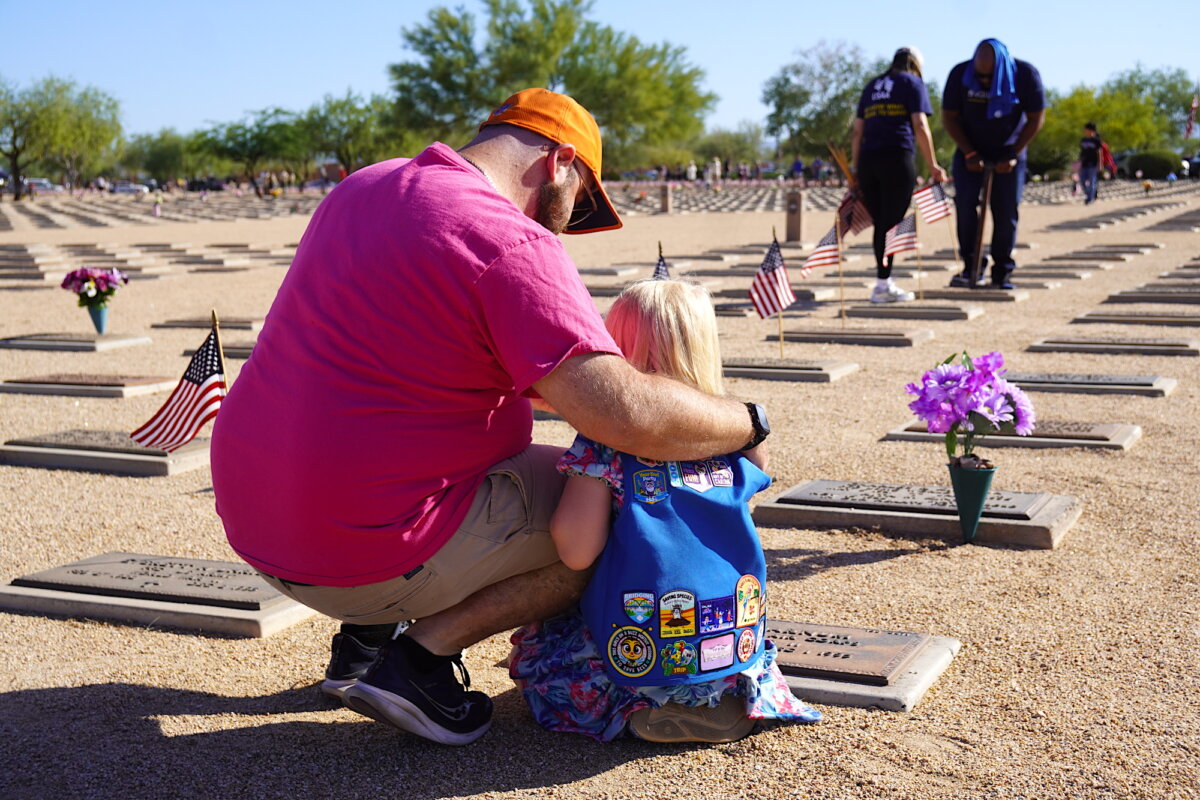

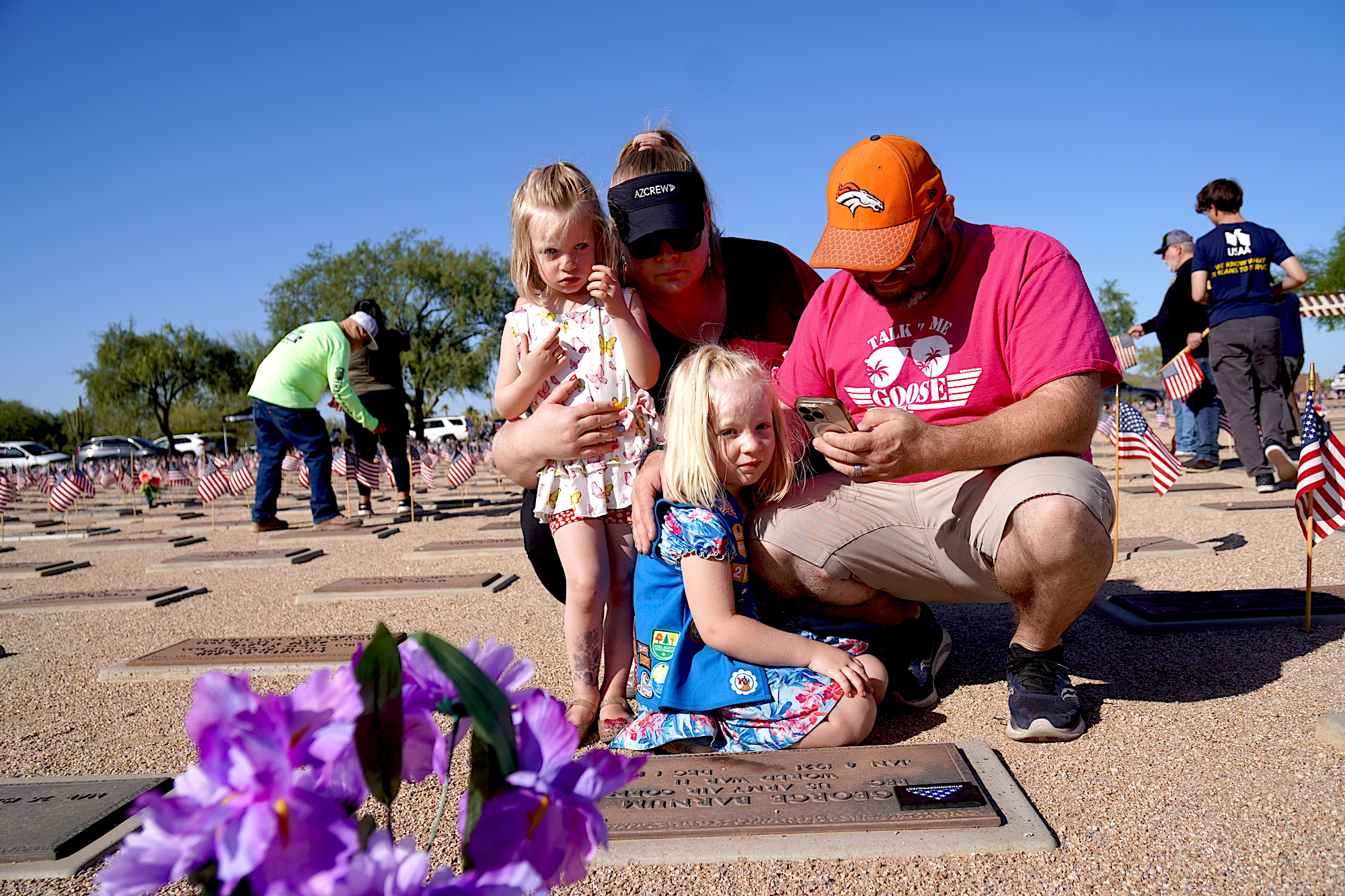
PHOENIX—With his arm gently resting on her small shoulders, Brian Barnum of Phoenix introduced his 5-year-old daughter Elizabeth to the great-grandfather she would never meet.
The name on the bronze grave marker was George Barnum, who served in the U.S. Army Air Corps during World War II before it became the U.S. Air Force. He died in 1995 at the age of 74.
Loralee Barnum, standing beside her other daughter, Lucy, 3, said her daughters would know their father’s grandfather only through family memory.
“This is our first time bringing the girls out. We figured they’re at a good age to understand a little bit of what we’re doing here,” she told The Epoch Times.
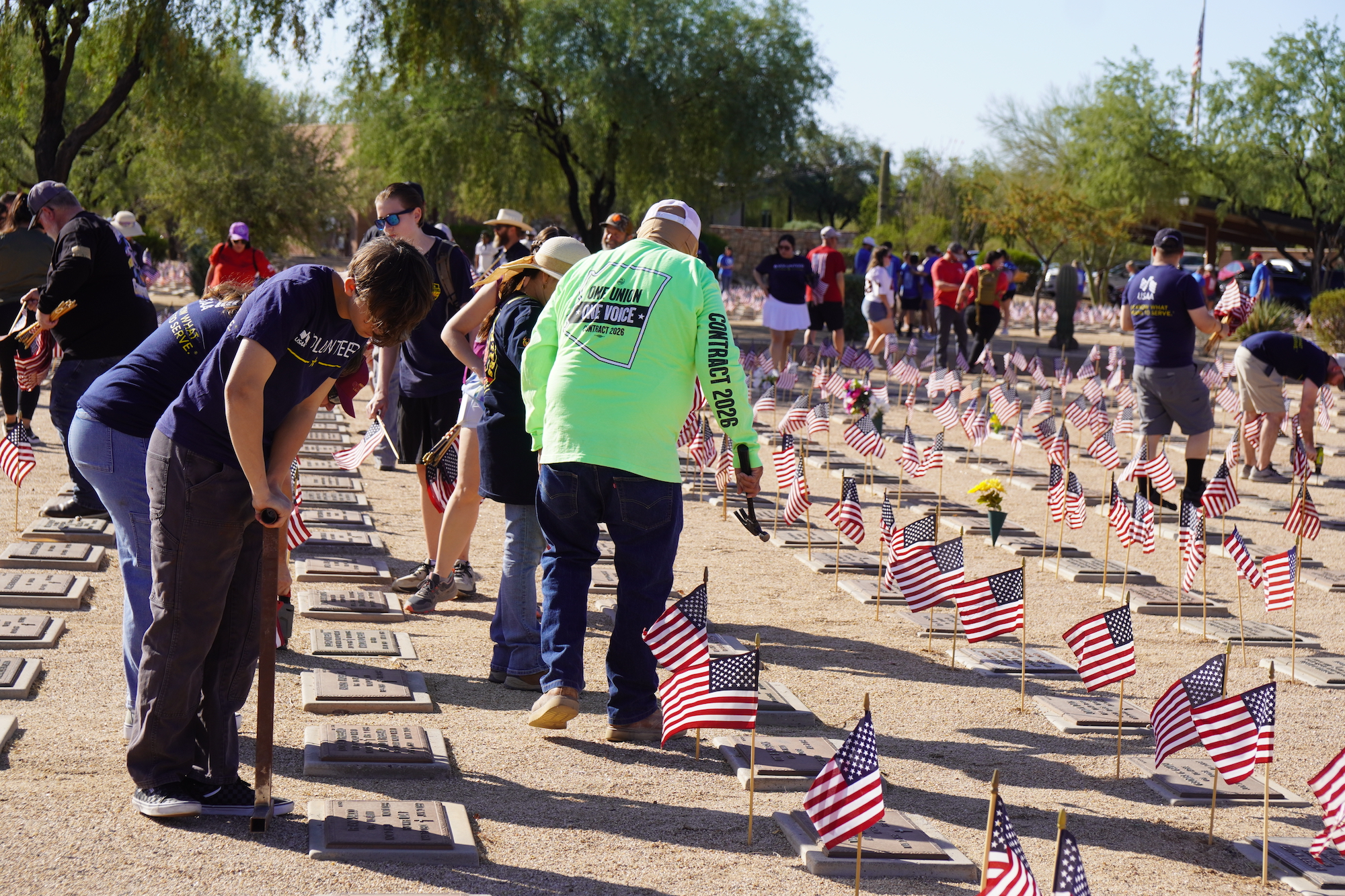
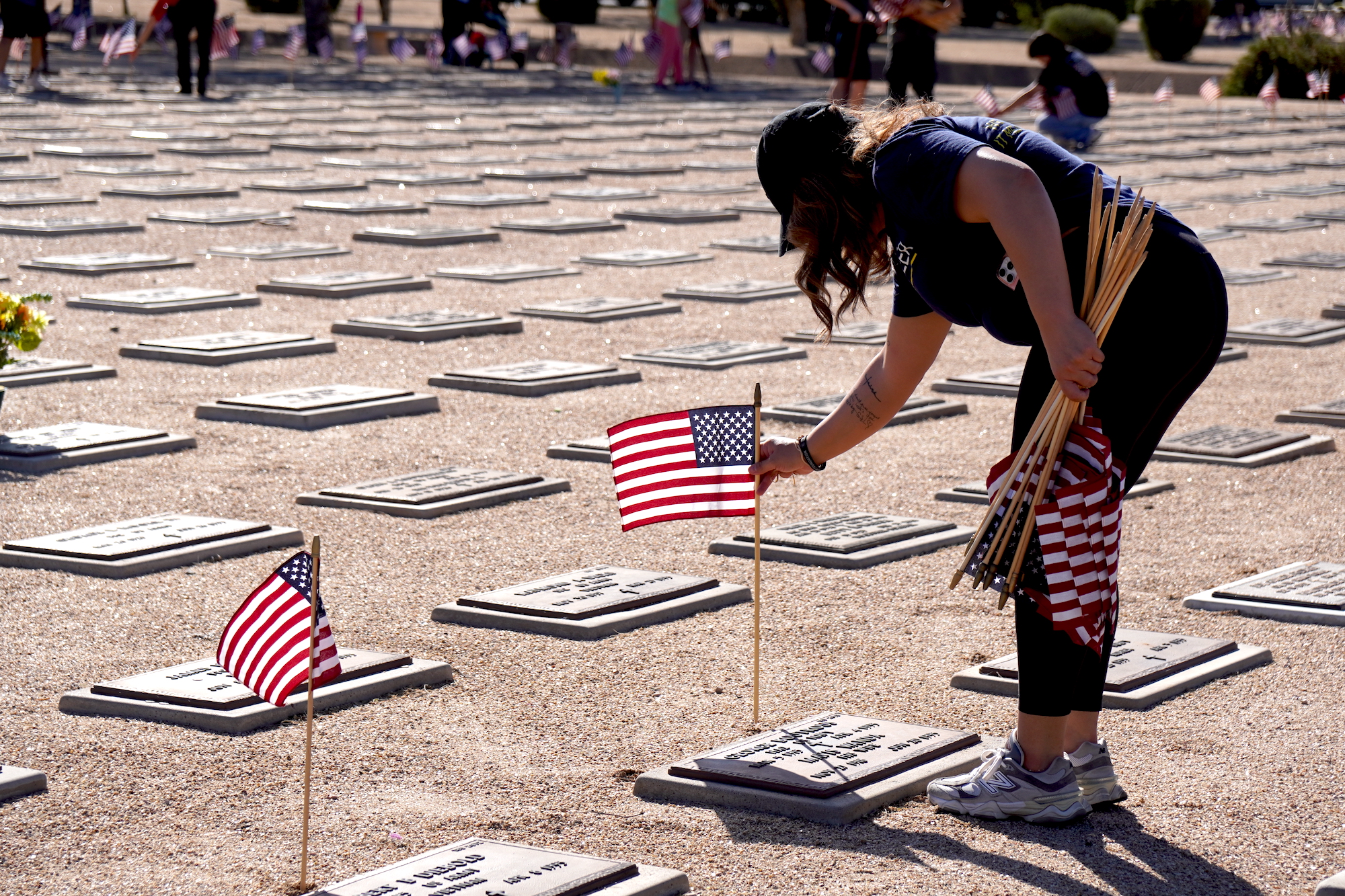
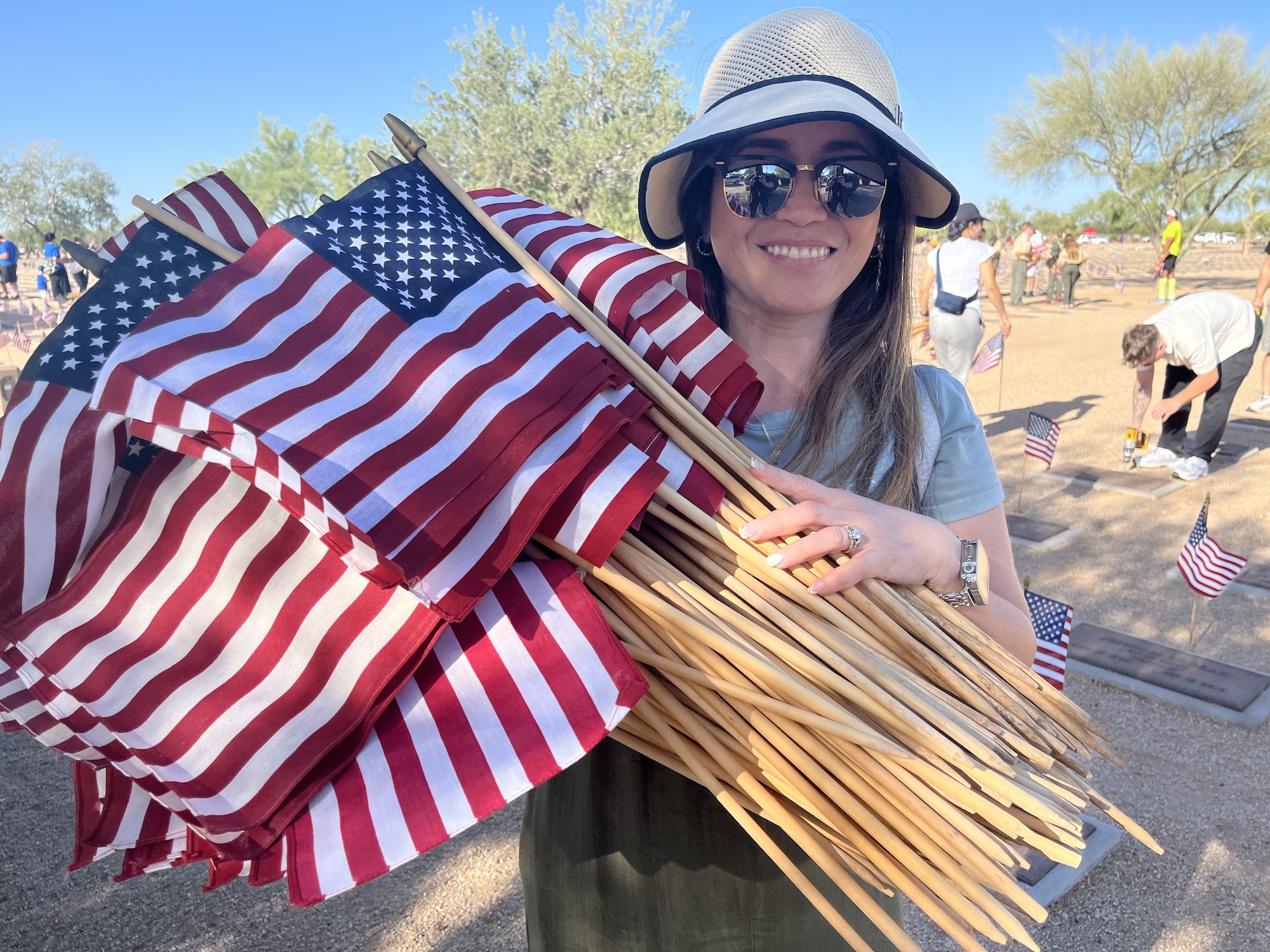
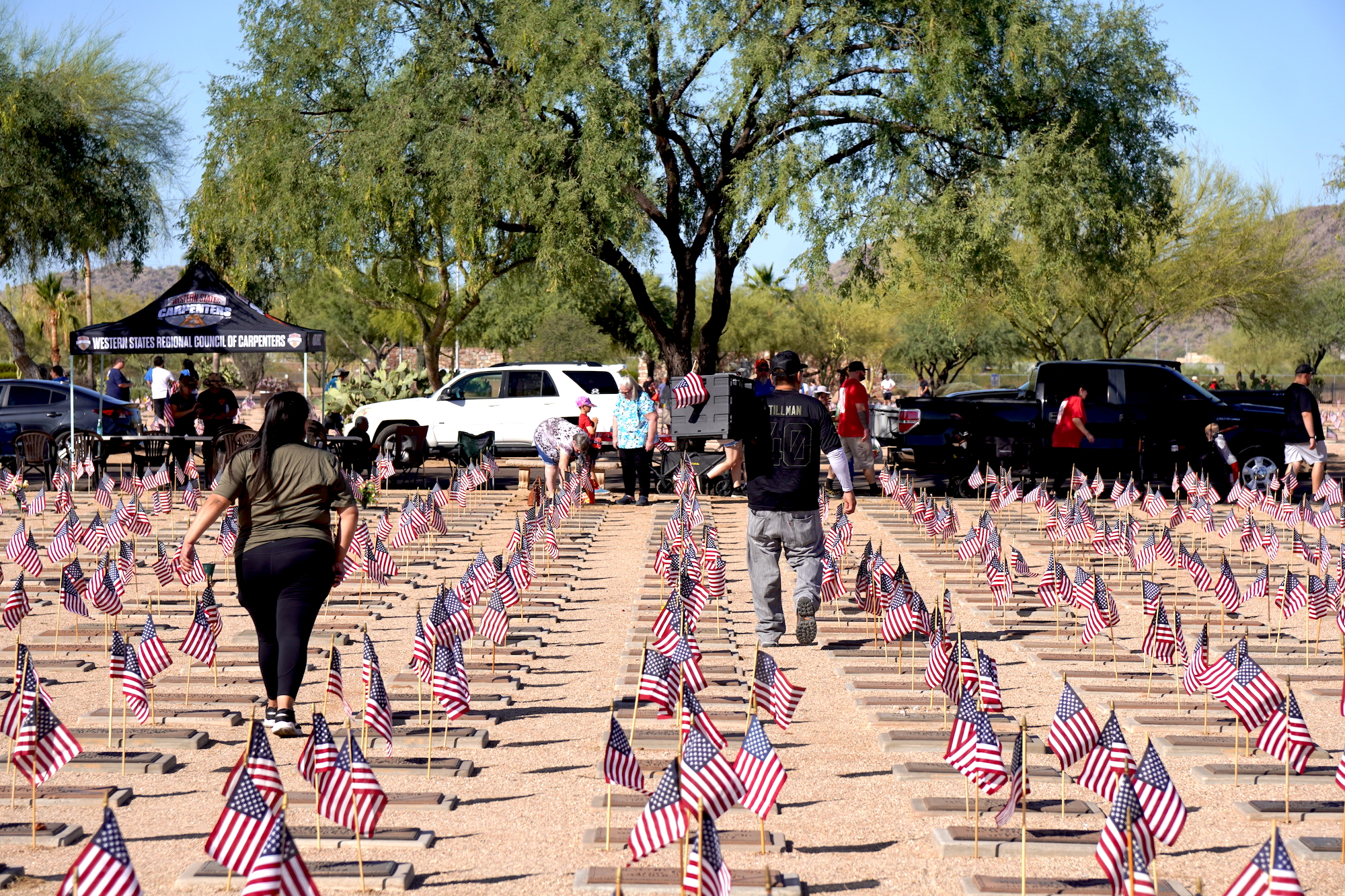
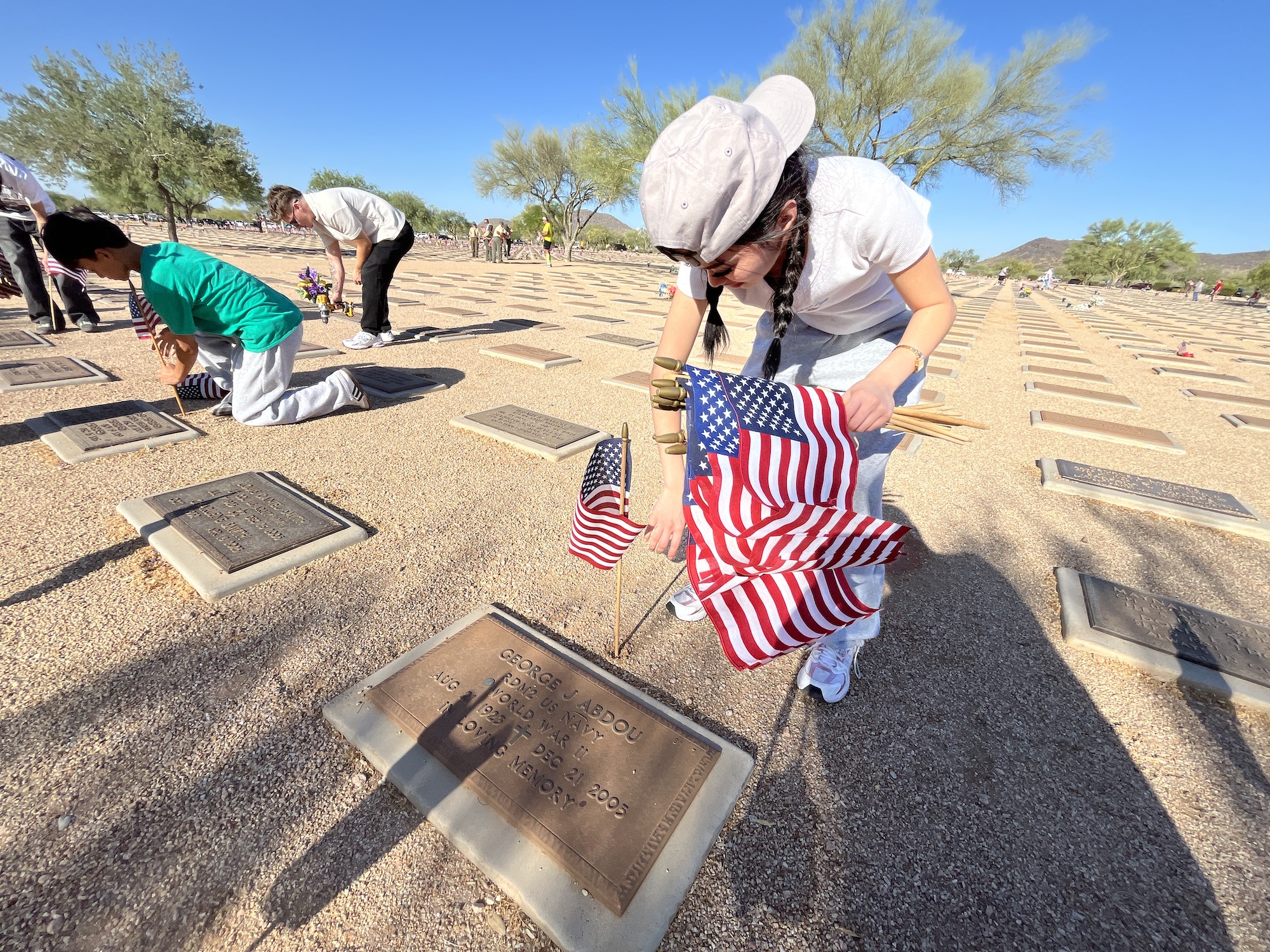
As the family knelt before the marker at the National Memorial Cemetery of Arizona, volunteers moved through the grounds placing flags at each headstone—tens of thousands in all.
The soil resisted each cut, but the volunteers kept working using digging tools, until the markers were softened by a field of red, white, and blue.
On May 23 at the memorial cemetery in Phoenix, flags waved in a gentle morning breeze as volunteers prepared the grounds for Memorial Day.
A cemetery staff member said hundreds more volunteers were still needed to place flags at every marker, with companies donating supplies for the effort.
Volunteers included Scouts USA, Girl Scouts, veterans groups, private organizations, and families honoring their dead.
At national cemeteries across the country, similar tributes were underway for Memorial Day as the nation prepares to mark its 250th birthday.
Michael Huston, Scout leader of Troop 818 in Scottsdale, said about two dozen members turned out for flag placement.
“Our troop is happy to be involved and pitch in to the effort,” Huston told The Epoch Times.
He said the work was also a way to reflect on sacrifice, especially on Memorial Day.
“That’s really why we’re here—to recognize those sacrifices and to honor them,” Huston said.
To the Scouts, Huston stressed the importance of reflection.
“Don’t just stop and plug a hole in the ground and walk on. Take a look at the name of the person who’s buried there,” Huston said.
“Take a look at where they’re from, when they died, what wars they fought in. That’s a great way to take a moment of reflection as you walk by and honor the sacrifice of the person buried there.”
Above all, he said, “Please remember: We’re on hallowed ground. This is the resting place of people who fought and died for this country. Let’s be respectful at all times—let’s really be model citizens out here.”
Huston’s son, Evan, 14, said his great-grandfather is buried in the cemetery, making the work more personal.
“It’s really special that we’re celebrating our country and pride for our nation. That’s what makes it really important and special,” he told The Epoch Times.
The National Memorial Cemetery of Arizona is one of 157 national cemeteries maintained by the National Cemetery Administration. More than 4.35 million veterans and spouses are buried or interred in them.
The National Memorial Cemetery of Arizona was dedicated on Dec. 9, 1978, with its first burials the following spring.
In 1988, lawmakers approved $300,000 for improvements, later supplemented by donations from veterans’ and service organizations.
With space for about 200,000 graves, control of the cemetery was transferred to the Department of Veterans Affairs in 1989.
In 1999, the VA invested more than $13 million in upgrades, including committal shelters, a maintenance building, a visitor center, columbaria, and expanded grounds.
The cemetery is projected to remain open for burials until after 2030.
More than 78,000 veterans and spouses are buried at the Phoenix cemetery, with 7,500 more at the Prescott National Cemetery.
Standing over a grave marker, Litchfield Park Cub Scout Pack 990 member Benjamin Stepp and a Cub Scout used a special tool to dig a hole in the hard dirt to place a flag—one of hundreds planned that morning.
Not far away lie Stepp’s Navy veteran sister-in-law Brandie Curtis, his great-grandparents, and two Marine friends who died in Iraq.
Stepp is also a Navy veteran, having served as a hospital corpsman in Iraq.
“We come out here every year as scouts but also as veterans to support the community,” Stepp told The Epoch Times.
“I’ve got family [buried] throughout the cemetery, so it’s big for me.”
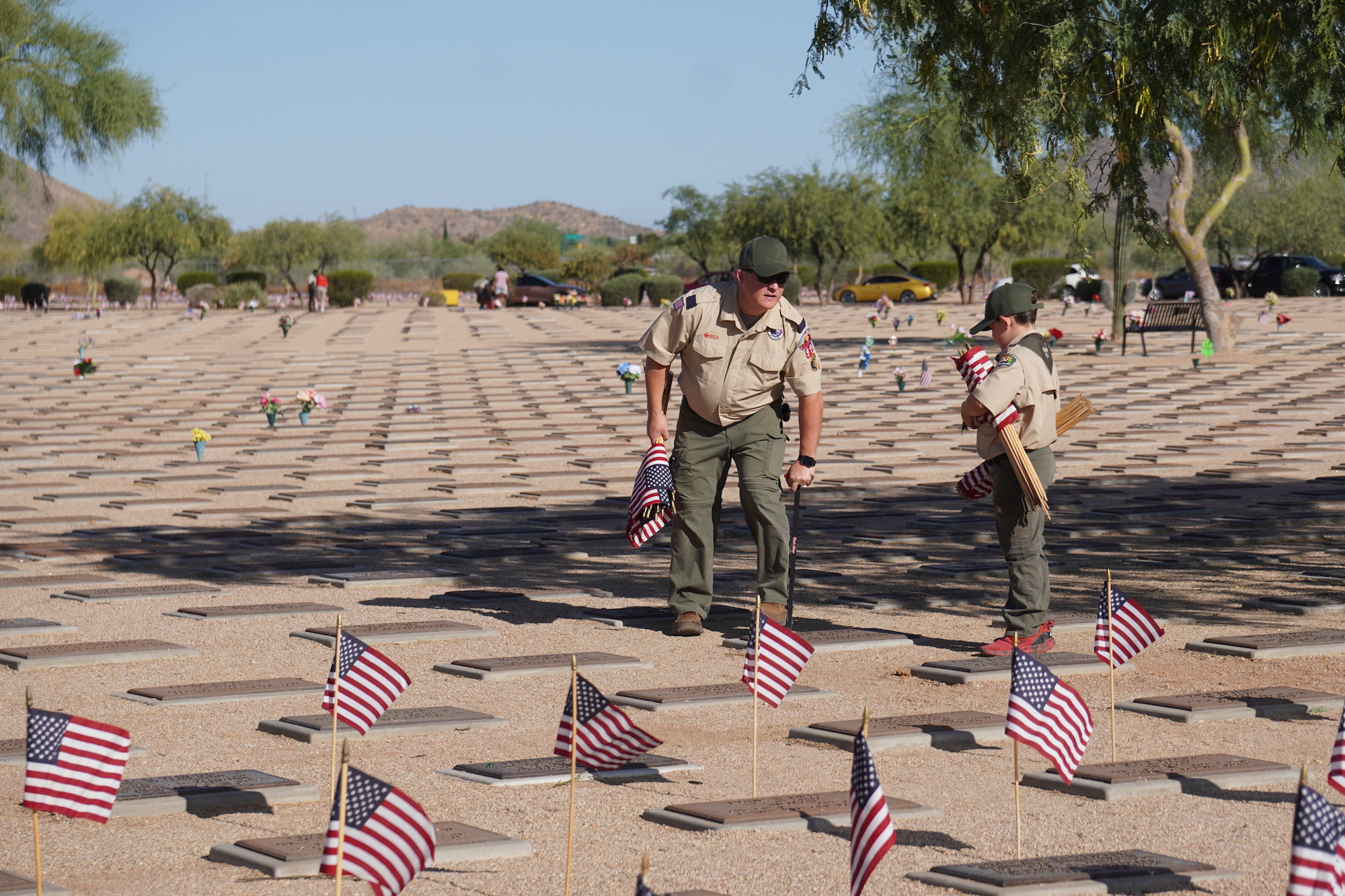
“Having a veteran and scouting family as strong as we are, it’s a huge significance that this is that 250-year anniversary. My family—and our troop—come out here for this event.”
“Every headstone will get a flag—without fail,” Stepp said, although the work stirs a deep reverence and sorrow in him.
“It brings back tough feelings, having served in combat and been around that. As much as a hospital corpsman’s job is to try and save lives, not everyone can be saved—and that’s tough.”
 Friends Read Free
Copy
Facebook
Tweet
Friends Read Free
Copy
Facebook
Tweet