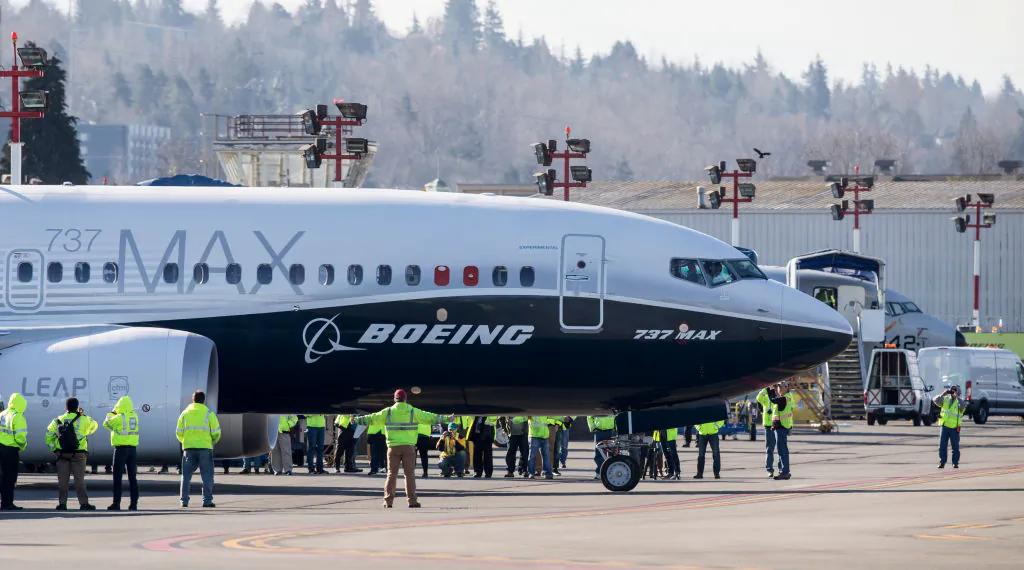
Following the fatal crash of a Lion Air jet in Indonesia last week, Boeing has issued a warning to airlines operating its new 737 MAX about what to do in the event of an “angle-of-attack” sensor failure and avoid a dangerous nose-dive.
The warning follows preliminary findings from the Lion Air crash that the angle-of-attack (AOA) sensor malfunctioned.
“The Indonesian National Transportation Safety Committee has indicated that Lion Air flight 610 experienced erroneous input from one of its AOA (Angle of Attack) sensors,” Boeing said in a statement.
Malfunctioning AOA sensors could cause the 737 MAX to try and automatically push down the nose of the airplane if they detect that an aerodynamic stall is possible, a person familiar with the matter told Bloomberg.
An aerodynamic stall is when the wings of an aircraft can’t produce enough lift and the plane starts to dive.
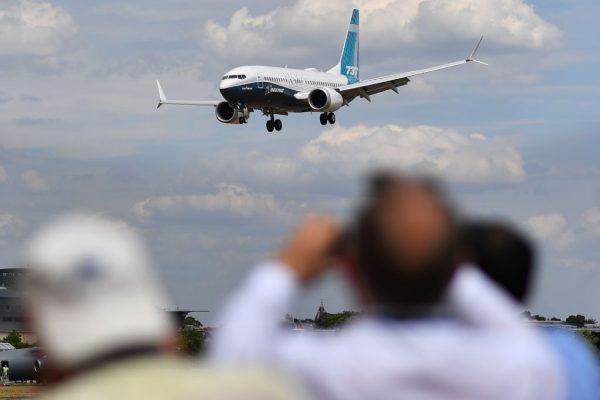 Visitors watch as a Boeing 737 Max lands after an air display during the Farnborough Airshow, southwest of London, on July 16, 2018. (Ben Stansall/AFP/Getty Images)
Boeing’s Instructions for Pilots
Boeing said that the warning directs operators to “existing flight crew procedures to address circumstances where there is erroneous input from an AOA sensor.”
An unnamed source familiar with the Boeing’s technical bulletin described how the sensor error could cause pilots to lose control of the plane.
“If the nose is trimmed down on an aircraft, it becomes difficult for the crew to hold it,” said a person briefed on Boeing’s bulletin, SeattleTimes reported. “The nose is turning itself down and they are having to fight it. It takes a lot of effort to keep it from diving. Especially if you have a crew that’s confused and doesn’t know what’s going on.”
Boeing says in the bulletin that if this failure arises, “initially, higher control forces may be needed to overcome any nose-down stabilizer trim.”
Pilots should then switch off the automatic trim system and carry out trim adjustments manually, the instructions say.
“This is all coming from the Indonesian crash,” said the person briefed on the Boeing bulletin. “I’m not aware of any other operator having this problem.”
Boeing added that issuing bulletins or recommendations regarding the operation of its planes is a “usual process.”
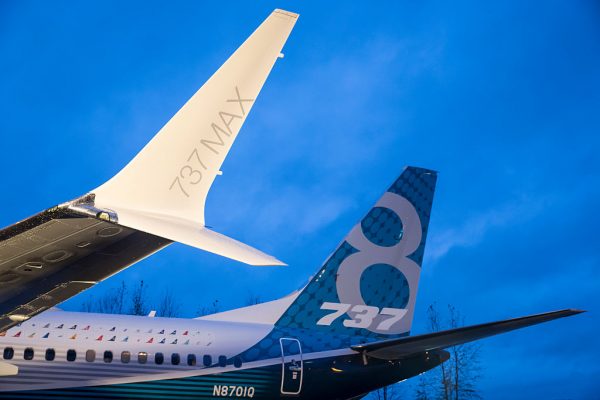 A winglet on the first Boeing 737 MAX airliner is pictured at the company’s manufacturing plant in Renton, Washington, on Dec. 8, 2015. (Stephen Brashear/Getty Images)
Lion Air Disaster
The Lion Air 737 Max 8 jetliner plummeted towards the Java Sea minutes after takeoff from Jakarta airport in Indonesia on Oct. 29.
Safety investigators said the plane may have hit speeds of 600 mph before hitting the water.
All 189 people aboard the plane were killed.
 Personnel from National Transportation Safety Board examine debris from Lion Air flight JT610 at Tanjung Priok port in Jakarta, Indonesia, on Nov. 1, 2018. (Reuters/Beawiharta)
Moments earlier, the pilots radioed a request to return to Jakarta to land, but never turned back toward the airport, according to Indonesia’s National Transportation Safety Committee and flight-track data, as cited by Bloomberg.
Erratic speed and altitude on the plane’s previous flight, from Denpasar on Bali to Jakarta, were reported and “when we opened the black box, yes indeed the technical problem was the airspeed or the speed of the plane,” National Transportation Safety Committee chairman Soerjanto Tjahjono told a news conference.
 Chief of National Search and Rescue Agency Muhammad Syaugi (L) shows part of the black box of Lion Air’s flight JT610 airplane, on Baruna Jaya ship, in the north sea of Karawang, Indonesia, Nov. 1, 2018. (Antara Foto/Muhammad Adimaja./Reuters)
The probe into what happened with the Lion Air plane “is ongoing and Boeing continues to cooperate fully and provide technical assistance at the request and under the direction of government authorities investigating the accident,” the company said in the statement.
The U.S. Federal Aviation Administration said Wednesday it would require airlines to follow Boeing’s newly released safety bulletin, reminding pilots how to handle erroneous data from the sensor.
The FAA said it plans to mandate the bulletin by issuing an airworthiness directive and “will take further appropriate actions depending on the results of the investigation.”
Boeing says that the 737 MAX is the fastest-selling airplane in the company’s history, with over 4,700 orders to date.
 Friends Read Free
Copy
Facebook
Tweet
Friends Read Free
Copy
Facebook
Tweet