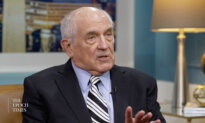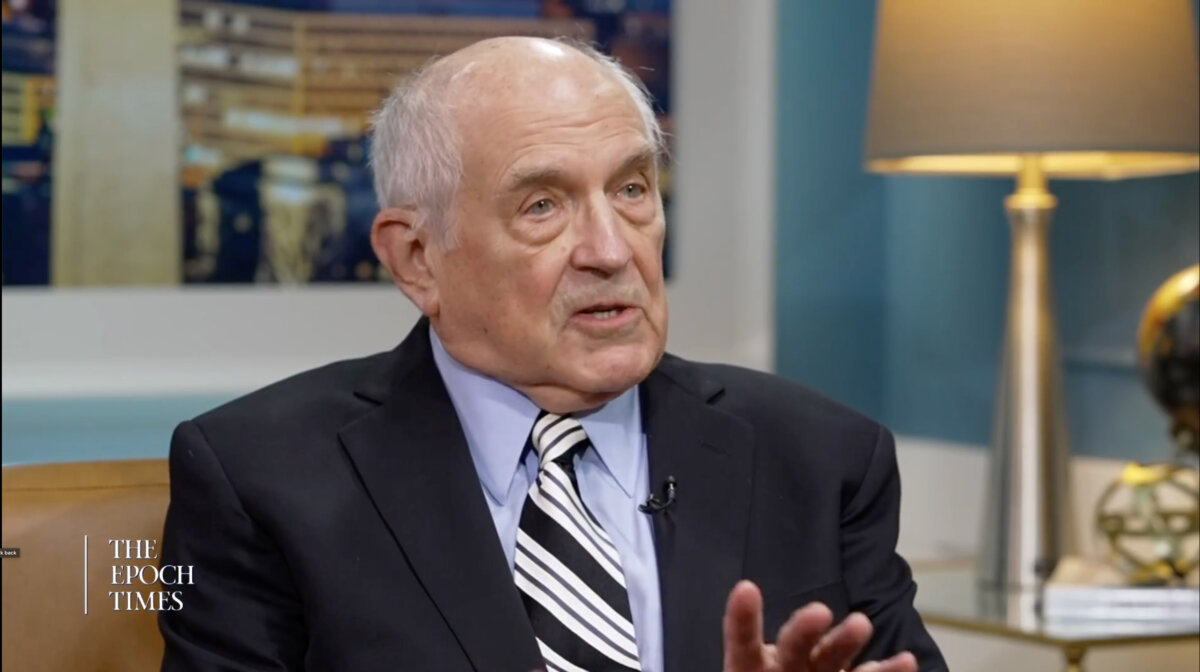

Political scientist and author Charles Murray says a late-in-life spiritual awakening has changed the way he views the world, science, and society and that a loss of faith in the West has left a dangerous cultural vacuum.
Murray recently spoke with Jan Jekielek, host of Epoch TV’s “American Thought Leaders,” about this shift in outlook and discussed his book “Taking Religion Seriously,” which was published in October.
A senior fellow at the American Enterprise Institute and coauthor of the 1994 bestseller “The Bell Curve,” Murray described a shift from detached secularism to belief in a “mysterious force” that “created an intentional universe that permits life.”
Murray said his journey began decades after attending Harvard in 1961, where, he recalled, “it just was the zeitgeist.”
“Smart people don’t believe that stuff anymore,” he said.
Religion, Murray said, was “of no particular interest for the next 25 years.”
His wife, Catherine, changed that trajectory.
After the birth of their daughter, she told him, “I love Anna more than evolution requires.”
Her decision to explore Quakerism led Murray to reconsider his own assumptions.
“I had to recognize there is such a thing as a quality known as spiritual perception,” he said. “I couldn’t follow her on this trip that she was taking, but I kind of wanted to.”
Reading British astronomer Martin Rees’s “Just Six Numbers” convinced him that the fine-tuning of the universe could not be accidental.
“The odds against those settings being just right are literally trillions to one,” Murray said.
“So what are our options? … The two options are it was [evolved] by chance, and the other option being a higher authority directed [an ordered universe]. That seemed to me a lot more plausible.”
When asked how faith might have altered his earlier intellectual work, Murray said his beliefs would have added faith to the secular trilogy of family, community, and vocation he once identified as the sources of human satisfaction.
He summarized the argument of “The Bell Curve” as an analysis of how “IQ took on a different role in America’s social structure,” shaping a “cognitive elite that kind of lives in a world of its own.”
That carried into “Coming Apart” (2012), which chronicled the cultural isolation of educated elites from working-class Americans.
“The segregation of the uneducated elite from the rest of the country … had become stunning,” he said.
“You have people from these elite schools in an elite culture … and that has produced a lot of what we see when the cognitive elite talks about flyover country.”
In the interview, Murray said his exploration of faith led him to see a moral weakness in societies that abandon religion altogether.
“We have watched an experiment going on in Europe now for the last several decades of advanced societies that are effectively secular,” he said.
“There has never been an advanced society that was secular the way that Europe is now. And I think the results are very troubling.”
While acknowledging “all sorts of secular humanists who live lives that are as virtuous as any Christians or Jews,” he warned that secular humanism “has no bedrock, it has no bottom.”
He said modern science faces puzzles pointing to mysteries once dismissed by materialists.
“Is it true that we can be confident that consciousness exists only in the brain?” Murray asked.
He cited documented near-death experiences and “terminal lucidity” in dementia patients as phenomena difficult to reconcile with a purely physical view of the mind.
“If you are a confident materialist in the current era,” Murray said, “it’s because you have not been paying sufficient attention to what is being learned.”
He suggested that, rather than religion being eroded by science, “science has been uncovering mysteries that we never knew existed before.”
The relationship has shifted from opposition to convergence, according to Murray.
“Religion has had answers, parsimonious answers, to things that have baffled science,” he said.
A major part of Murray’s new book explores Christian thought through the lens of C.S. Lewis’s “Mere Christianity,” whose reasoning he called persuasive.
Lewis’s observation that “no culture has ever held up selfishness as a virtue” helped Murray conclude that moral instincts point to a divine origin.
“He says, ‘If God were a God of love and mercy … he could convey it to us by instilling in us certain instincts that are not explained by evolution,’” Murray told Jekielek.
“The more I have thought about it … the more I have decided that he was essentially right.”
Murray emphasized that “Taking Religion Seriously” is not prescriptive.
“People can pick up this book with no fears that I’m going to try to tell them, ‘Do what I did,’” he said.
 Friends Read Free
Copy
Facebook
Tweet
Friends Read Free
Copy
Facebook
Tweet