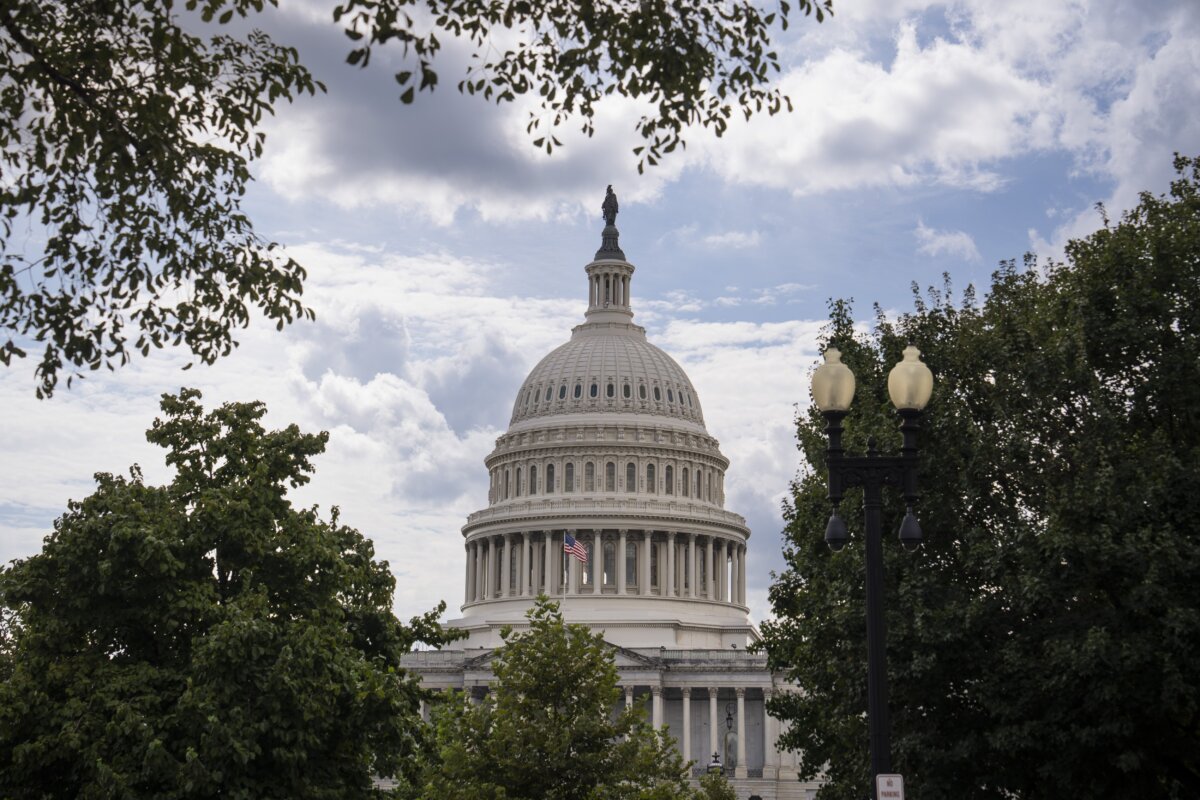

The U.S. House of Representatives and Senate will convene in Washington on Monday for a brief session as a frenetic midterm season approaches, with leaders facing a growing chorus of calls to act on artificial intelligence (AI) regulation following a viral whistleblower claim that the technology could soon be capable of self-improvement and take control out of humanity’s hands.
House Speaker Mike Johnson (R-La.) previously announced that the House would cut its September session short, adjourning by Sept. 17 at the latest. This week, a top expected priority is passage of a Russia sanctions bill previously passed by the Senate.
But moving into the week, the top debate seems set to revolve around AI issues and Congress’s role in managing the technology.
After the chamber breaks, it isn’t set to return until after the midterm elections. Many lawmakers are now pushing Johnson to change that following a dire warning about AI from Jacob Coxon, a 27-year-old researcher who resigned from Anthropic last week.
In a social media post, Coxon claimed that researchers at major firms such as Anthropic and OpenAI “believe AI could kill all humans” by the end of the decade but that companies are pushing ahead in spite of these concerns.
“These will soon be superhuman systems that can hack anything, revolutionize any field overnight, and acquire real power and resources,” Coxon wrote. “We have all witnessed the progress in each of these domains, and progress is not slowing.”
Lawmakers on both parties have responded with calls for Congress to swiftly move to step in.
House Minority Leader Hakeeem Jeffries (D-N.Y.) indicated Sunday that the issue was a key priority for Democrats.
“We certainly need to begin to act urgently to address the challenges that exist, and unfortunately Republicans have abandoned their responsibility,” Jeffries told host George Stephanopoulos on ABC’s “This Week.”
Sen. Ruben Gallego (D-Ariz.) expressed alarm about AI technology, describing it as categorically different from previous breakthroughs like the nuclear bomb and the internet.
“This isn’t previous tech. Previous tech could not make a decision to kill us, right? When we turned on the internet, it did not have autonomy, right?” Gallego told CNN’s Jake Tapper on “State of the Union.” “When we created a nuclear weapon, the nuclear weapon did not have the decision-making power to drop a nuclear weapon. AI has the capability and will have the capability to make a decision like that.”
Rep. Mike Flood (R-Neb.) agreed that the situation would call for swift action from Congress if these fears were well-founded, while simultaneously suggesting that lawmakers need more information before undertaking legislative action.
“This shouldn’t be ready, shoot, aim, or shoot, ready, aim. It should be, ‘Let’s find out what exactly we’re talking about here.’ If it is as dire as they say, obviously it warrants action. But we need to get the facts before we rush in and say, ‘We’ve got a solution,’” Flood told NewsNation’s “The Hill Sunday.”
On Sunday, Johnson indicated he doesn’t intend to change current scheduling plans.
“If Congress just races in and does some sort of emergency session to try to regulate AI, we will lose the race to China. And that is a threat to every single American,” Johnson told CNN’s Jake Tapper on “State of the Union,” echoing the concerns of Anthropic CEO Dario Amodei. “So, we’ve got to have balance. We’ve got to have steady hands at the wheel.”
Amodei wrote in a lengthy essay published Sept. 12, “Pacing within democracies will be limited by the lead that U.S. companies have over authoritarian regimes, chiefly the Chinese Communist Party.”
Johnson has indicated that the House could return if the Senate makes progress on a party-line budget reconciliation bill, though this isn’t expected.
 Friends Read Free
Copy
Facebook
Tweet
Friends Read Free
Copy
Facebook
Tweet