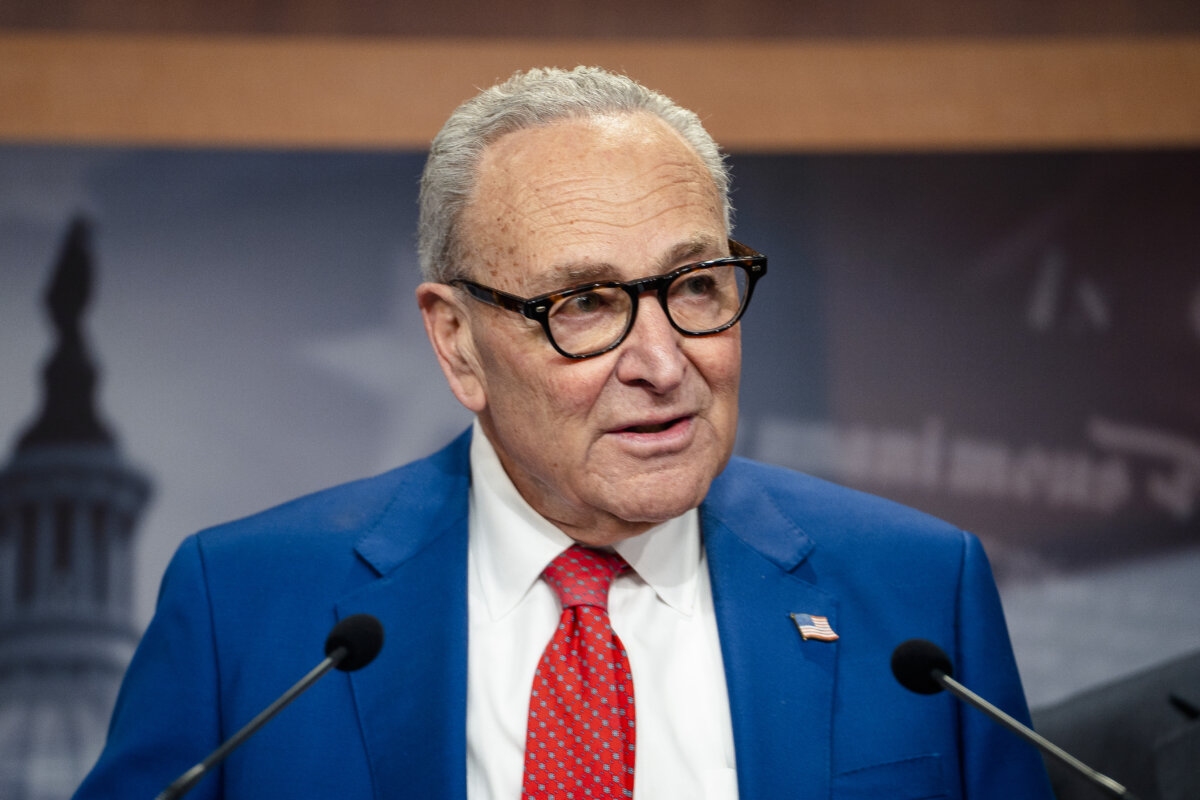

Senate Democrats sent a counteroffer to the White House and Republicans on funding for the Department of Homeland Security (DHS) late on Feb. 16, according to a spokesperson for Senate Minority Leader Chuck Schumer (D-N.Y.).
This came as the partial DHS shutdown entered its fourth day with no deal in sight.
Senate Majority Leader John Thune (R-S.D.) said he was hopeful that negotiations would continue but questioned the Democrats’ motives.
“We’ll see if they are at all serious about actually getting a solution to this, or whether they just want to play political games with these really important agencies,” Thune told Fox News Digital.
Thune compared the standoff to the 43-day government shutdown last year, saying Democrats had slow-walked negotiations during that episode as well.
“It’s wrong, in my view, for Democrats to use these folks as collateral in yet another harmful government shutdown,” he said.
A White House official said the administration wants to continue talking.
“The Trump administration remains interested in having good-faith conversations with Democrats,” the official told Fox News Digital, adding that “President Trump has been clear—he wants the government open.”
The official noted that the funding lapse is affecting agencies under the DHS umbrella beyond immigration enforcement, including the Transportation Security Administration, the Federal Emergency Management Agency, the U.S. Coast Guard, and the U.S. Secret Service.
The Epoch Times reached out to the White House and Thune’s office for additional comment, but did not hear back by publication time.
DHS funding expired at 12:01 a.m. on Feb. 14 as Congress left Washington for a scheduled recess without reaching an agreement. Lawmakers are not expected to return until Feb. 23, the day before President Donald Trump’s scheduled annual State of the Union address.
The standoff centers on the Democrats’ demands for restrictions on immigration enforcement operations after two U.S. citizens were fatally shot by federal agents during Immigration and Customs Enforcement (ICE) operations in Minneapolis in January.
Earlier this month, House Minority Leader Hakeem Jeffries (D-N.Y.) and Schumer released a list of 10 demands they said must be in any DHS funding bill. They include stricter use-of-force standards, clearer identification for DHS officers, judicial warrants for entering private property, limits on what Democrats describe as racial profiling, and wider use of body cameras.
Jeffries said on Feb. 12 that Democrats would not support DHS funding “in the absence of dramatic changes that are bold, meaningful, and transformational—period, full stop.”
The White House sent Democrats a counterproposal on Feb. 12. Democrats rejected it, with Schumer calling it “not serious, plain and simple.” The counteroffer sent late Monday represents the Democrats’ response to that proposal.
White House border czar Tom Homan pushed back on several of the Democrats’ demands during a Feb. 15 interview on CBS’s “Face the Nation.”
Homan said he doesn’t want ICE agents to wear masks during operations, but that face coverings are necessary because “threats against ICE officers are up over 1,500 percent” and “actual assaults and threats are up over 8,000 percent.”
On the issue of judicial warrants, Homan said ICE is operating within the framework set by Congress.
“Congress themselves wrote the Immigration Nationality Act that gave power on the administrative warrant to arrest somebody, and that’s what’s set up in federal statutes,” he said. “So if Congress wants that change, then Congress can legislate.”
ICE and Customs and Border Protection operations are expected to continue largely unaffected by the funding lapse. Both agencies received about $70 billion each from the One Big Beautiful Bill Act, signed into law by Trump last year.
Thune has said lawmakers would be called back to Washington if a deal is reached before the recess ends.
 Friends Read Free
Copy
Facebook
Tweet
Friends Read Free
Copy
Facebook
Tweet