
Democrats pledged April 29 to push back against Republican-led redistricting in the wake of the Supreme Court’s ruling that struck down a Louisiana congressional map containing two majority-black districts, pointing to legislation, court fights, and grassroots organizing as avenues of response.
Republican officials in Tennessee, Georgia, and Alabama have begun discussing redistricting in response to the ruling. Louisiana’s Republican attorney general said the state would draw a new congressional map. The Supreme Court’s ruling automatically triggered a Mississippi special session, set to begin 21 days from April 29, that Republican Gov. Tate Reeves had called to give the state Legislature a chance to redraw electoral maps under the new standards.
The Supreme Court ruled 6–3 in Louisiana v. Callais that the state’s redrawn congressional map was unconstitutional because race was the predominant factor in drawing the lines. The map had been redrawn under a lower court order to include a second majority-black district to comply with Section 2 of the 1965 Voting Rights Act, which bars voting practices that discriminate by race. Democrats said the decision narrows that section of the law.
Democratic Congressional Campaign Committee Chair Suzan DelBene (D-Wash.), who leads House Democrats’ campaign arm, said the party would respond through multiple channels.
“Whether it’s through legislation, litigation, or the combined power of people, we refuse to sit back and let Republicans and a politicized Supreme Court undermine America’s march towards a more perfect nation,” DelBene said.
Democratic National Committee Chair Ken Martin said the party would push back in states where Republican legislators use the decision to redraw congressional maps.
“While today’s decision is a gut punch, make no mistake: Democrats will fight tooth and nail to ensure the voices of all Americans will be heard in November and in every election that follows,” Martin said in a statement.
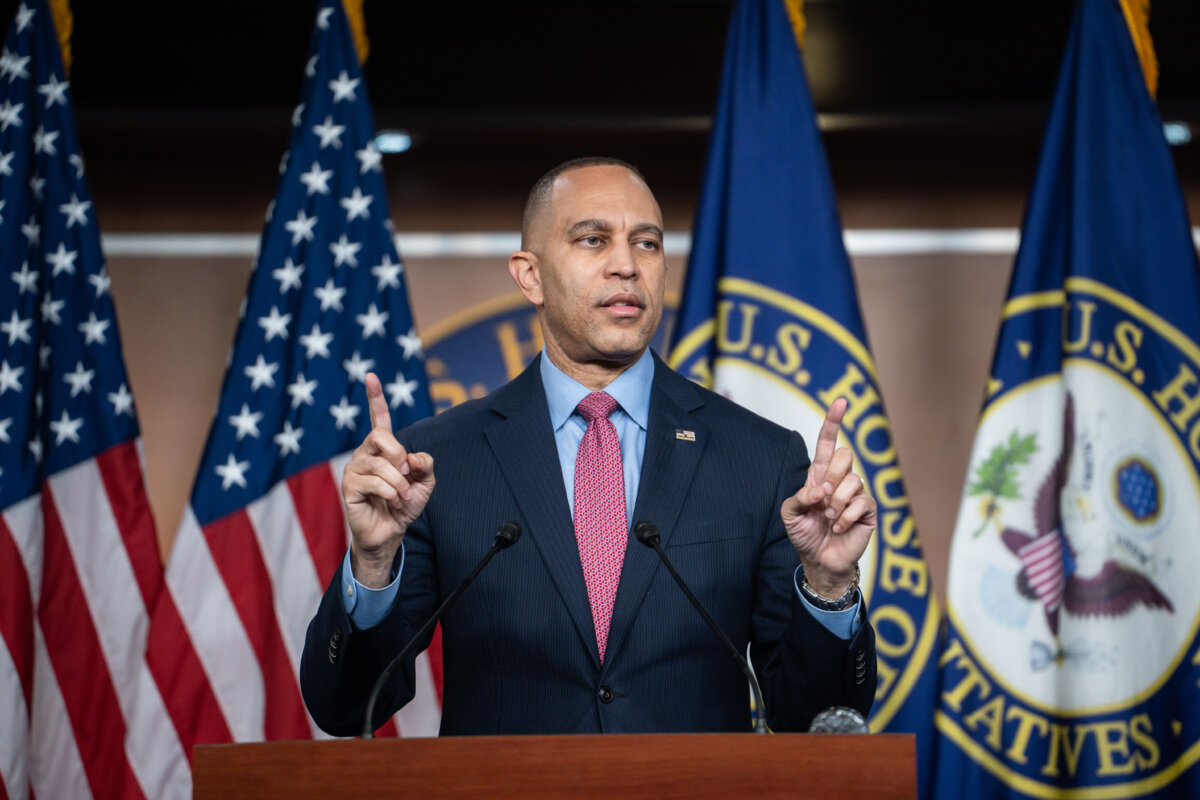
House Democratic Leader Hakeem Jeffries (D-N.Y.) said his party will continue contesting Republican map redraws across the country.
“We are not going to let the extremists successfully rig the midterm election. We will not allow them to artificially hold power as a result of a racial gerrymander, a partisan gerrymander, or DeSantis Dummymander,” Jeffries said at a press conference with the Congressional Black Caucus.
Jeffries was referring to a new congressional map proposed by Florida Gov. Ron DeSantis and passed by the state Legislature on April 29 that aims to expand the Republican advantage in the state.
Rep. Terri Sewell (D-Ala.) said the ruling could push blue states to redraw their own maps in response.
“To the extent that it’s urging, it’s inviting, red states to totally take away all the Democratic seats and be totally red. It also encourages blue states to do exactly the same. … I’d take 52 seats from California. I sure would. And 17 seats from Illinois,” Sewell said.
Sewell was responding to a question about whether blue states such as California, New York, and New Jersey should unravel their existing Voting Rights Act districts to pick up Republican-held seats, even if doing so reduced black representation overall.
The Congressional Black Caucus is also pressing for a vote on the John R. Lewis Voting Rights Advancement Act, of which Sewell is the author and lead sponsor. The bill, reintroduced in 2025, would update the 1965 Voting Rights Act and require states with a history of voting discrimination to get federal sign-off before changing their voting rules or congressional maps.
Rep. Troy Carter (D-La.), whose state is at the center of the ruling, said the timing leaves little room for the decision to affect the upcoming midterms.
“This wagon has gone too far down the road to be impactful in the 2026 election. We are in the 2026 election cycle now,” Carter said, noting early voting in his election begins on Saturday.
Rep. Yvette Clarke (D-N.Y.), who chairs the Congressional Black Caucus, said the party’s 2026 response will be handled through grassroots organizing.
“What it looks like, it looks like door to door. It looks like the NAACP standing up. Local chapters. It looks like fraternities and sororities that do voter registration on a regular basis, mobilizing,” Clarke said.
Senate Democratic Leader Chuck Schumer (D-N.Y.) said his caucus would work to reverse the ruling’s effect.
“The commitment of equal representation has been broken before—and every time, Americans have forced it back into law,” Schumer said in a statement. “Senate Democrats will fight it once again to reverse this awful decision.”
National Republican Redistricting Trust Executive Director Adam Kincaid praised the ruling in a statement.
“For decades the left has spent hundreds of millions of dollars seeking to divide Americans along racial lines in a cynical pursuit of partisan power masquerading as civil rights,” Kincaid said. “Today’s decision rebukes that divisive and unconstitutional effort.”
White House spokesperson Abigail Jackson called the ruling “a complete and total victory for American voters.”
“The color of one’s skin should not dictate which congressional district you belong in. We commend the court for putting an end to the unconstitutional abuse of the Voting Rights Act and protecting civil rights,” Jackson said.
The Associated Press and Matthew Vadum contributed to this report.
 Friends Read Free
Copy
Facebook
Tweet
Friends Read Free
Copy
Facebook
Tweet