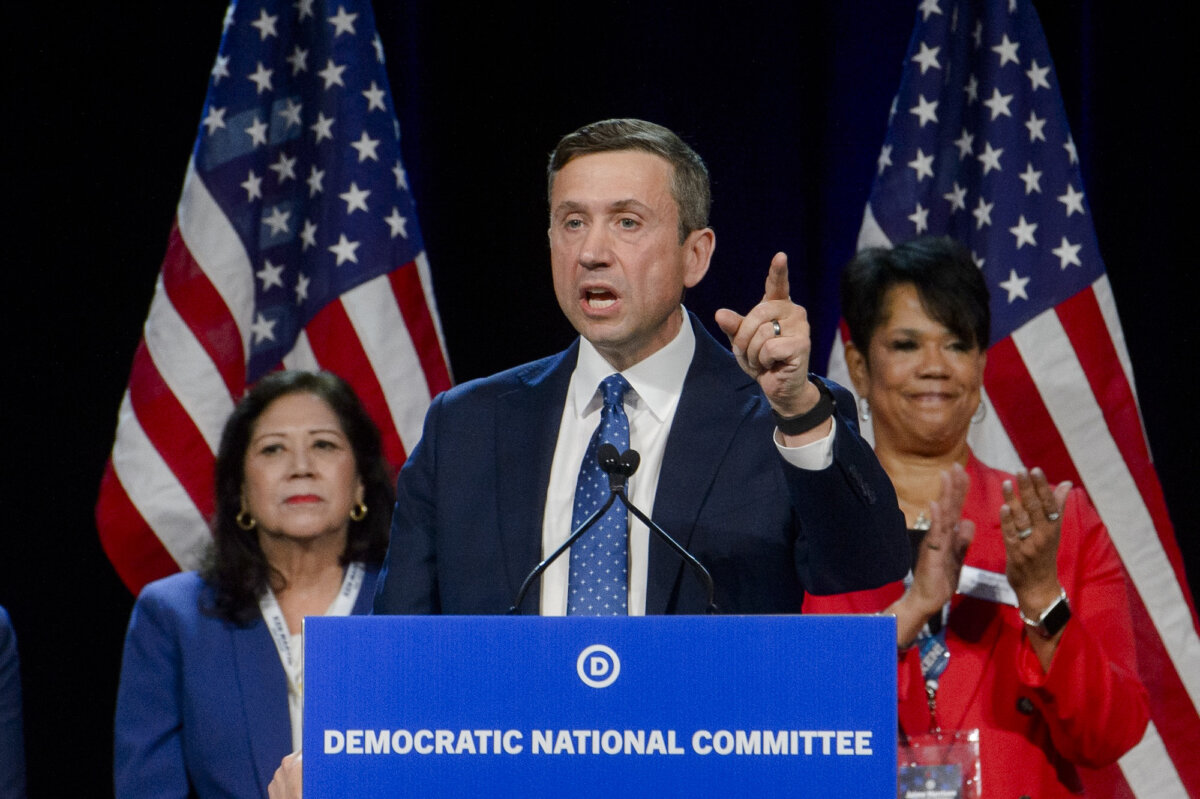

The Democratic National Committee is deploying tens of thousands of volunteers and ramping up direct voter outreach in Texas as part of a new national organizing program aimed at countering Republicans’ mid-decade redistricting push in the state.
Announced on July 28, ahead of a final redistricting field hearing in Texas, the effort includes sending more than 250,000 texts to voters and preparing 30,000 grassroots organizers to reach persuadable Republican and independent Texans in key districts.
“The DNC is all hands on deck to hold [President] Donald Trump and [Texas Gov.] Greg Abbott accountable for their scheme to use the tragic Texas floods as cover to redraw the Texas maps in a last-ditch effort to save the Republican majority,” DNC Chair Ken Martin said in a statement.
The announcement follows a meeting on July 25 between California Gov. Gavin Newsom and Texas Democratic state lawmakers, which came amid growing calls for Democrats to consider redrawing maps in states they control.
Newsom has not ruled out pursuing legislative or legal action if Texas proceeds.
“This moment requires us to be prepared to fight fire with fire,” Newsom said in a statement. “Whether that’s a special election, a ballot initiative, a bill, a fight in court. If they proceed in Texas, we will be ready.”
Texas Democrats say the redistricting plan, advanced through a special session called by Abbott, is aimed at shoring up Republican control of the U.S. House.
The redistricting effort began after the U.S. Department of Justice sent a letter to Abbott on July 7 raising concerns about four congressional districts in the Houston and Dallas areas. The DOJ said the current boundaries may violate the Voting Rights Act by relying on racial demographics to group minority voters into “coalition districts”—where no single racial group forms a majority. The department cited a recent Supreme Court decision requiring states to show a compelling interest to justify such configurations.
In response to the DOJ’s letter, Abbott called a 30-day special legislative session starting July 21, saying the state needed to address the “constitutional concerns” about its maps. Republican lawmakers say the new maps will comply with federal law while ensuring fair representation.
“I have the highest level of confidence that we’re not going to pass a bill out of the committee or off this floor that violates the Voting Rights Act,” state Sen. Phil King, a Republican involved in the redistricting effort, said.
Trump has publicly endorsed the effort and said it could net Republicans up to five seats in Texas alone.
In response, DNC organizers said they are targeting Republican-held districts identified through the party’s analytics team, making persuasion calls, encouraging residents to submit public comments, and organizing protests and direct lawmaker engagement. Influencers and volunteers have also been deployed to cover hearings in the Texas cities of Houston, Austin, and Arlington.
Texas Democratic House Caucus Leader Rep. Gene Wu called the initiative “exactly the type of partnership Texas Democrats need” and said the DNC’s backing has been consistent since the effort began.
The July 25 meeting at the California Capitol included several Texas legislators and members of the California congressional delegation, including Rep. Zoe Lofgren and Rep. Ted Lieu.
Democratic leaders across the country say the Texas redistricting push has national implications.
Sen. Alex Padilla (D-Calif.) accused Trump of “planning to steal the 2026 election” by manipulating the congressional map. Lieu called the redistricting effort “an attack on our democracy.”
In a joint statement last week, Lofgren and Rep. Pete Aguilar (D-Calif.) called the Texas push “egregious” and warned it “cannot go unanswered.” House Democratic Leader Hakeem Jeffries (D-N.Y.) described it as a “dummymander” that could backfire by creating competitive Republican districts.
Democratic governors and leaders in New York, Illinois, New Jersey, Michigan, Maryland, and Arizona have voiced support for countermeasures.
“We do redistricting every 10 years,” New York Gov. Kathy Hochul said. “But if there are other states that are violating the rules and trying to give themselves an advantage, all I say is I’ll look at it closely with Hakeem Jeffries.”
Republicans stated that Texas law permits mid-decade redistricting and that the revisions are necessary to protect the integrity of the state’s elections.
Democrats accused Republicans of rushing the redistricting plan under the guise of an emergency response to the recent deadly floods in the state. A spokesperson for Abbott said that while “partisan activists focus solely on political issues,” the governor remains committed to delivering results on issues important to Texans, including flood relief and education policy.
A GOP strategist familiar with national redistricting efforts told The Epoch Times that Texas faces fewer legal restrictions than states such as California and New York, which are bound by independent commissions or voter-approved constitutional rules.
“This is about making sure Texas maps are legally sound,” the strategist said, pointing to recent concerns from the Justice Department about possible Voting Rights Act violations.
Texas Republicans say they are using the same process followed in 2021 and 2023.
The strategist added that Democrats could face “steep legal and logistical challenges” if they try to redraw their own maps in response, particularly in states with commission-led systems. He said attempts to do so could backfire politically and legally.
Experts have also warned about escalating tit-for-tat redistricting. Stewart Parnacott, a Texas-based instructor at Baylor College of Medicine and former Democratic candidate for the Georgia House, said the trend could further erode public trust and “shift power from voters to the courts.”
Nicholas Higgins, chair of political science at North Greenville University, said mid-cycle redistricting outside of court orders is rare, but added that Democrats may succeed in flipping one or more seats in California depending on population shifts—although results in Texas are less certain.
Savannah Hulsey Pointer and Joseph Lord contributed to this report.
 Friends Read Free
Copy
Facebook
Tweet
Friends Read Free
Copy
Facebook
Tweet