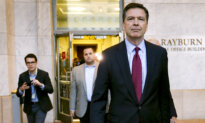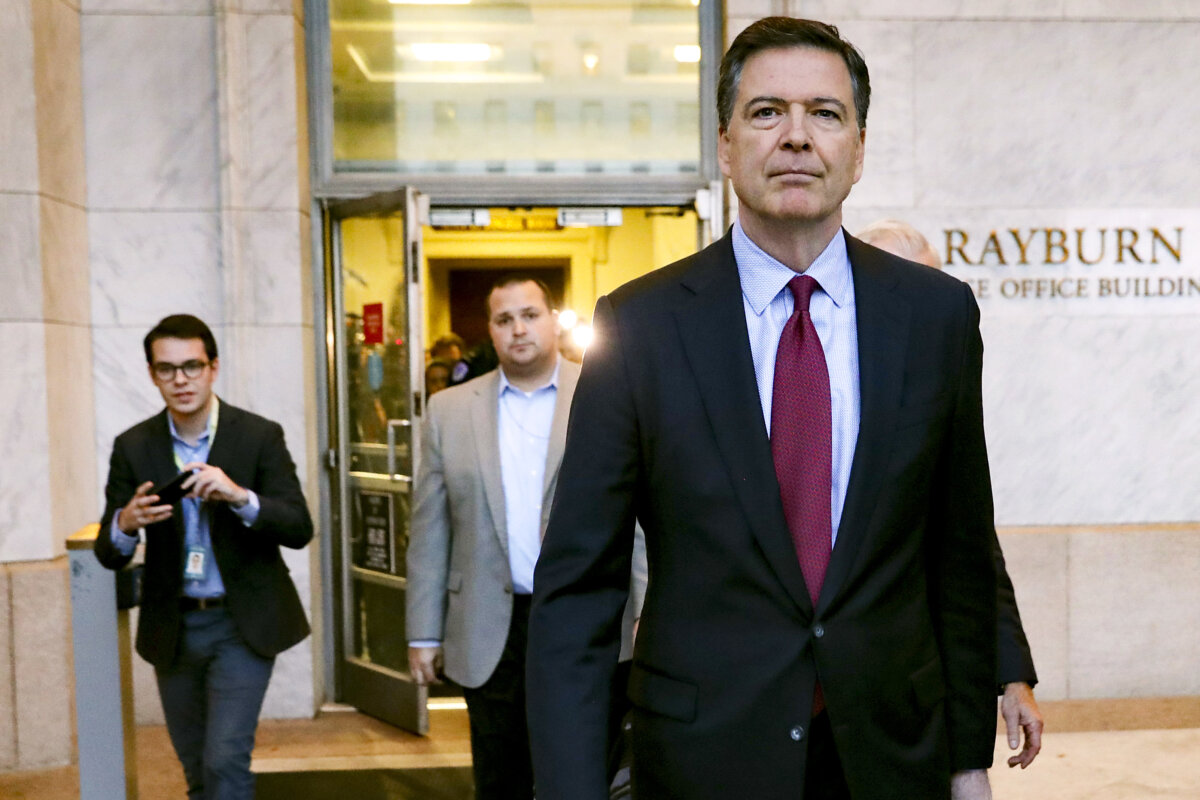

The Department of Justice argued at an appeals court hearing on Sept. 15 that indictments against former FBI Director James Comey and New York Attorney General Letitia James should be reinstated.
Comey was indicted for allegedly lying to Congress about media leaks, and James faces allegations of mortgage fraud.
Both indictments were tossed out in November 2025, after a federal judge found that former Trump aide Lindsey Halligan was improperly appointed as interim U.S. attorney in the Eastern District of Virginia and had no right to bring the cases.
Ephraim McDowell, representing Comey, said the problem was not just a “defect” in the indictment itself.
“The defect is that the indictment should have never happened at all because it was not lawfully secured by the government in the first place,” he said.
Arguments at the hearing before the Court of Appeals for the Fourth Circuit revolved around two questions: whether Halligan’s appointment was illegal and whether then-Attorney General Pam Bondi could “ratify” the indictments after the appointment was challenged.
Attorney Henry Whitaker, arguing for the Justice Department, told the three-judge panel that Halligan’s appointment was proper because Section 546 of U.S. Code 28 lets the attorney general appoint an interim U.S. attorney when a position is vacant.
The law allows those appointees to serve for 120 days without Senate confirmation; after that, the local district court can fill the vacancy. Halligan’s predecessor, Erik Siebert, held the interim position from January to May 2025, but a court allowed him to stay in the role. After he resigned in September 2025, Bondi appointed Halligan.
Whitaker told the Fourth Circuit that the 120-day period started over with Halligan’s appointment.
But attorneys for Comey and James said that logic defeated the purpose of the law and would allow the president to keep appointing “interim” attorneys as a workaround to getting Senate confirmation.
Senior Circuit Judge Henry Floyd seemed to agree with that reasoning.
“Because you know, 120 days means 120 days,” he said. “And since 2007, since the district court appointment process was put back in—with one exception I think—custom and usage dictates that everybody believes that 120 days is all the executive’s got.”
Putting aside Halligan’s appointment, Whitaker also argued that the indictments should never have been dismissed in the first place, because Bondi later approved them. Even if Halligan’s appointment could not be upheld, he said, Supreme Court precedent had allowed that kind of after-the-fact approval.
“If there was an error here, it was simply an error in the title Miss Halligan was given,” he told the court.
He said that such an error was “harmless” and would have no effect on a grand jury’s decision.
He also argued that Comey’s case should not be dismissed as a result of the statute of limitations, because the indictment process began before time ran out.
Comey and James have denied the charges against them but also argue that the indictments were revenge by their political opponent, President Donald Trump.
James campaigned for the attorney general position on an explicitly anti-Trump platform and later brought multiple suits against him, his business interests, and his family members. Comey headed the FBI during the period when that agency concurred in the later-debunked assessment that Russia interfered in the 2016 election to help Trump.
Correction: A previous version of this article misspelled the name of attorney Lindsey Halligan. The Epoch Times regrets the error.
 Friends Read Free
Copy
Facebook
Tweet
Friends Read Free
Copy
Facebook
Tweet