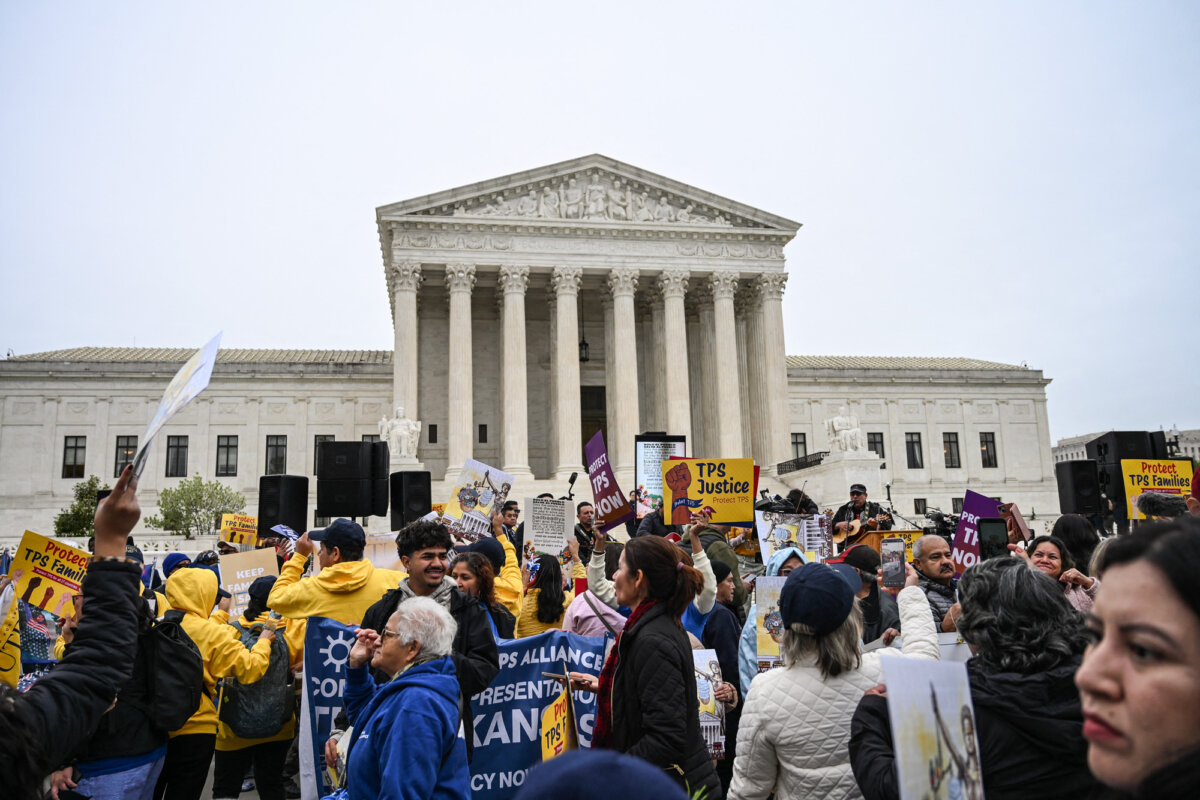

The Trump administration on Wednesday moved to set expiration dates on work permits for temporary protected status (TPS) holders after the Supreme Court last month ruled to end deportation protections for a host of countries.
The work authorization expiration deadline, issued by the U.S. Citizenship and Immigration Services (USCIS), impacts nationals who were under TPS from Haiti, Syria, Burma, Yemen, Ethiopia, South Sudan, and Somalia. The work permits for these nations will expire on July 10.
News releases issued on the USCIS website on Wednesday said businesses should use the July 10 date as the new expiration date for workers who hold TPS status for employment verification purposes. Earlier this year, the agency said the permits would expire on July 1, but moved the expiration to July 10 in light of the Supreme Court’s June 25 ruling.
The TPS program, established under the Immigration Act of 1990, generally allows foreign nationals to remain in the United States for up to 18 months for legal work authorization. The program was designed to be temporary, but previous administrations have extended the protections for some countries—in some cases—for decades.
President Donald Trump and administration officials have argued that TPS is being abused, while Justice Department lawyers have argued before the Supreme Court that the program was meant to be only temporary and that the federal government has the authority to remove said designations.
During the 2024 presidential campaign, Trump and then-vice presidential candidate JD Vance claimed that Haitian nationals who were sent to a city in Ohio were causing havoc for locals, including eating pets or birds in parks.
In President Donald Trump’s second term, his administration has removed TPS designations for around a dozen countries. Prior to the Supreme Court decision, some federal judges blocked the federal government from terminating TPS for a handful of countries.
Noting the legal wrangling over the program terminations, USCIS said in a Wednesday news release about the termination of TPS for Yemen that the “designation of Yemen and related benefits was set to terminate on May 4, 2026.” But it noted that “on May 1, 2026, the U.S. District Court for the Southern District of New York issued an order staying the TPS Yemen termination.”
It said that “beneficiaries will keep their status and employment authorization, and their documentation will remain valid per the court order” but noted that there will be only “limited relief until the U.S. District Court for the Southern District of New York aligns with the U.S. Supreme Court’s favorable decision.”
“The employment authorized through date will be the Employment Authorization Document (EAD) expiration date of ‘July 10, 2026,'” it added.
Similar language was used in other USCIS announcements about the other countries where the work authorization is due to expire.
In its order focused on TPS designations for Syria and Haiti, Supreme Court Justice Samuel Alito wrote for the majority that courts cannot review the administration’s TPS decisions. Chief Justice John Roberts and Justices Clarence Thomas, Neil Gorsuch, Brett Kavanaugh, and Amy Coney Barrett joined his opinion.
Department of Homeland Security (DHS) Secretary Markwayne Mullin said on Sunday that those who lived in the United States under TPS should have sought a green card or another means to stay in the country. Or, he added, they should leave the United States entirely.
“The status itself can be ended,” Mullin told CNN on Sunday. “Either try to fill out the paperwork and be here under permanent status, or we’ll help you get back to your home country.”
Correction: A previous version of this article misstated the date of the Supreme Court’s ruling that allowed the termination of deportation protections for temporary protected status holders. The Epoch Times regrets the error.
 Friends Read Free
Copy
Facebook
Tweet
Friends Read Free
Copy
Facebook
Tweet