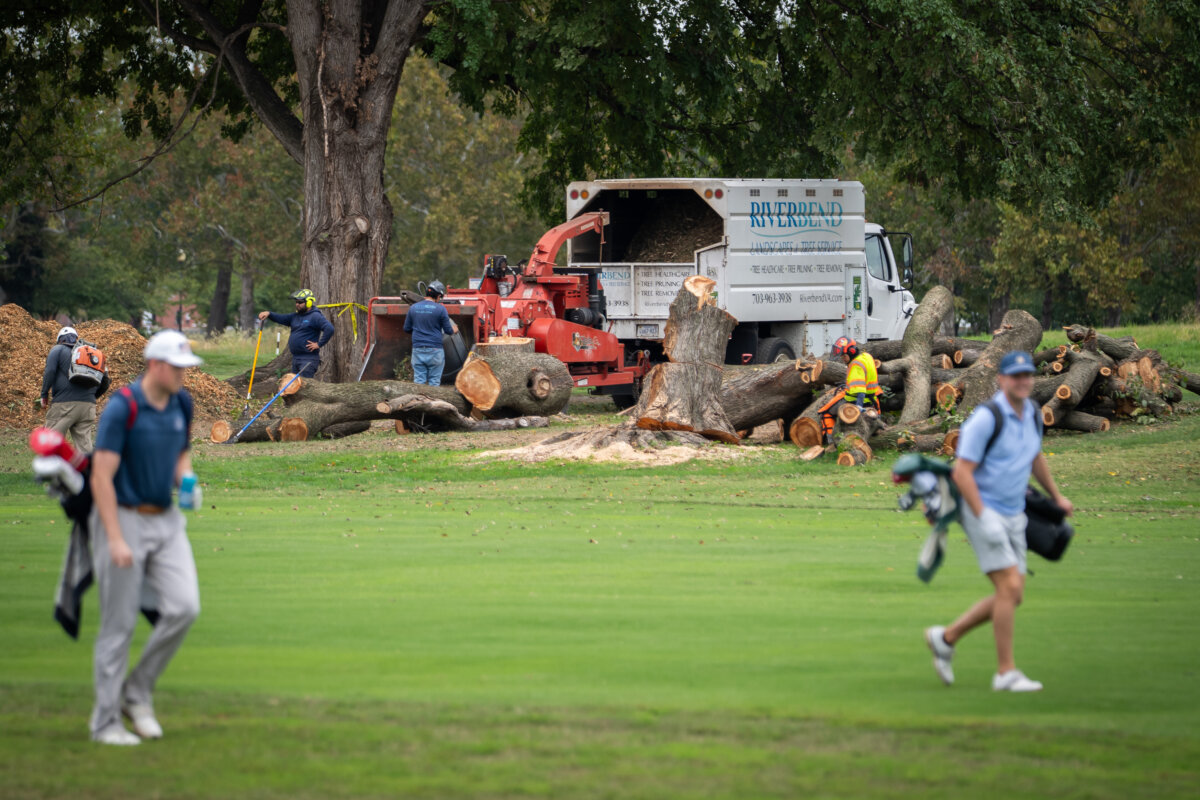

A federal judge late Oct. 18 turned down the Trump administration’s request to remove her from overseeing litigation challenging the administration’s efforts to update a golf course in Washington.
Judge Ana Reyes of the U.S. District Court for the District of Columbia said that the government did not meet the standards for removal, including showing that she displayed favoritism to plaintiffs and disregard for how the government works.
“It is easy to weaponize selective quotations to bring a baseless recusal motion. But it is much harder to meet the demanding legal standard against a full record,” Reyes said in her 13-page decision on the motion for disqualification. “By any objective measure, the Government fails to meet the standard for recusal.”
The case involves East Potomac Golf Links, a golf course in Washington, and the administration’s efforts to update it. President Donald Trump announced earlier Sunday that the government plans to redevelop the course to host major tournaments.
In the motion for recusal, administration lawyers said that recent developments in the case show Reyes is not impartial enough to oversee it.
They said that the judge “has unfairly questioned Trump Administration attorneys’ intelligence, allowed her disdain for the Trump Administration to influence how hearings unfold, and systematically disregarded basic separation of powers principles and Article III constraints on judicial authority.”
That includes effectively giving plaintiffs veto power over significant course maintenance by requiring notice to the plaintiffs for “big things” and berating one of the government’s lawyers, telling the lawyer, “you did not do your best” and “you did your absolute worst,” according to the filing.
Lawyers also cited unscheduled testimony from Frank Lands, a National Park Service official, during a hearing on a federal holiday. Lands had to call into the hearing from his car without the opportunity to consult with counsel, they wrote.
Federal law says that any federal judge shall disqualify him or herself from a proceeding in which their impartiality might “reasonably be questioned,” or proceedings where they have “bias or prejudice concerning a party.”
Reyes said in her ruling that the testimony was needed because of the administration’s own actions, or plans to cut down more trees at the course on the Monday of a holiday weekend.
She said the court was furious during the hearing, where she criticized one of the administration’s lawyers, but she has also repeatedly praised government lawyers. She also said that she repeatedly declined to issue any restrictions on maintenance before her Oct. 12 order blocking further tree removal.
“With the facts in focus, the Court finds that no reasonable person could believe that after October 12 the Court exercised favoritism in a manner supporting disqualification,” Reyes wrote.
The ruling came after Reyes said she noted Trump’s Sunday announcement of plans to redevelop the Golf Links. She ordered government lawyers to attend a hearing slated for Monday and asked whether the government continues to take the position that there is no final agency action and that Trump has “at most … given preliminary thought to” the plan to rebuild the course.
Government lawyers said in response that they maintain there is no final agency action regarding the course.
“We also respectfully note that the Court’s order mischaracterizes Defendants’ position. Defendants did not portend to represent the actual position or mental impressions of the President in arguing that no final agency action had occurred,” they said.
“Instead, commenting only on the President’s publicly available statements, Defendants presented an argument about what those statements might be evidence of. Defendants further maintain that any direct communication with the President would be protected by many constitutional-based privileges.”
 Friends Read Free
Copy
Facebook
Tweet