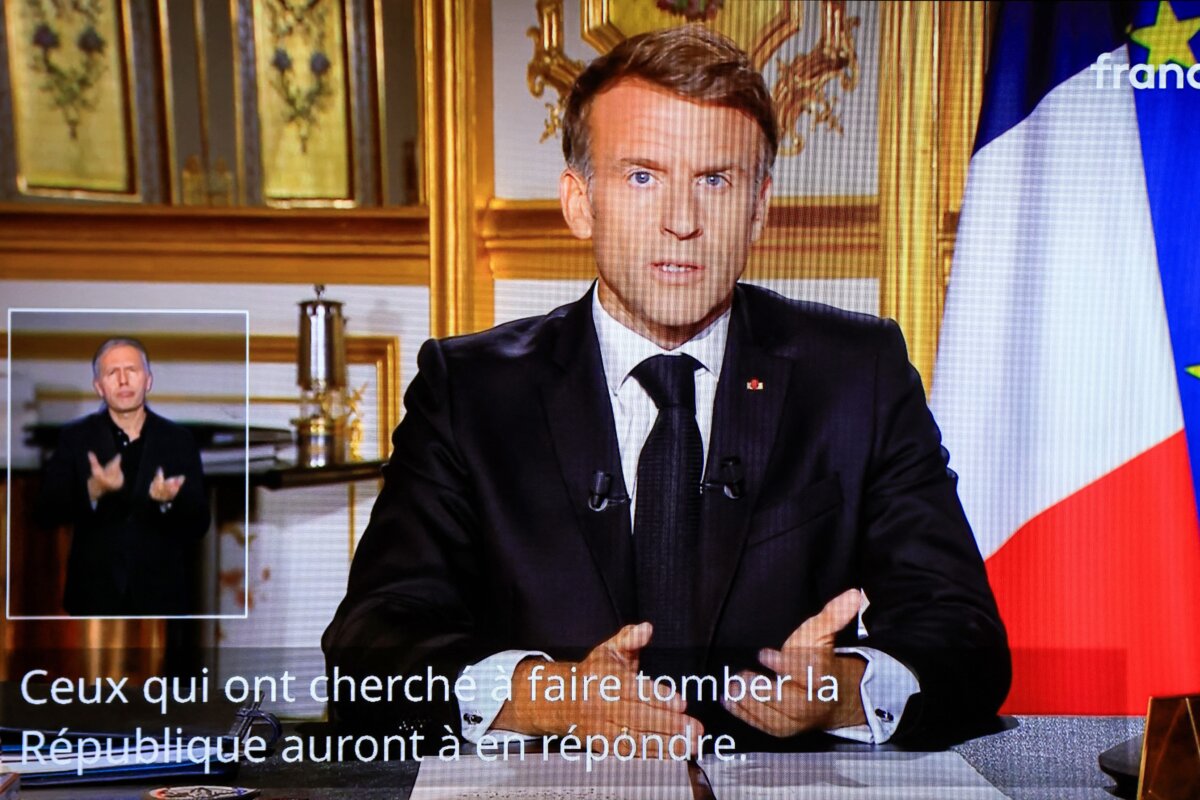

PARIS—“Those who destroyed must pay, those who looted must repay, and those who sought to bring down the Republic will have to answer for it,” President Emmanuel Macron told the French in a televised address on the evening of Oct. 18, a day after a nationwide protest against the cost of living collapsed into the worst rioting the country has seen in years.
Speaking of “a moment of extreme gravity,” Macron blamed the destruction on “seditious elements from ultra-left splinter groups, joined by many criminals,” and singled out the burning of Limoges Town Hall.
“How can French people do this to France?” he asked. “Tonight we all feel anger and shame.” He promised that shopkeepers “will not be left alone,” said prefects could ban “certain gatherings,” and warned that “the country needs order, not escalation.”
‘They [Smashed] Everything’
Hours earlier, spent tear-gas cartridges still littered Place de la République, where crews swept up glass around the Marianne monument, its stone base torn apart from projectiles.
Nearby, Yoni found the display pieces of his marble showroom, Pierres Exclusives, smashed.
“We expected this kind of thing and had done everything we could to protect the shop,” he told The Epoch Times. “But here there was nothing to steal, only things to break.” A marble table worth 25,000 euros ($28,000) lay in pieces. “This morning, when we arrived, there were still people inside the store.”
In the 3rd arrondissement, pharmacist Fabien Carême stood amid the remains of his shop. “I don’t understand why anyone would ransack a pharmacy, which is, after all, a first point of care,” he told The Epoch Times, putting the lost stock alone at close to 150,000 euros. “They’ve cut off my little business, and for a long time.”
Camille Michelin, whose optician’s shop Opti’Shop sells only French-made frames, spoke of “isolation and dismay.”
“It’s a company going in the right direction, and they loot everything, they smash everything,” he told The Epoch Times, estimating his losses at more than 50,000 euros. He and his three employees were inside until 5 p.m. Saturday as the crowd passed. “There were messages of hate, throat-slitting gestures aimed at us.”
The looting did not end with daylight.
By Sunday afternoon the Paris police prefecture had counted three more stores looted and 25 arrests, describing those detained as “essentially young people from the suburbs looking for looting opportunities.”
A boutique on Rue Beaurepaire was stripped in seconds. Hundreds of protesters gathered again at République. Police fired tear gas, brought in a water cannon, and sent in the CRS 8 riot unit while barricades of trash cans burned on Boulevard Voltaire and rental bikes went up in flames on nearby streets.
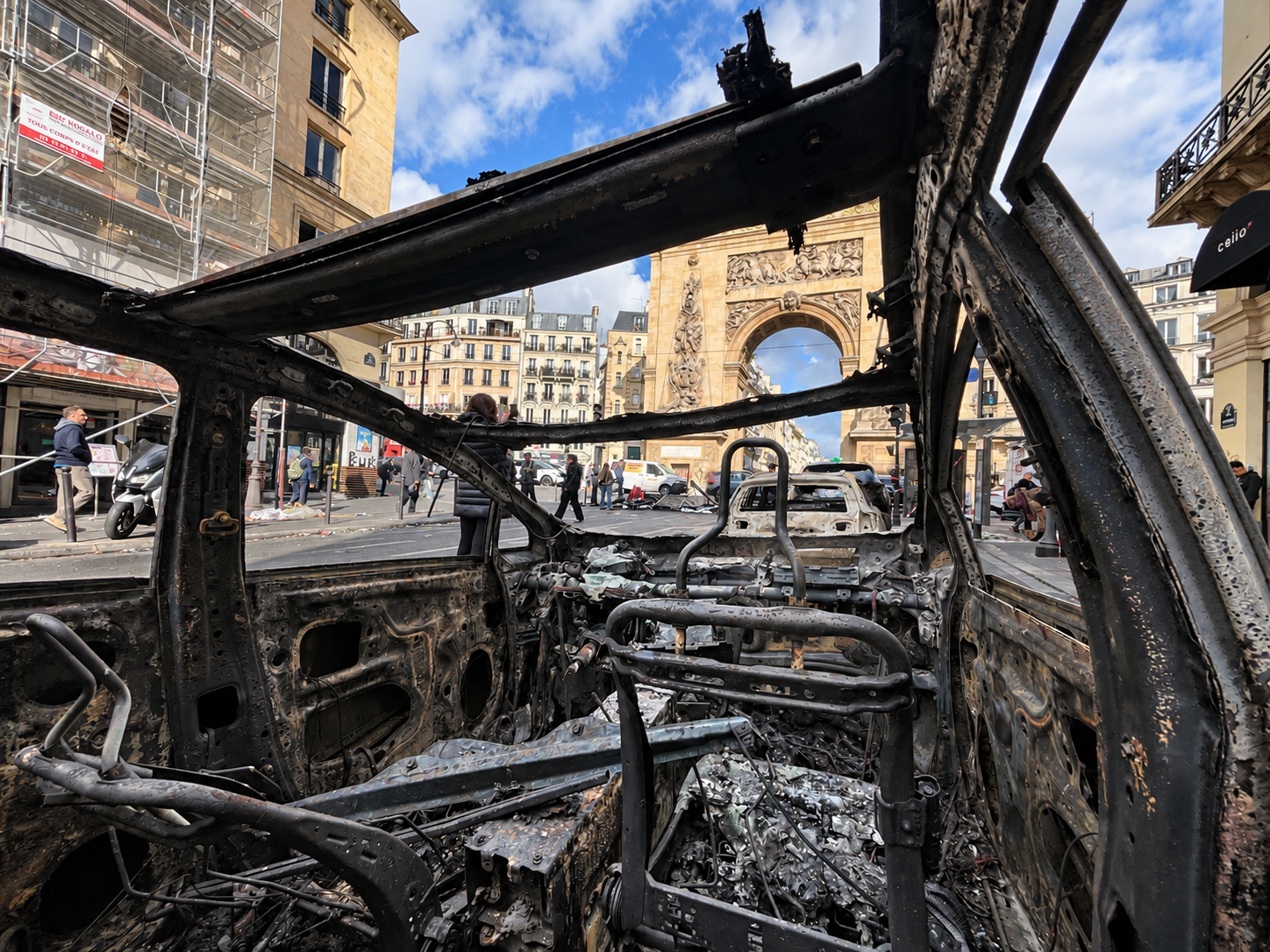 The charred remains of a vehicle stand near the Porte Saint-Denis monument in Paris on Oct. 18, 2026, a day after violent protests and widespread destruction swept through the French capital. (Etienne Fauchaire/The Epoch Times)
A March That Turned
Saturday’s march capped a month of unrest that began with far-left high-school students protesting dilapidated buildings and teacher shortages in the immigrant suburbs. The anger soon spread to rising prices and government spending cuts, and calls went around online to bring back the “yellow vest” movement of 2018 that protested the high cost of living.
The Interior Ministry put the turnout at 550,000 nationwide. Organizers, the General Confederation of Labour union among them, said 800,000 had marched.
Police said that 110,000 people peacefully marched in Paris, while several thousand others participated in the rioting.
Paris police said the violent contingents were far larger than usual, numbering between 500 and more than 1,000. When the march broke up, small groups dressed in black pried open shop shutters between République and Bastille, and others went in behind them to loot. “Entire streets were methodically ravaged,” Mayor Emmanuel Grégoire told reporters. Police made 855 arrests in the capital, a record, and said one marcher had died of cardiac arrest on Boulevard Magenta.
The most shocking images came from Limoges, in central France, where the 1883 city hall, a listed monument, was set ablaze while elected officials and staff were still inside, the prefecture said; its bell tower collapsed into the flames.
Mayor Guillaume Guérin told reporters on Oct. 18 that about 700 hooded, “overtrained, armed” far-left militants had infiltrated a march of 5,000 and that police holding them on the boulevards “had no more ammunition” by 3:30 p.m. The intruders told elected officials “we’re going to kill all of you,” he said. “It was a premeditated arson. An attempted murder of the Republic’s elected officials.” About 7,000 people marched through Limoges on Sunday.
In Marseille, protesters forced the doors of city hall, knocked a bust of Marianne, the national personification of the French Republic, to the floor, and tried to set fire to a municipal police station. The police prefecture said it counted more than 30,000 “looters” at the height of the disorder, 8,000 of them classed as rioters; 118 officers were injured, and 4,000 tear-gas grenades were fired.
In Bordeaux, rioters ransacked the prefect’s residence and looted up to 100 stores, the mayor said; Lille’s city hall was briefly invaded.
‘Extremely Firm’ Response
By Sunday evening, the Interior Ministry counted 2,397 arrests and 997 police officers, gendarmes, and firefighters injured, seven of them seriously. Interior Minister Laurent Nuñez said groups of rioters had formed “at the very clear instigation of the ultra-left,” joined in the afternoon by looters and “opportunistic criminals.”
“Demonstrating is a fundamental right,” he wrote on X. “Sowing disorder with violence and in a concerted manner is not.”
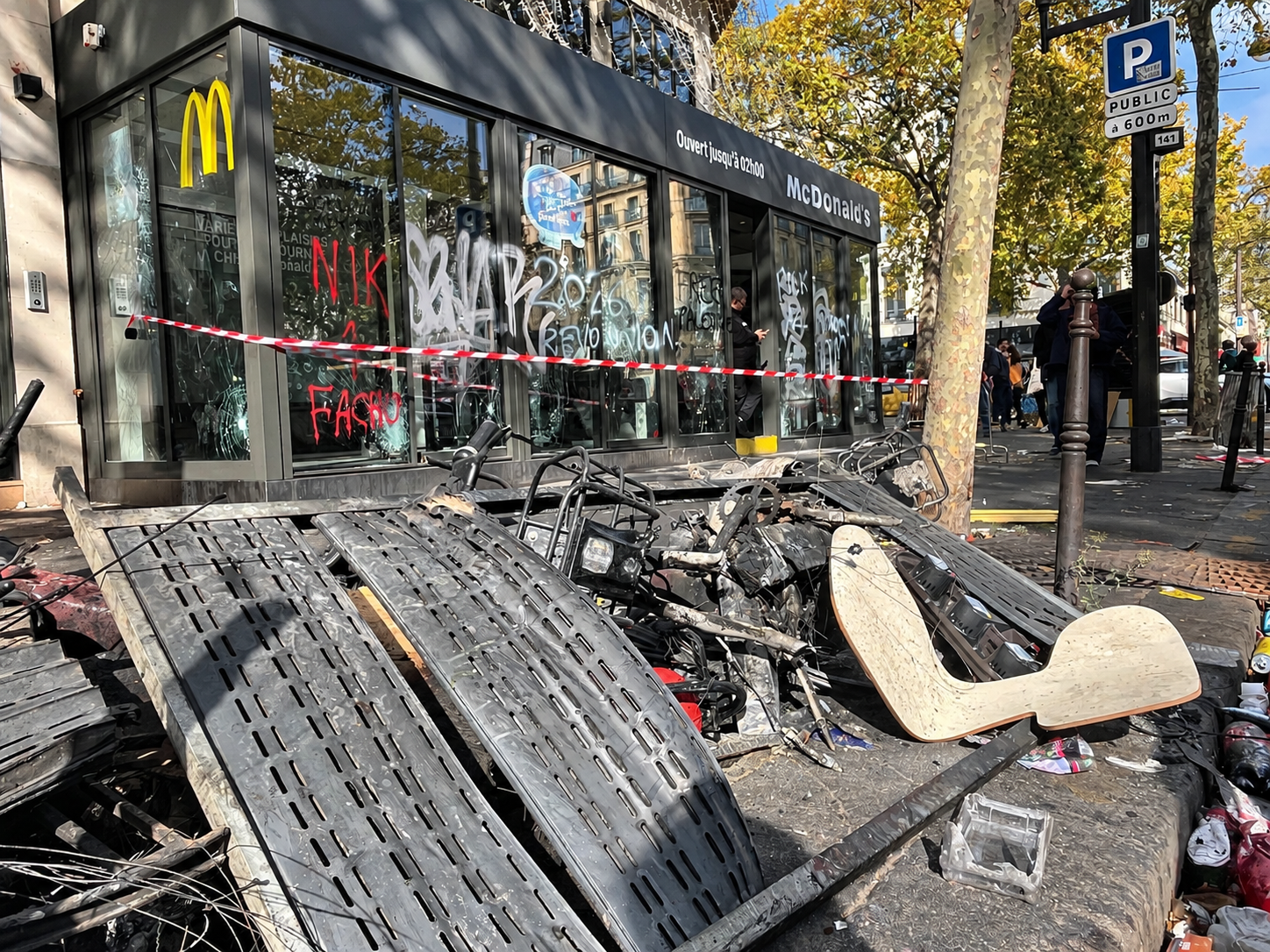 The remains of a barricade erected by rioters lie outside a vandalized McDonald’s restaurant in Paris on Oct. 18, 2026, a day after violent far-left protests swept through the French capital. The restaurant’s windows are covered with graffiti, including the slogan “2026 Revolution.” (Etienne Fauchaire/The Epoch Times)
Justice Minister Gérald Darmanin ordered an “extremely firm” judicial response; 557 people remained in custody in Paris alone.
In an interview on LCI television on Sunday, Mélenchon refused to condemn the rioting, asking, “What would that change?” and insisting “it is the government’s fault, it alone is responsible for all this.” He called the burning of Limoges city hall “a crime,” accused the government of “letting things rot,” and demanded a price freeze and 10 billion euros for schools.
Marine Le Pen, the National Rally’s presidential candidate, said in a video address that France was living through “a profound crisis of confidence, of authority” under “a Macronist power that is out of breath, exhausted, disoriented,” and tied the “forces of destruction” to Mélenchon’s La France Insoumise party and antifa groups.
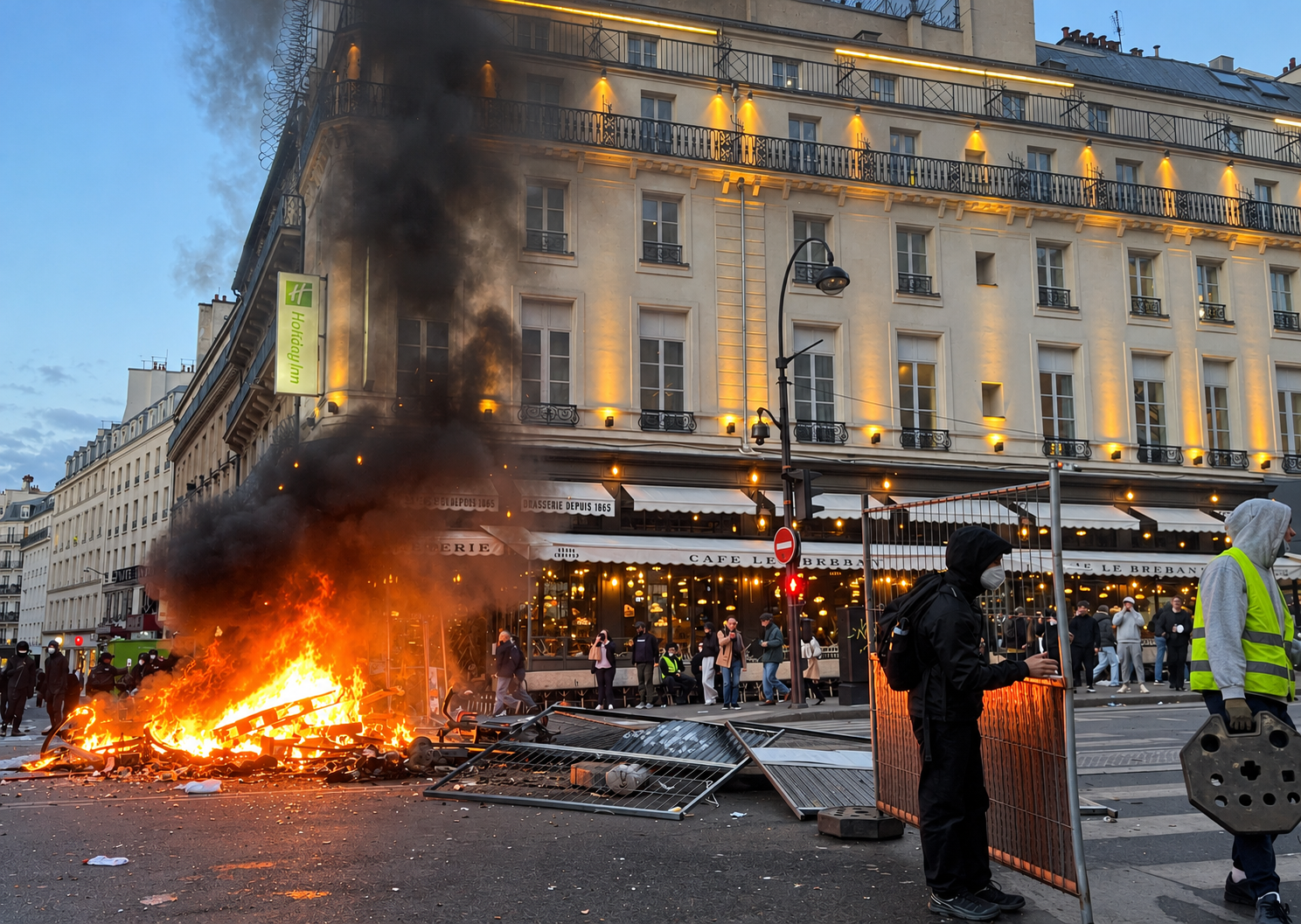 A masked protester erects a barricade beside burning debris outside Café Le Brébant on Boulevard Poissonnière in Paris on Oct. 17, 2026, amid violent protests that swept through the French capital. (Etienne Fauchaire/The Epoch Times)
The Bill Comes Due
Alexandre Bompard, who heads both the retail federation FCD and Carrefour, estimated that about 1,500 businesses had been hit, at a cost of “several hundred million euros.” Commerce Minister Serge Papin summoned retailers, banks, and insurers to a meeting Monday morning.
The Association of French Mayors called for rallies outside town halls nationwide at noon Monday, National Assembly President Yaël Braun-Pivet said she would propose a parliamentary inquiry into the violence and policing, and five of the country’s largest unions have already called a national strike for Nov. 5.
U.S. President Donald Trump wrote on Truth Social that “France is burning!” and urged the country to “Close your Borders.”
“The immigration of people from an entirely different world, people with hatred in their hearts, has shattered that once great country. Close your Borders and take control, before it is too late!” he wrote.
Back near République, Yoni was already planning to board up his showroom again. Barricading costs several thousand euros each time and means closing on a Saturday, his busiest day. “Are we going to have to do this before every demonstration?” he asked. “We don’t know what to do anymore.”
 Friends Read Free
Copy
Facebook
Tweet
Friends Read Free
Copy
Facebook
Tweet