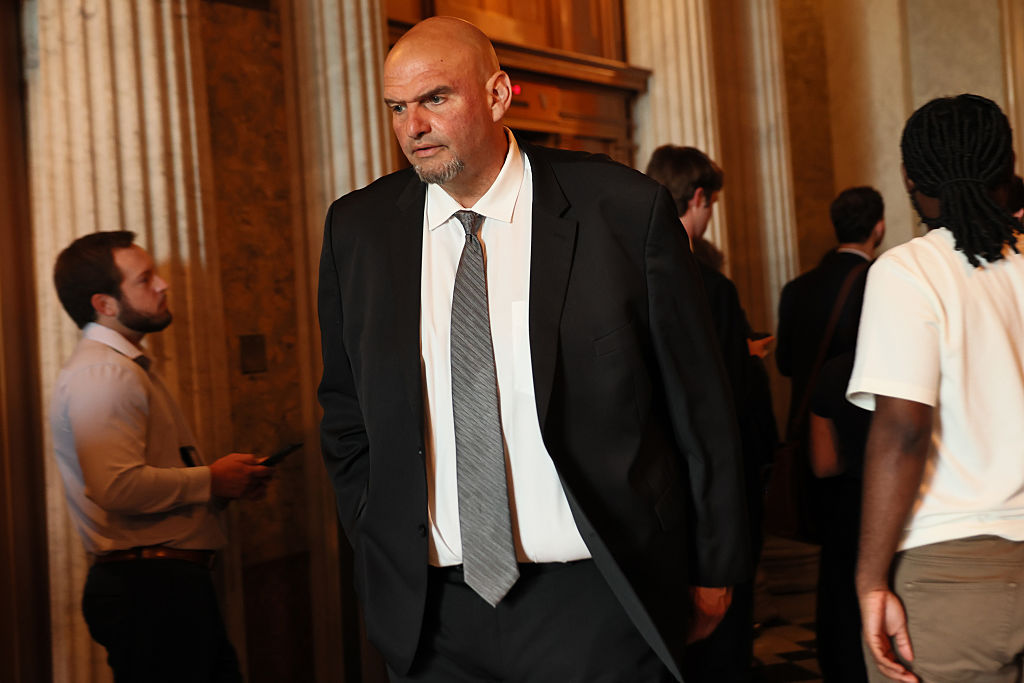

Sen. John Fetterman (D-Pa.)—who recently broke with many in his party to say that he supports photo ID being required to vote—said he does not support the Republican-backed Safeguard American Voter Eligibility (SAVE) America Act.
The SAVE America Act passed the House earlier this week with one House Democrat, Rep. Henry Cuellar (D-Texas), joining Republicans to pass it. The bill would require proof of citizenship when registering to vote and would require photo identification when casting ballots, including mail-in ballots, along with other changes that include limits on registration by mail and more frequent voter-roll purges of ineligible voters.
In a Feb. 12 appearance on Politico’s “The Conversation” with Dasha Burns, Fetterman said his support for voter ID does not extend to the House-passed bill.
“Yeah, but, I don’t support [the] SAVE act,” he said, after being asked about the legislation and his support for voters being required to show ID.
Fetterman said that requiring voters to produce an ID is broadly seen as reasonable, and he pushed back on rhetoric that likens voter ID policies to historic voter suppression. Senate Minority Leader Chuck Schumer (D-N.Y.) and other Democrats have said the SAVE America Act is akin to “Jim Crow 2.0” in reference to racial segregation laws of the past.
“It’s Jim Crow 2.0, and I called it Jim Crow 2.0,” Schumer said last week on MS Now’s “Morning Joe.”
“What they’re trying to do here is the same thing that was done in the South for decades to prevent people of color from voting.”
He argued that the bill could block eligible voters who lack certain documents or whose names do not match.
“For instance, if you change, if you’re a woman who got married and changed your last name, you won’t be able to show ID, and you’ll be discriminated against,” Schumer said. “You will not get a single Democratic vote in the Senate.”
Fetterman said he “refuse[d] to call it as Jim Crow 2.0” and pointed to examples of current Democratic-led states—including Virginia and Wisconsin—that require voter ID to vote.
When asked directly, however, whether he’d vote for the SAVE America Act, Fetterman said no, while also stressing that the measure is unlikely to advance in the Senate under current rules.
“No, no, I won’t, but even if I loved it, and I vote for it, I’ll be the only Democrat, and that doesn’t matter, because we won’t come anywhere close to hitting 60,” he said, referring to the Senate’s 60-vote threshold to overcome a filibuster.
Those comments aligned with his public posture in a separate Pittsburgh Post-Gazette interview, where he stressed that he did not say he would support the bill and said provisions affecting mail-related voting were a “non-starter” for him.
Pennsylvania’s no-excuse mail-in voting system dates to a 2019 law, and mail ballots have since become a major—and frequently litigated—part of the state’s elections. Just this week, the RNC petitioned the Supreme Court to reverse a ruling that requires Pennsylvania to count undated and misdated mail-in ballots.
Fetterman’s comments come as Republicans are pressing the Senate to take up the House-passed bill. House Republicans and allies have framed it as an election integrity measure focused on citizenship verification and voter identification. Democrats have criticized the push as restrictive and have argued it could complicate voting access for eligible voters, particularly through changes affecting registration and mail voting.
Fetterman has tried to separate the general concept of voter ID from the broader package House Republicans advanced. In the Feb. 12 interview, he also voiced concerns about a potential situation in which the bill passed only because the filibuster was weakened or removed.
“We would have a much bigger problem if that does pass,” he said.
 Friends Read Free
Copy
Facebook
Tweet
Friends Read Free
Copy
Facebook
Tweet