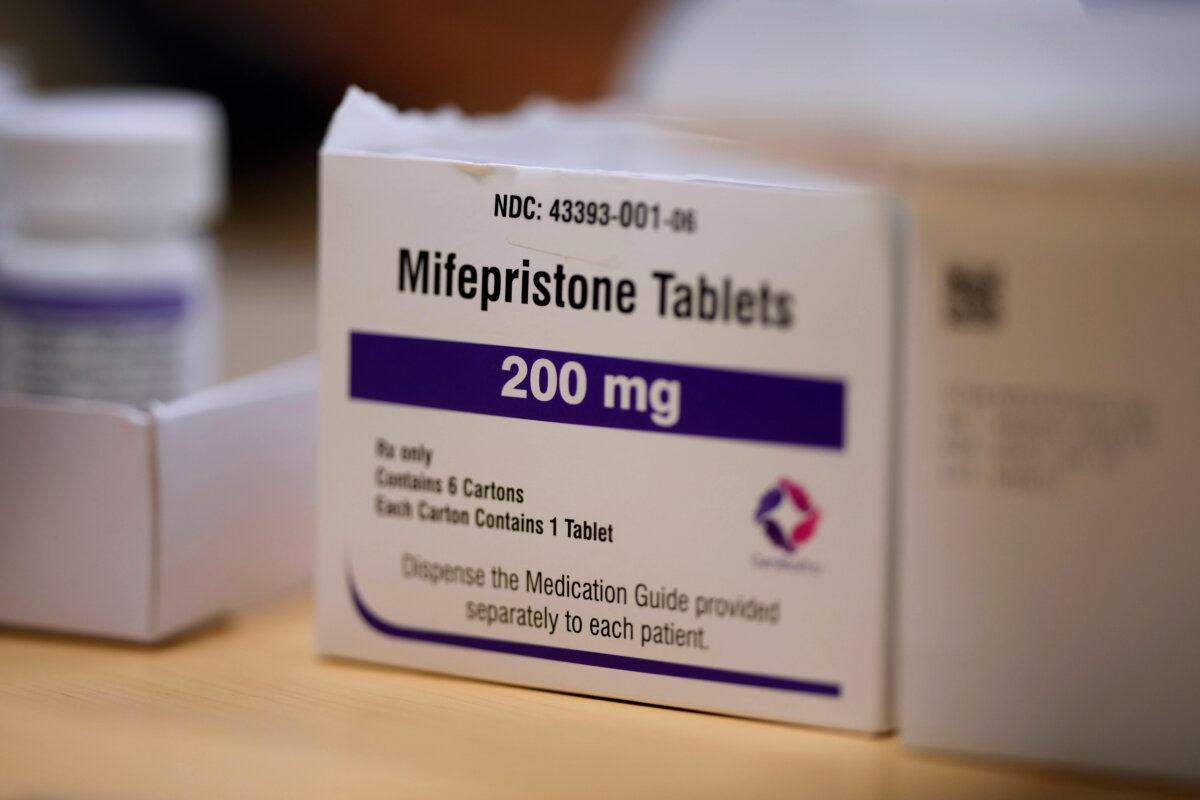

A federal appeals court on Sept. 9 questioned whether Louisiana, which has a near-total ban on abortion, has standing to force a nationwide return of in-person dispensing for abortion drug mifepristone, which patients can now obtain by telehealth and mail.
A medication abortion generally involves mifepristone, which blocks the hormone progesterone, and misoprostol, which induces contractions.
Louisiana says mifepristone can cause heavy bleeding and, in rare cases, life-threatening infection, and that the U.S. Food and Drug Administration (FDA) should bring back the pre-2023 rule requiring the drug to be dispensed in person at a clinic, office, or hospital. The state argues the Biden-era change, which allows a certified prescriber to order the pills by telehealth services and a pharmacy to mail them, skipped an adequate safety review and undercuts Louisiana’s abortion ban.
A panel of the U.S. Court of Appeals for the Fifth Circuit temporarily blocked the rule in May, but later that month the Supreme Court lifted that order, allowing the drug to continue to be dispensed through the mail.
The FDA, now under President Donald Trump, is currently reviewing safety claims about the drug.
If the state ultimately wins its ongoing lawsuit against the FDA to reinstate the requirement for in-person dispensing, demand for medication abortions, which now account for most abortions in the United States, could drop. This is because patients who currently obtain the medication through the mail without visiting a doctor would have to do more legwork to obtain it.
Louisiana has been challenging so-called shield laws in places such as California and New York that protect healthcare providers from out-of-state investigations and prosecutions. Louisiana has indicted out-of-state doctors for prescribing mifepristone to Louisiana residents.
But mifepristone continues to find its way into Louisiana.
Louisiana Solicitor General Ben Aguinaga told a newly constituted three-judge panel of the Fifth Circuit on Sept. 9 that the FDA rule undermines abortion bans enacted by his state and others after the Supreme Court overturned Roe v. Wade. That 2022 ruling held there was no constitutional right to abortion and returned regulation of the practice to the states.
“There’s no dispute that Louisiana is experiencing 1,000 abortions a month due to mifepristone mailed into the state,” Aguinaga said.
U.S. Circuit Judges Stephen Higginson and Dana Douglas asked whether the state had legal standing, or a close enough connection to the legal controversy, to sue over the FDA decision, saying Louisiana could not show that abortions taking place in the state were related to the 2023 rule.
“There are too many independent actors to say that actually the government’s assessment of safety is what’s causing your 1,000 abortions a month,” Higginson said.
Daniel Winik, an attorney for the U.S. Department of Justice, said the FDA’s review is still in progress.
“The whole point of our position in this case is that it’s the FDA’s job in the ongoing consideration of mifepristone to address all these issues,” Winik said.
U.S. Circuit Judge Priscilla Richman asked how many complications “would not have occurred had the woman seen a physician in person.”
Attorneys for mifepristone makers GenBioPro and Danco have said the drug is safe and that the FDA appropriately considered the drug’s risks when making its decision in 2023.
“The FDA’s decision was richly supported,” GenBioPro lawyer John Elwood told the panel.
It is unclear when the panel will rule.
 Friends Read Free
Copy
Facebook
Tweet
Friends Read Free
Copy
Facebook
Tweet