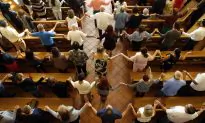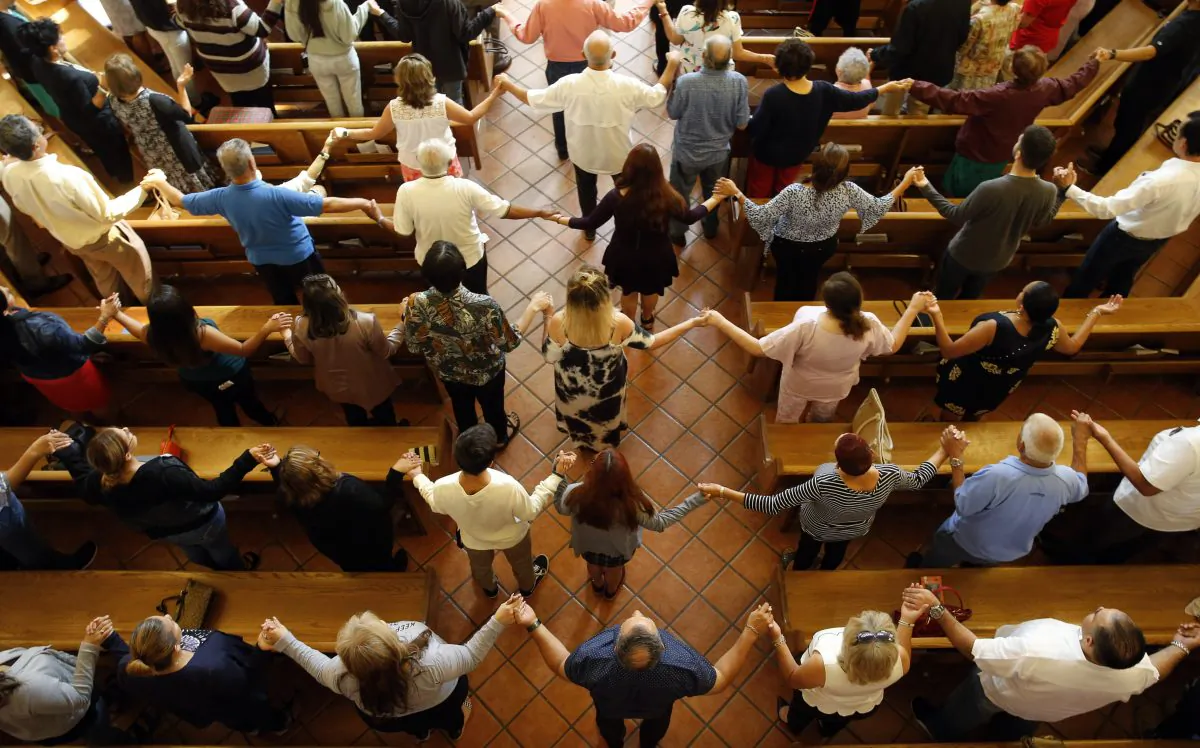

More Americans now say religion is gaining influence in national life than at any point in the past 15 years, the Pew Research Center said on Oct. 20.
The share of U.S. adults who said religion is gaining influence jumped from 18 percent to 31 percent between February 2024 and February 2025.
While a 68 percent majority still believed that religion was losing ground, that number dropped dramatically from 80 percent the previous year.
Pew called the increase “a sharp rise … across several demographic groups—with gains of at least 10 percentage points among Democrats and Republicans, adults in every age category and in most large religious groups.”
The numbers arrive at a time of increased signs of interest in religion. The assassination of conservative influencer Charlie Kirk, an evangelical Christian, in September is credited in part for the upsurge. In April, the Barna Group, a Christian polling firm, reported that 66 percent of all U.S. adults said they had made a personal commitment to faith in Jesus, up by 12 percent from 2021.
Pew’s February survey of 9,544 adults found that 59 percent of Americans held a positive view of religion’s influence—either saying it was growing and that this was a good thing, or that it was declining and that this was bad. Only 20 percent expressed a negative view, and 21 percent said the changing influence made no difference, or did not express an opinion.
Those positive views mark a significant uptick since 2019 and 2022, suggesting an overall shift toward optimism about religion’s place in public life.
Support for religion’s societal role cut across lines of belief and politics, although gaps remained. Nine in 10 white evangelical Protestants (92 percent) viewed religion’s influence positively, along with 75 percent of black Protestants, 71 percent of Catholics, and 67 percent of white mainline Protestants. By contrast, only 6 percent of atheists and 11 percent of agnostics shared that sentiment, while roughly half of religiously unaffiliated Americans viewed religion positively.
The partisan divide was wide: 78 percent of Republicans and Republican-leaning independents saw religion’s role as positive, compared with 40 percent of Democrats and those who lean Democratic. Older adults also held a more favorable view; 71 percent of those 65 and older expressed a positive view, versus 46 percent among 18- to 29-year-olds. Still, Pew noted that positivity had risen at least somewhat “across all age groups and among … both political parties” since 2019.
Even as optimism increased, a growing majority said they felt that their faith conflicted with broader cultural values. Fifty-eight percent of adults said their religious beliefs clashed a great deal or somewhat with mainstream U.S. culture—up by 10 points since 2024 and 16 since 2020. This is the first time since Pew began asking the question that a majority have reported at least some conflict.
A separate Pew survey conducted in May among 8,937 adults examined how patriotism and moral traits relate to religious identity. It found that 29 percent of Christians considered “loving your country” essential to being Christian, 47 percent deemed it important but not essential, and 24 percent said it was not important. The trait ranked near the bottom of those that Christians viewed as core to their faith, far behind honesty (86 percent), kindness (85 percent), and belief in God (85 percent).
Protestants and Catholics show similar patterns: Roughly 28 percent to 30 percent said patriotism was essential to Christian identity. Republican Christians were somewhat more likely than Democratic Christians to rate it essential (33 percent versus 23 percent). Among Jews, 22 percent said loving one’s country was essential to being Jewish, while 46 percent called it unimportant. Just 16 percent of the religiously unaffiliated described patriotism as essential to being “a good person.”
On questions of theology, nearly half of Americans (48 percent) said “many religions may be true,” while 26 percent believed that only one religion is true. Another 24 percent said there was little truth (18 percent) or no truth (6 percent) in any religion. White, nonevangelical Protestants (69 percent) and Catholics (65 percent) led the pluralistic camp, whereas 62 percent of white evangelicals said only one religion is true. Most atheists and agnostics said there was little or no truth in religion, although 38 percent of agnostics said that “many religions may be true.”
Politically, Republicans were more likely than Democrats to say only one religion is true (38 percent versus 15 percent), while Democrats more often saw little or no truth in any faith. Older Americans (age 50 and older) tended toward the view that “many religions may be true,” whereas younger adults more often said they doubt that any contain much truth.
Findings are drawn from Pew Research Center’s nationally representative American Trends Panel, which conducted two waves of interviews, the first from Feb. 3 to Feb. 9, with a margin of error plus or minus 1.3 points, and the other from May 5 to May 11, with a margin of error plus or minus 1.4 points. The interviews were conducted in English and Spanish online and by telephone.
 Friends Read Free
Copy
Facebook
Tweet
Friends Read Free
Copy
Facebook
Tweet