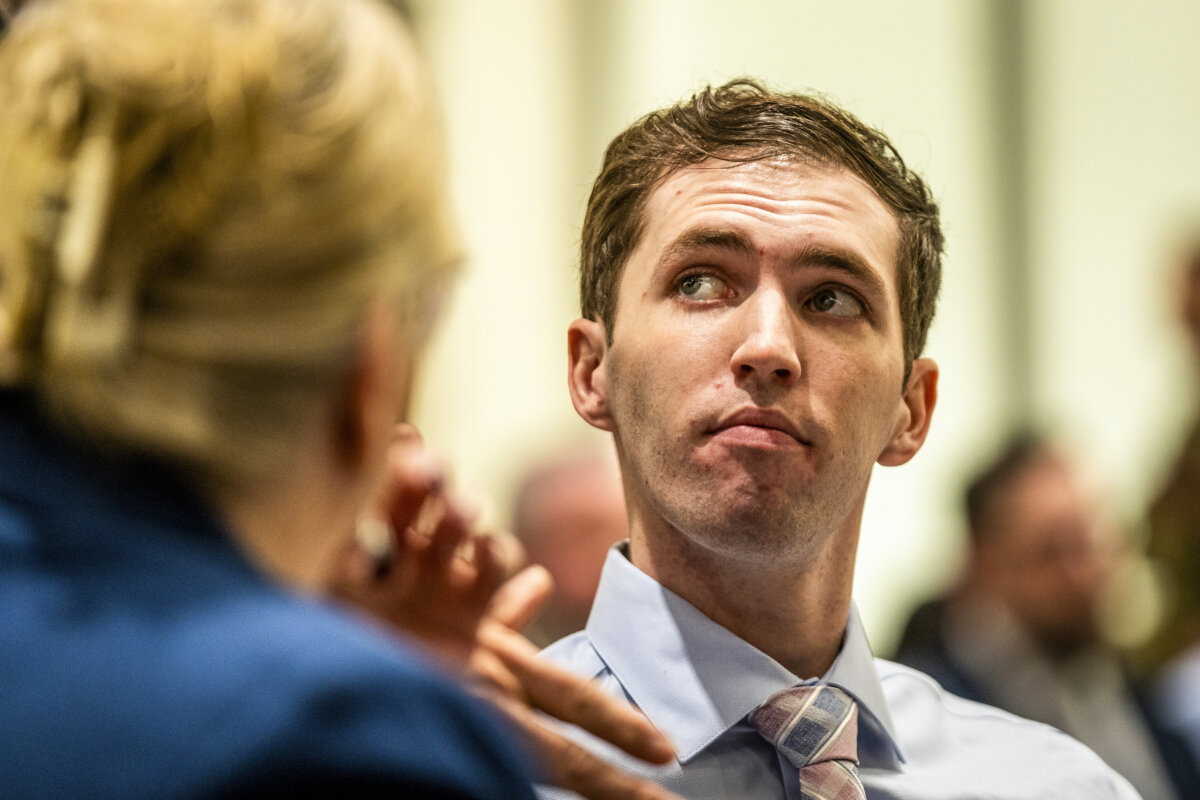
A key hearing in the case of Tyler James Robinson, the alleged gunman in the assassination of conservative commentator Charlie Kirk, will be open to the public and media, a judge declared in a June 1 ruling.
Judge Tony Graf Jr. also ruled that prosecutors could be held in contempt for out-of-court statements to the media, depending on the outcome of a hearing he set for June 12 in Utah’s Fourth District Court in Provo, Utah.
The judge, appearing via video with the attorneys in the case, made his decisions based on arguments from attorneys representing the prosecution, defense, and media on May 19.
Robinson’s lawyers asked the judge to at least partially block access to the preliminary hearing set for July 6 to July 10. That hearing, a required step before trial, calls for prosecutors to present sufficient evidence to support charges against Robinson.
Based on the presumption that proceedings should remain open, Graf said Robinson’s defense attorneys provided only “generalized concerns” that evidence disclosed during the preliminary hearing could jeopardize their client’s right to a fair trial.
“Several methods remain available” to safeguard that right, the judge ruled. Those include expanding the pool of potential jurors and using detailed jury questionnaires to weed out those whose exposure to news coverage has created prejudice.
Another factor Graf cited in his decision was that much of the evidence prosecutors plan to present at the preliminary hearing “is already in the public arena” and is part of public records filed in the case.
“The possibility that evidence introduced at the preliminary hearing may later be ruled inadmissible at trial does not, standing alone, bar the public from the courtroom,” Graf said, noting that remaining issues about admissibility of evidence will be handled at the June 12 hearing.
Prosecutors had sided largely with media attorneys, who asserted that open court proceedings boost public confidence in the justice system.
However, prosecutors agreed with Robinson’s defense team that some exhibits presented during the hearing should be shielded from public view. The judge ruled that the issue has been settled between the parties.
The 23-year-old defendant could be executed if convicted of murdering Kirk, a founder of the popular Turning Point USA youth movement. Kirk was fatally shot while speaking during an outdoor event at Utah Valley University in Orem, Utah, on Sept. 10, 2025.
Robinson faces seven charges. He is accused of aggravated murder, felony discharge of a firearm causing serious bodily injury, two counts of obstructing justice, two counts of witness tampering, and committing a violent offense in the presence of a child.
Contempt Allegations
The prosecution and defense teams each will be given 90 minutes to present evidence about the contempt allegations during the June 12 hearing.
During last month’s hearing, Robinson’s attorneys had asked the judge to hold prosecutors in contempt over statements that Christopher Ballard, general counsel at the Utah County Attorney’s Office, made publicly about the case.
Defense attorney Richard Novak alleged that Ballard went on “a media tour” and made statements that violated a gag order that Graf had issued.
Ballard’s statements “clearly are expressions of opinion as to Mr. Robinson’s guilt,” Novak said, and were therefore contrary to the judge’s order.
“[Ballard] commented on what future versions of [ballistics testing] and FBI reports will say after future testing is done, as if he had a crystal ball as to what the evidence ultimately will be,” Novak said.
Ryan McBride, chief of the General Crimes Division at the Utah County Attorney’s Office, argued during the May 19 hearing that Ballard’s statements were permissible under the circumstances.
Media reports about ballistics analysis inaccurately asserted that the prosecutors’ case was “falling apart and this evidence was exonerating the defendant,” McBride said during the hearing last month.
“There was a tidal wave of media, garnering more than 10 million views in a matter of hours, that mischaracterized the evidence” and risked prejudicing or tainting potential jurors’ beliefs about the case, he said.
“There were quippy headlines like, ‘If the Bullet Doesn’t Fit, You Must Acquit,’” McBride said.
Major networks worldwide “picked up this story and echoed it,” leading to misleading impressions of the evidence, he said.
McBride said an attorney has a “duty” to correct the public record in such an instance.
“An attorney cannot stand idly by while his client’s legal rights are undermined and trampled upon by mischaracterizations of the evidence,” he told the judge.
McBride said he did not blame the media because their reports were based on defense lawyers’ pleadings.
But those pleadings—and media reports—left out crucial facts, McBride said.
The bullet remnant, recovered during Kirk’s autopsy, was a .30 caliber round—the same as the weapon that Robinson allegedly fired. And although the tested fragment lacked enough characteristics to allow a definitive match, the rifle was not excluded as the source of the fired fragment, McBride said.
Therefore, it was appropriate for Ballard to set the record straight, McBride said.
Novak countered that prosecutors should have asked the judge whether the circumstances warranted the public statements. Prosecutors also could have asked defense lawyers to correct the record in court filings, Novak said.
“Massive media interest in this case is not ‘an escape hatch’” from the rule prohibiting certain out-of-court statements, Novak argued.
 Friends Read Free
Copy
Facebook
Tweet
Friends Read Free
Copy
Facebook
Tweet